Bagasse VSP & MAP Solutions Guide 2026 | Sustainable Ready-Meal Packaging
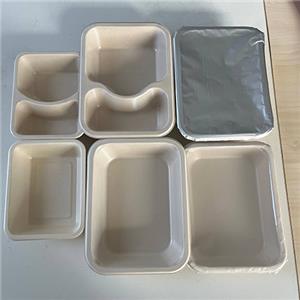
Introduction: The High-Performance Sustainable Shift In 2026, the global ready-meal industry is moving beyond basic sustainability. The demand for extended shelf life combined with plastic reduction has placed Laminated Sugarcane Bagasse Trays at the center of innovation. For food processors, the transition from traditional plastic to a compostable sealable tray format is no longer just an environmental goal—it is a technical requirement to meet global mandates like California’s SB 54 and the UK Plastic Packaging Tax.
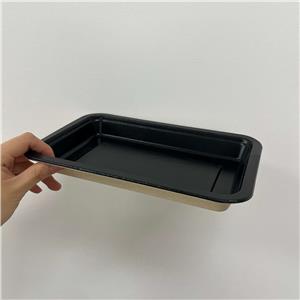
I. The Technical Barrier: Why Traditional Pulp Fails VSP & MAP Unlaminated pulp containers, while eco-friendly, are structurally insufficient for Modified Atmosphere Packaging (MAP) and Vacuum Skin Packaging (VSP). The high-vacuum pressure (≤ 10mbar) required for VSP causes unlaminated fiber to collapse, while the lack of a gas barrier allows oxygen to penetrate the matrix instantly. To achieve a functional heat seal food tray, a continuous, high-precision barrier is required. MountainHB solves this through physical lamination. Our BPI Certified Compostable Trays utilize a 30μm PLA or CPET film that creates a hermetic seal, providing the "Structural Skeleton" necessary for automated industrial lines.
II. Barrier Science: OTR, WVTR, and Puncture Resistance For meat and seafood, the success of any sealable tray depends on its barrier properties.
Oxygen Transmission Rate (OTR): By utilizing EVOH-enhanced lamination, our Laminated Sugarcane Bagasse Trays achieve an OTR < 1.0 cc/m²·day, effectively stopping oxidation.
Moisture Barrier (WVTR): We maintain a WVTR < 5.0 g/m²·day, ensuring that chilled proteins do not lose mass through evaporation.
Puncture Resistance: Bone-in products require a rugged heat seal food tray. Our trays exhibit a puncture resistance > 15N, outperforming standard biodegradable films and ensuring vacuum integrity throughout the logistics chain.
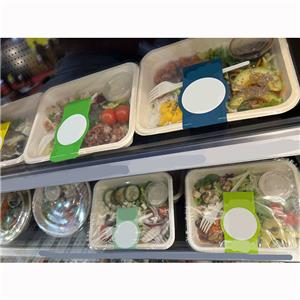
III. Maximizing Freshness: The 21-Day Threshold The primary ROI for switching to a high-barrier sealable tray is the reduction of retail waste. In comparative trials, chilled beef and poultry packaged in our BPI Certified Compostable Trays maintained a shelf life of 14 to 21 days. This extension allows supermarkets to optimize inventory and reduces the "Short-dated" markdowns that plague the ready-meal sector. Every heat seal food tray we manufacture is precision-engineered to maintain gas ratios within 0.1% tolerance.
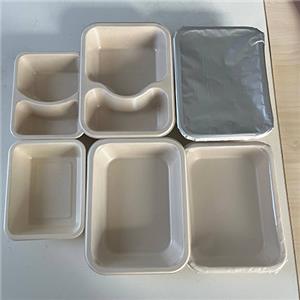
IV. Economic Impact: EPR Fees and 1:1 Scalability Beyond performance, the shift to Laminated Sugarcane Bagasse Trays is a financial strategy. By keeping plastic content ≤ 4.8% (verified by weight), buyers can classify their inventory as "Fiber-based," significantly lowering Extended Producer Responsibility (EPR) fees. Furthermore, our library of over 3,000 existing molds allows for a 1:1 replacement of CPET plastic trays. Whether you need a standard meat sealable tray or a custom heat seal food tray, our 7-day rapid sampling ensures your transition is seamless.
Conclusion: The Turnkey Commitment MountainHB provides more than just BPI Certified Compostable Trays. We offer a turnkey ecosystem including matched high-barrier films and semi-automatic sealing machinery. Our dual-factory hubs in China and Cambodia ensure your Laminated Sugarcane Bagasse Trays are delivered with zero duty to the EU and mitigated tariffs to the USA, securing your position in the sustainable future.