South Korea's 2026 Packaging Pivot: Mastering the Resource Circulation Act and the Rise of Fiber-Based Solutions
South Korea's 2026 Packaging Transformation: Mastering the Resource Circulation Act, MFDS Standards, and the PFAS-FREE Era
South Korea runs one of the most aggressive single-use plastic reduction programmes in the world. Under the Resource Circulation Act (자원순환기본법), the nation has committed to cutting single-use plastics by 25% and ensuring that 100% of single-use packaging is designed for recyclability. As 2026 unfolds, these binding targets—combined with tightened MFDS (Ministry of Food and Drug Safety) chemical standards for food contact materials—are transforming every segment of Korea's food service economy.
For Korean B2B operators, from the massive 배달 (food delivery) platforms to the nation's ubiquitous cafe chains, the era of conventional plastic packaging is ending. At Hebei Mountain Environmental Protection Technology, we provide the verified PFAS-FREE and fiber-based with functional lamination solutions required to secure your market position in Asia's most regulated packaging environment.
The Resource Circulation Act: Why Korea's 25% Plastic Reduction Target is Redefining the Delivery Economy
The Resource Circulation Act is not a voluntary guideline—it is a legally binding framework with specific, time-bound deliverables. By 2026, Korea aims to achieve measurable progress toward its 25% reduction in single-use plastic generation, alongside a 65% recycling rate for single-use plastics. Enforcement includes strict penalties for non-compliance, particularly for high-volume operators in the food service and retail sectors.
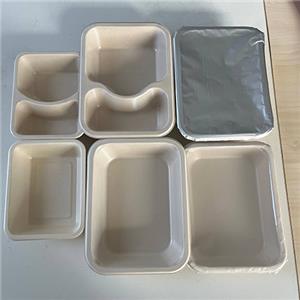
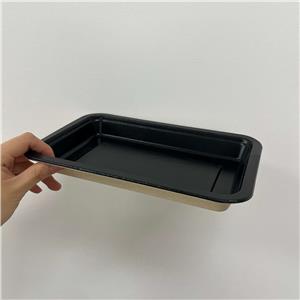
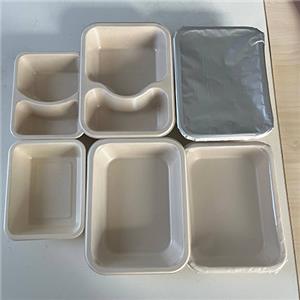
For Korean wholesalers and franchise operators, this means that traditional PET and PP containers are increasingly becoming a regulatory and financial liability. Hebei Mountain's fiber-based bagasse trays with functional lamination offer a direct, compliance-ready solution. Our products consist of a natural plant fiber base with a functional coating that accounts for a minimal percentage of the total weight. This "fiber-first" design aligns naturally with the Resource Circulation Act's quantitative reduction targets, ensuring your packaging counts as a circular asset rather than a plastic liability.
배달 (Delivery) Nation: Solving the Food Delivery Packaging Crisis with Fiber-Based Solutions
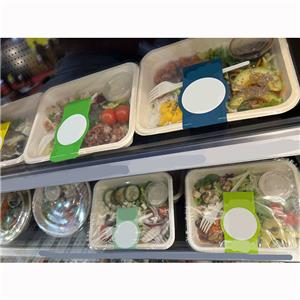
South Korea's food delivery culture is unmatched globally in its scale and sophistication. The 배달 economy generates billions of delivery orders annually, creating enormous demand for functional food containers. However, the government has identified delivery packaging as a primary target for regulatory intervention, imposing phase-out deadlines and incentivising the switch to reusable and compostable alternatives.
This creates a critical market need for high-performance, fiber-based containers that can withstand the rigours of hot soups, fermented foods (kimchi, jjigae), and high-volume delivery logistics. Hebei Mountain's fiber-based trays with functional lamination are purpose-built for this challenge:
Hot Food Stability: Our trays maintain structural integrity with steaming hot Korean dishes, eliminating the warping and leakage common with traditional paper containers.
100% Oil and Liquid Barrier: The ultra-thin functional layer provides complete containment of oils and broths—essential for Korea's rich culinary traditions.
1:1 Mold Replication: We match your existing delivery container dimensions precisely, allowing Korean central kitchens to switch to fiber without disrupting automated filling lines.
MFDS and Chemical Safety: Meeting Korea's Tightened Phthalate and PFAS Standards
The Korean MFDS (Ministry of Food and Drug Safety) has enacted a wave of tightened chemical safety standards for food contact materials. In 2026, these include stricter migration limits for phthalates (DEHP, DEHA) and expanded prohibitions on toxic and harmful substances under the Food Sanitation Act. Korea is also actively strengthening its national framework for PFAS regulation.
In this rigorous environment, "Low-PFAS" claims do not survive MFDS scrutiny. Hebei Mountain provides the industry's most comprehensive safety verification: our latest July 2026 SGS report confirms our products are PFAS-FREE (ND - Not Detected) and BPA-free, with full compliance against REACH and POPs standards. By choosing an "ND" verified supplier today, Korean importers can pre-empt future MFDS chemical audits and protect their brand's reputation with Korea's discerning consumer base.
The Recyclability Grading System: How Fiber-Based Designs Achieve Premium EPR Ratings
South Korea's Extended Producer Responsibility (EPR) system employs a sophisticated recyclability grading mechanism that directly impacts your compliance costs. Packaging materials are evaluated based on material composition, ease of separation, and compatibility with Korea's advanced sorting infrastructure. Materials that are difficult to recycle—particularly coloured PET and multi-material composites—face the highest EPR contribution fees.
Hebei Mountain's fiber-based hybrid solutions are engineered to achieve premium EPR ratings. Our tray structure—a renewable fiber base with a minimal functional layer—does not trigger the "composite material" penalty under Korea's grading system. This design directly reduces your annual EPR costs and aligns your brand with the government's stated goal of achieving 100% recyclability-compatible design by 2026.
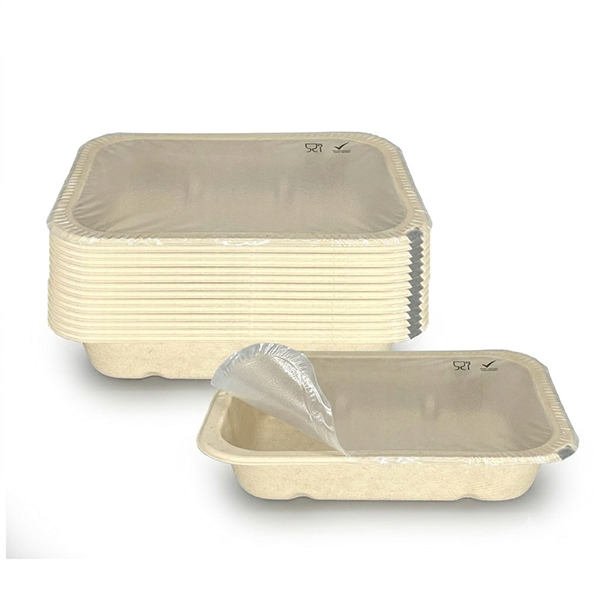
Hebei Mountain's Solution: Fiber-Based with Functional Lamination (PFAS-FREE ND)

We provide more than a container; we deliver a documented, high-performance compliance strategy for the Korean market:
Extreme Barrier Performance: Our EVOH and functional laminations provide oxygen and moisture barriers essential for Korea's fresh produce and prepared food sectors.
Certifications: Our products carry AS 4736 Industrial Compostable Certification, and our SGS reports cover the full suite of REACH, POPs, and BPA-free standards required for Korean MFDS documentation.
Compliant Labelling: We provide full material declarations to support Korea's mandatory packaging material labelling requirements.
Strategic Supply Chain: Cambodia-Based Manufacturing for Korean Importers
Supply chain resilience and tariff-advantaged sourcing are critical strategic priorities for Korean importers. Hebei Mountain's production base in Cambodia provides a resilient alternative supply route, helping our partners benefit from a diversified supply route and a tariff-advantaged position compared with single-region sourcing.
By sourcing from our Cambodia facility, Korean distributors ensure a stable, high-volume supply of premium compostable food containers, supported by efficient maritime logistics to major Korean ports in Busan and Incheon.
Conclusion: Future-Proof Your Korean Business for 2026 and Beyond
The convergence of the Resource Circulation Act's binding targets, MFDS chemical safety enforcement, and Korea's recyclability grading system makes the transition to fiber-based packaging an urgent strategic necessity. Korean brands that act today to integrate PFAS-FREE, fiber-based hybrid packaging will be the market leaders in Asia's most advanced circular economy.
Contact Hebei Mountain today to request samples of our SGS-certified sugarcane bagasse solutions and discover how our 1:1 mold replication can secure your compliance and your brand's future in South Korea.