The Ultimate VSP Tray Material Comparison: CPET vs. Paperboard vs. Laminated Bagasse (220x168x41mm)
The Ultimate VSP Tray Material Comparison: CPET vs. Paperboard vs. Laminated Bagasse (220x168x41mm)
A Technical Guide for Fresh Meat, Seafood, and Ready-Meal Processors | 2026 Edition
Vacuum Skin Packaging (VSP) has become the standard expectation for fresh proteins and convenience meals. It extends shelf life, reduces food waste, and delivers a leak-free, tamper-evident presentation. However, the success of any VSP application depends almost entirely on the choice of tray material. A tray that cannot withstand vacuum pressure or bond with the skin film will destroy the package integrity—regardless of the sealing machinery used.
In this guide, we compare the three dominant materials at the standard 220x168x41mm format: CPET plastic, Coated Paperboard, and PFAS-FREE Laminated Bagasse, analyzing their performance, regulatory standing, and total cost of ownership.
Chapter 1: The Physics of VSP and Material Stress

Unlike MAP (which injects gas into the headspace), VSP operates by dramatically reducing pressure inside a chamber. The heated top film conforms tightly around the food, creating a "second skin" effect. This process subjects the tray to:
-
Vacuum Pressure: Chambers operate at 95-99% vacuum, generating up to 1 bar (14.5 PSI) of compressive force on the sidewalls.
-
Thermal Stress: Sealing stations apply 120-160°C to melt the film's adhesive onto the tray flange.
-
Contour Following: The film must stretch into every corner; weak sidewalls cause "bridging" or tearing.
The ideal VSP tray therefore requires: high rigidity (resistance to collapse), a wide sealing window (compatibility with multiple films), and dimensional stability across extreme temperatures.
Chapter 2: CPET (Plastic) — Mature but Vulnerable
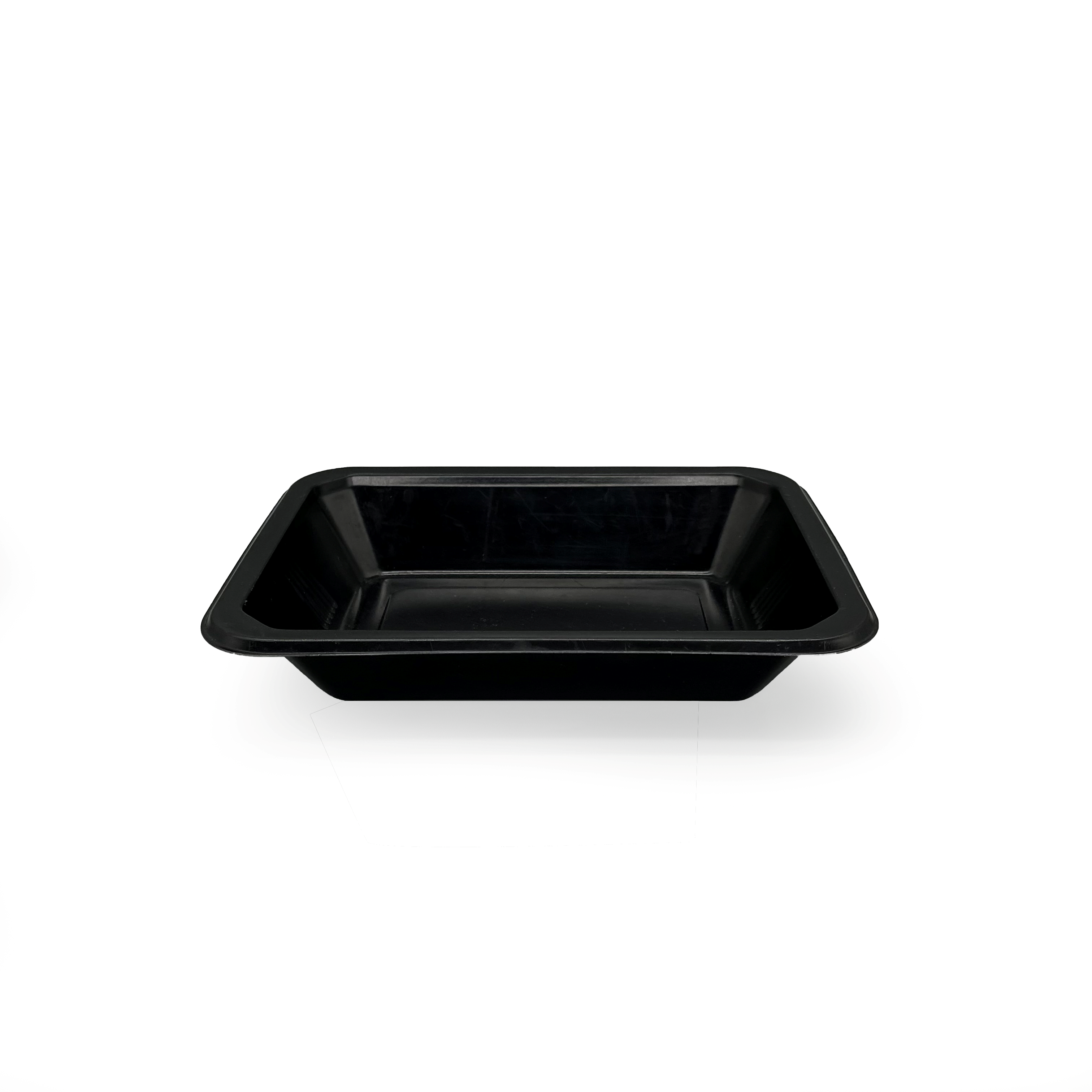
CPET (Crystallized PET) is a thermoplastic engineered for high-heat applications, with a melting point near 260°C, enabling dual-ovenable performance.
-
Temperature: -40°C to 220°C (industry benchmark).
-
Barrier: Moderate oxygen barrier (OTR ~1-3 cc/m²/day); often requires EVOH co-extrusion for long shelf life.
-
Strength: Excellent rigidity-to-weight ratio; strong puncture and stacking resistance.
-
Sealing: Broad window, compatible with most commercial skin films.
The Catch: CPET faces mounting single-use plastic bans (EU SUP Directive, Canada SOR/2022-111, multiple US states). It is difficult to recycle due to food contamination and is not compostable—a growing liability for retailers.
Chapter 3: Coated Paperboard — Print-Friendly but Risky
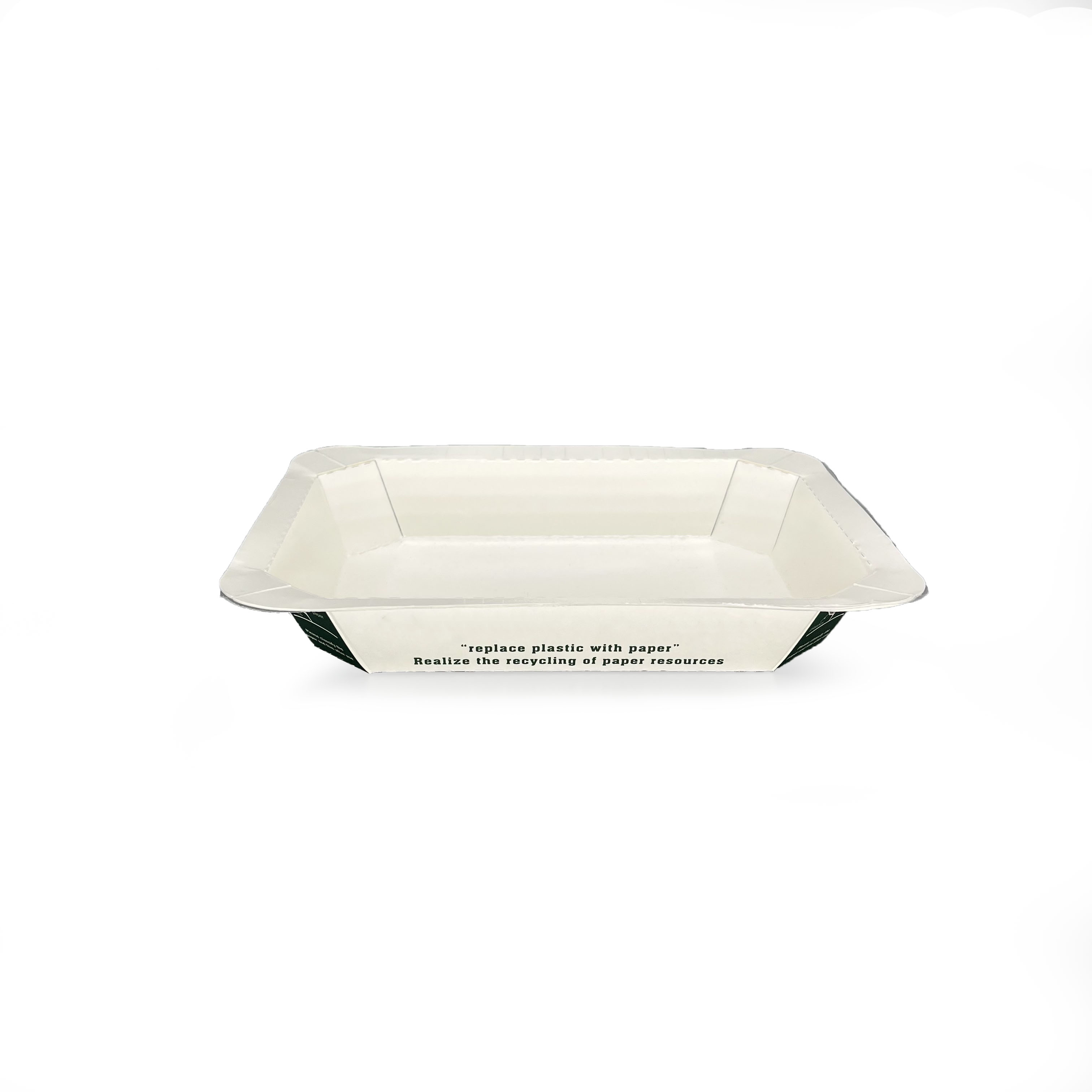
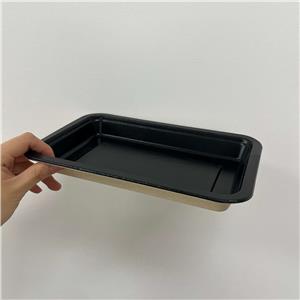
Paperboard trays are pressed from virgin or recycled pulp and coated with a barrier layer (PE, PLA, or dispersion coating) for moisture resistance.
-
Temperature: Typically -20°C to 180°C, dependent on coating chemistry.
-
Barrier: Generally weaker; high oxygen permeability unless metallized or EVOH-coated.
-
Strength: Good dry strength, but suffers "wicking" (edge absorption) in high-moisture environments.
-
Sealing: Narrower window; sensitive to dust and fiber contamination.
The Catch: Under high vacuum, paperboard risks delamination—air escapes through porous edges, causing seal failure and blistering. Additionally, many dispersion coatings rely on PFAS chemistry for grease resistance, a compliance landmine under California AB 1200 and EU PPWR.
Chapter 4: Laminated Bagasse — The Game Changer
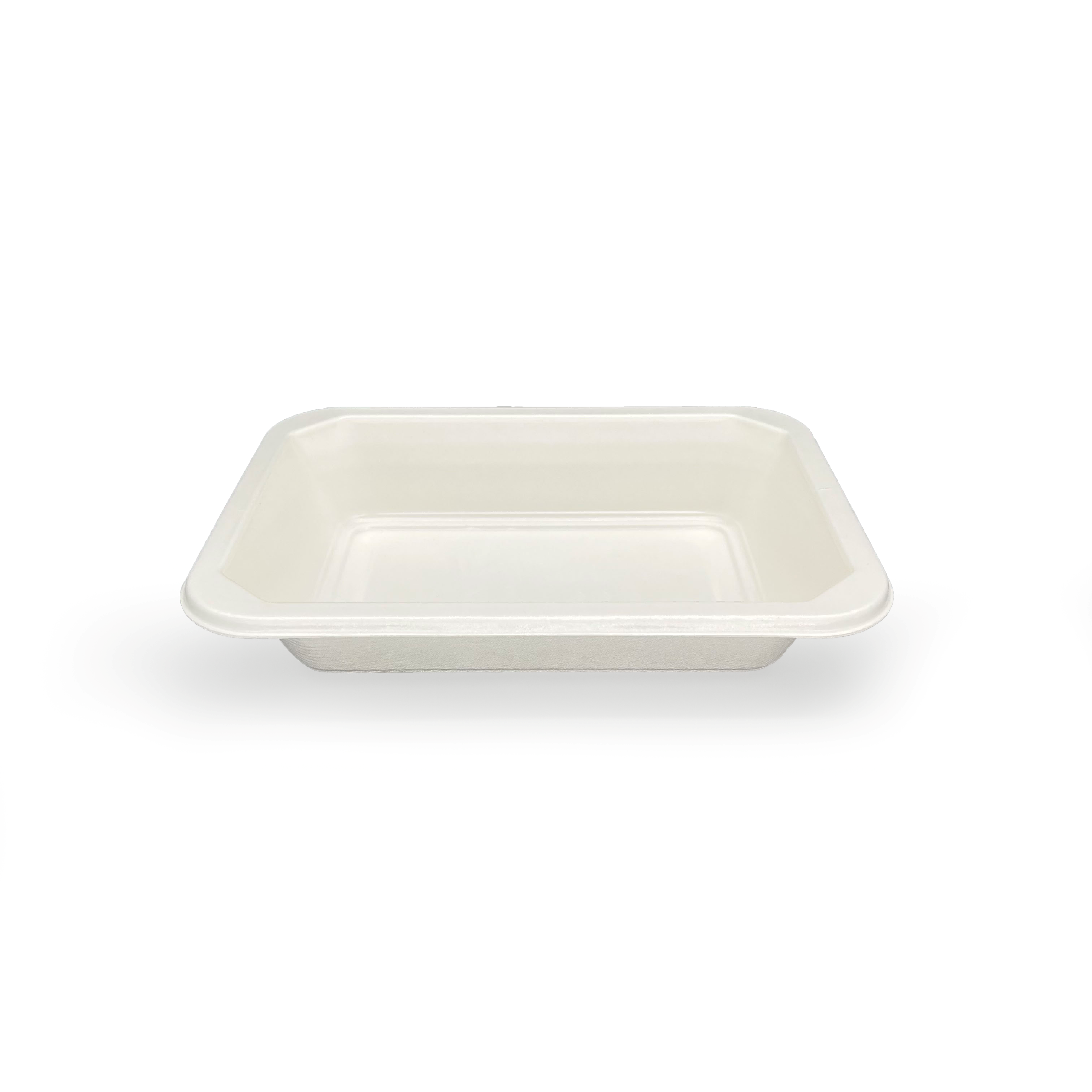
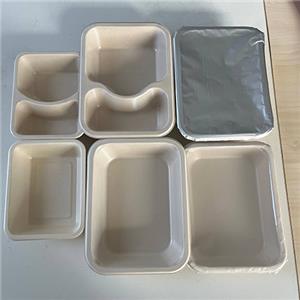
Bagasse is the fibrous residue of sugarcane after juice extraction—once agricultural waste, now upcycled into dense natural fiber pulp. At Hebei Mountain, this base is precision-laminated with a micron-thin functional film (PP, PET, CPET, PLA, or PBAT).
-
Temperature: With a CPET layer, -40°C to 220°C, matching plastic.
-
Barrier: Physical lamination creates a 100% non-porous shield against oil, moisture, and oxygen.
-
Strength: Reinforced fiber density delivers puncture resistance engineered for high-vacuum VSP.
-
Plastic Content: ≤ 5%, satisfying OK Compost, BPI, and ABAP certifications.
The Gold Standard: Grease resistance is achieved through physical film technology, not chemistry. Every batch is third-party verified PFAS-FREE with trace residues below 10ppm (ND), providing total legal safety for exporters to North America and the EU.
Chapter 5: Head-to-Head Comparison (220x168x41mm)
| Criteria | CPET | Paperboard | Bagasse |
|---|---|---|---|
| Oven / Microwave | Yes (220°C) | Varies (180°C) | Yes (220°C) |
| VSP Vacuum Resistance | Excellent | Risky (Delamination) | Excellent |
| PFAS-FREE | N/A | Often Fails | Verified < 10ppm |
| Compostable | No | Limited | OK Compost |
| Brand Image | Standard | Premium Print | Eco-Premium |
Chapter 6: 2026 Regulatory Compliance
The regulatory environment is now the dominant factor in material selection:
-
California AB 1200: Prohibits PFAS in plant-based packaging and mandates compostability labeling.
-
EU PPWR: Requires all packaging to be recyclable or reusable by 2030.
-
Canada SOR/2022-111: Bans single-use plastic food trays.
-
Maine & Minnesota: Aggressive PFAS phase-out timelines.
Key Takeaway: Distributors locked into plastic CPET or PFAS-contaminated paperboard face severe penalties. Verified PFAS-FREE laminated bagasse provides the only future-proof pathway.
Chapter 7: Total Cost of Ownership (TCO)
Smart procurement looks beyond unit price:
-
Compliance Costs: Fines and recalls from PFAS non-compliance.
-
Tariff Exposure:Anti-dumping and additional tariffs on China-origin shipments can add substantially to landed costs.
-
Consumer Preference: Major retailers mandate sustainable packaging and de-list non-compliant suppliers.
-
EPR Fees: Non-recyclable trays incur significant fees in EU jurisdictions.
When quantified, laminated bagasse from our Cambodia hub often emerges as the lowest-TCO solution for 2026-2030.
Chapter 8: The Hebei Mountain Advantage — Total Solution
Unlike single-material suppliers, Hebei Mountain Environmental Protection Technology provides the complete VSP ecosystem: custom trays in all three materials, matching high-clarity skin films (EVOH barrier available), and professional sealing machines. This "Key-in-Hand" approach eliminates cross-supplier compatibility risks.
-
1:1 Mold Replication: 3,000+ existing molds; 200+ custom molds developed annually. Your existing automation remains 100% compatible.
-
Cambodia Factory:0% antidumping duty and a 10% U.S. import duty for molded pulp tableware (HTS 4823.70) — a low-duty, cost-stable supply chain to the US and Canada.
-
Industrial Scale: Three hubs (Anhui, Shandong, Cambodia); 350+ machines; 800+ technicians.
-
Certifications: OK Compost, FDA, BPI, BRCGS, ISO 9001, ABAP.
Chapter 9: Conclusion & Recommendation
The VSP tray landscape is shifting fundamentally. While CPET remains technically mature, its regulatory liabilities compound annually. Paperboard introduces delamination and PFAS risks incompatible with premium VSP. PFAS-FREE Laminated Bagasse converges every critical requirement: plastic-level performance, extreme temperature versatility, verified purity (< 10ppm), industrial compostability, and a tariff-advantaged supply chain through Cambodia (10% U.S. duty, 0% antidumping for HTS 4823.70).
At Hebei Mountain, we do not simply sell trays—we engineer total packaging solutions. From the 220x168x41mm standard format to bespoke molds, our team is ready to guide your transition to a compliant, sustainable, and commercially superior system.
Ready to Upgrade Your VSP Packaging Line?
Request technical datasheets, PFAS-Free reports, or a free 220x168x41mm sample kit today.
Visit mountain-bio.com