Heat Sealable Bagasse Trays: What Food Manufacturers Need to Know Before Switching From Plastic
For food manufacturers, switching from conventional plastic trays to more sustainable packaging is not simply a matter of changing materials.
The new tray still needs to fit the production line, protect the food, handle the required temperature range, work with the sealing process, and meet the packaging requirements of the final product.
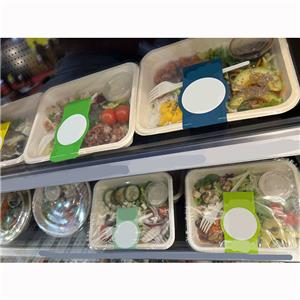
This is where heat sealable bagasse trays are becoming an important option for ready meals, fresh food, prepared meals, supermarket products, and other applications that traditionally rely on plastic trays.
A molded bagasse fiber tray with a suitable functional film can provide the structure of molded fiber while adding the sealing and barrier performance needed for modern food packaging.
In this guide, we explain what food manufacturers should evaluate before replacing PP, PET, or CPET trays with heat-sealable bagasse packaging.
What Is a Heat Sealable Bagasse Tray?
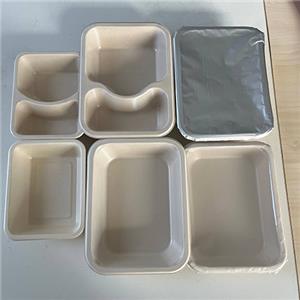
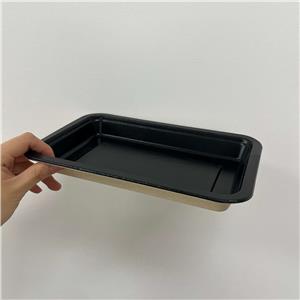
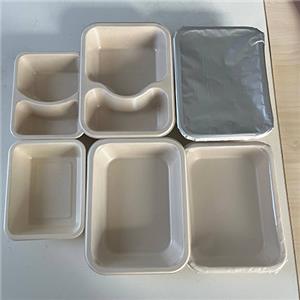
A heat sealable bagasse tray is a molded food tray made primarily from sugarcane bagasse fiber with a functional film or coating applied to the food-contact or sealing surface.
The bagasse fiber provides the tray structure and rigidity, while the selected film helps provide properties such as:
- Heat sealing
- Water resistance
- Oil resistance
- Leak resistance
- Barrier performance
- Compatibility with different food temperatures
- Compatibility with VSP or MAP packaging, depending on the tray design and film
The film does not have to be the same for every application.
Depending on the food, temperature, sealing method, shelf-life requirement, and packaging line, different film structures can be considered, including PP, PET, CPET, PLA, EVOH, and PBAT-based solutions.
This makes heat-sealable bagasse packaging more flexible than a simple “one material fits all” approach.
Why Are Food Manufacturers Looking at Bagasse as a Plastic Alternative?
Traditional plastic trays such as PP, PET, and CPET have been widely used because they are lightweight, rigid, and suitable for automated food packaging.
However, many food companies are now looking for packaging solutions with a higher share of renewable or fiber-based material.
Sugarcane bagasse is the fibrous material left after sugarcane is processed. Instead of treating this agricultural residue as waste, it can be processed into molded fiber packaging.
For food manufacturers, the important question is not simply whether bagasse is more sustainable.
The real question is:
Can a bagasse tray perform well enough for the actual food, production line, sealing process, storage conditions, and distribution environment?
For heat-sealable applications, the answer depends heavily on the tray structure and the selected film.
How Does a Heat Sealable Bagasse Tray Replace a Plastic Tray?
The basic concept is straightforward.
A conventional plastic tray is replaced by a molded bagasse fiber tray, while the functional layer is designed around the sealing and barrier requirements of the application.
For example:
Traditional packaging:
Plastic tray → lidding film → heat sealing
Bagasse packaging:
Molded bagasse tray → functional film → lidding film → heat sealing
The important part is that the bagasse tray must be designed as part of the complete packaging system.
This means manufacturers should evaluate the tray, lidding film, sealing temperature, sealing pressure, dwell time, packaging atmosphere, and production equipment together.
A tray that looks suitable by itself may not perform correctly when introduced to an existing packaging line.
Can Bagasse Trays Be Heat Sealed?
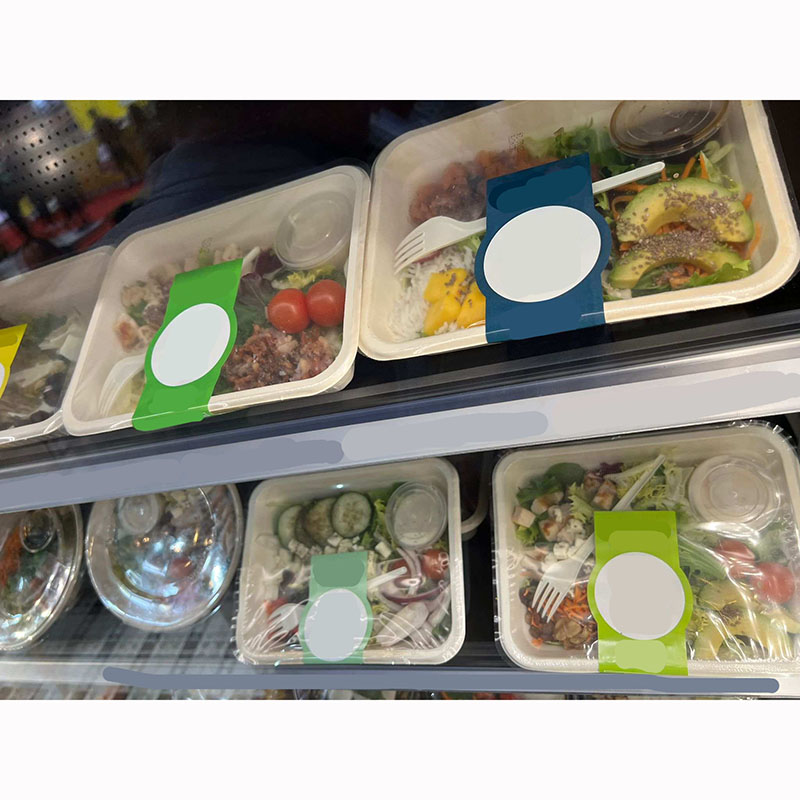
Yes, specially designed laminated or coated bagasse trays can be heat sealed.
The sealing performance comes primarily from the functional film layer rather than from the untreated fiber itself.
During the packaging process, the compatible sealing layer on the tray is brought into contact with the lidding film and heated under controlled pressure.
The final sealing result depends on several factors, including:
- Tray film type
- Lidding film type
- Film thickness
- Sealing temperature
- Sealing pressure
- Sealing time
- Tray rim design
- Sealing machine
- Food contamination around the sealing area
This is why selecting a heat-sealable bagasse tray should be treated as an engineering and packaging project rather than simply a product purchase.
PP vs PET vs CPET vs PLA vs EVOH: Which Film Should You Choose?
There is no universal film that is best for every ready-meal or food packaging application.
The right choice depends on the food and the conditions the package will experience.
| Film | Typical Application Considerations |
|---|---|
| PP | Suitable for many chilled and heated food applications where PP sealing performance is required |
| PET | Useful when PET-based sealing and barrier characteristics are needed |
| CPET | Suitable for applications requiring a wider high-temperature range, including certain oven and heating applications |
| PLA | A fiber-oriented option for applications where compostable film structures are appropriate |
| EVOH | Used when higher oxygen barrier performance is required, particularly for selected MAP applications |
| PBAT | Can be considered for applications requiring flexible compostable film structures |
The actual operating range should always be confirmed according to the specific film structure and final tray construction.
For a food manufacturer, the most important question is therefore not:
“Which film is the most sustainable?”
Instead, ask:
“Which film provides the performance required by my product and packaging process?”
What Should You Check Before Replacing a CPET or PP Tray?
Before changing the tray material, we recommend evaluating at least seven areas.
1. Food Type
Start with the food itself.
Consider:
- High-moisture foods
- Oily foods
- Sauces
- Ready meals
- Meat products
- Fresh produce
- Frozen meals
- Prepared foods
- Foods requiring long shelf life
Different foods place different demands on the packaging.
A dry bakery product and a high-moisture ready meal should not automatically use the same tray structure.
2. Temperature Requirements
Temperature is one of the most important factors.
You should identify the complete temperature cycle of the package.
For example:
Production → Refrigeration → Transportation → Freezing → Microwave or Oven Heating → Consumer Use
A tray designed only for chilled storage may not be suitable for high-temperature reheating.
Similarly, a tray designed for heating may not automatically be the best solution for every frozen-food application.
The film should therefore be selected according to the actual temperature requirements of the final product.
3. Sealing Machine
If you already have a sealing machine, the tray should be evaluated against the existing equipment.
Important factors include:
- Sealing temperature
- Sealing pressure
- Dwell time
- Tooling dimensions
- Tray rim design
- Lidding film compatibility
- Production speed
For large food manufacturers, maintaining compatibility with existing equipment can significantly reduce the difficulty of a packaging conversion project.
4. Lidding Film
The tray and lidding film should be considered together.
A heat-sealable bagasse tray may use different lidding solutions depending on the application.
The goal is to create a reliable seal without damaging the tray or creating unnecessary production problems.
For some applications, manufacturers may also require specialized structures for:
- MAP
- VSP
- High oxygen barrier
- Chilled storage
- Frozen food
- Microwave heating
- Oven heating
5. Barrier Requirements
Barrier requirements depend on the food and expected shelf life.
For MAP applications in particular, oxygen and moisture transmission can become important factors.
A standard fiber tray may not provide the same barrier performance as a multilayer plastic package.
This is why coated or laminated bagasse trays are important for applications where barrier performance matters.
For higher-barrier requirements, an EVOH-enhanced structure can be considered as part of the overall tray design.
The correct barrier structure should be selected according to the food, shelf-life target, atmosphere, distribution conditions, and packaging process.
6. Tray Shape and Dimensions
Replacing a plastic tray does not always mean creating a completely new packaging format.
In many projects, the existing plastic tray can be used as the dimensional reference.
A custom molded bagasse tray can be developed around:
- Length
- Width
- Depth
- Number of compartments
- Corner radius
- Rim structure
- Stacking requirements
- Sealing area
For food manufacturers that already have a successful retail package, maintaining similar dimensions can make the transition easier.
Can You Replace a Plastic Tray Without Changing the Packaging Line?
Sometimes yes, but this should always be verified through testing.
A properly designed bagasse tray can be developed around the dimensions and sealing requirements of an existing plastic tray.
However, molded fiber behaves differently from conventional plastic.
The tray stiffness, rim geometry, dimensional tolerance, film structure, and sealing behavior may differ.
Therefore, a packaging conversion project should normally include:
Existing tray evaluation → Mold design → Prototype → Sealing test → Packaging-line test → Food test → Sample approval → Mass production
This approach is much safer than ordering a large quantity before testing.
What About MAP and VSP?
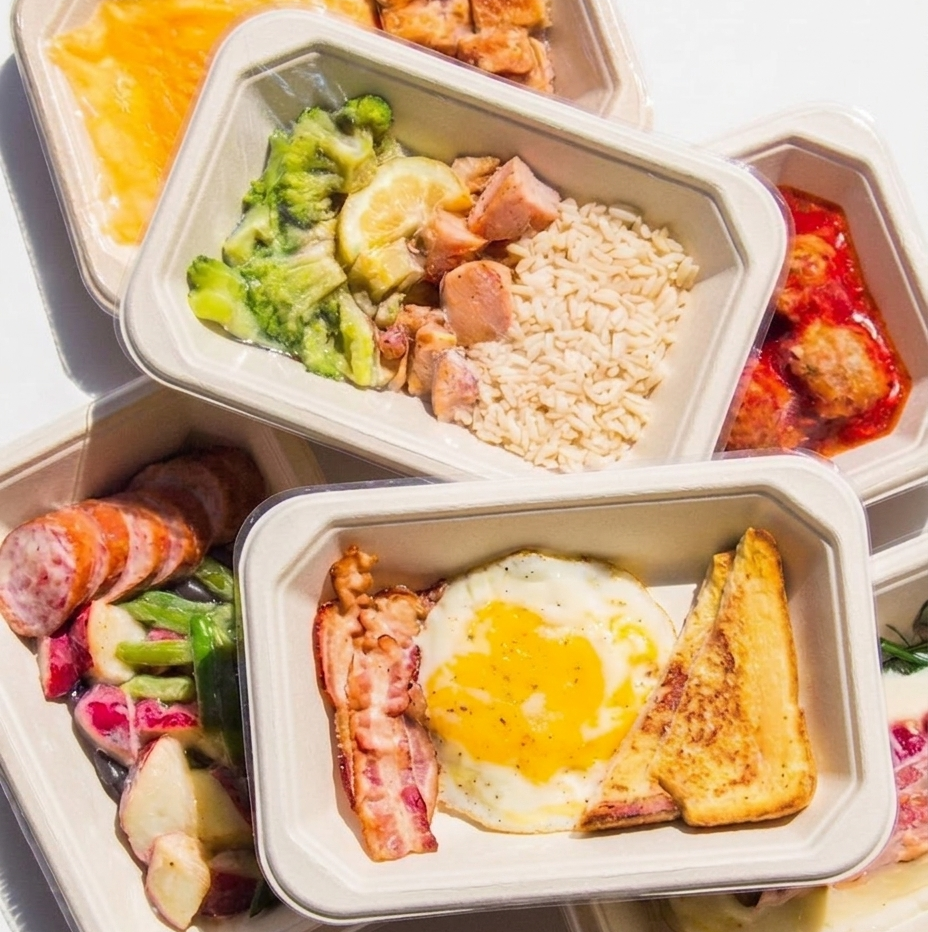
Heat-sealable bagasse trays can also be developed for selected MAP and VSP packaging applications.
MAP — Modified Atmosphere Packaging
MAP replaces part of the air inside the package with a controlled gas mixture.
For these applications, the packaging system needs appropriate sealing performance and barrier properties.
A bagasse tray used for MAP therefore requires more than simply a fiber structure.
The tray, film, lidding material, sealing conditions, and gas-flushing process need to work together.
VSP — Vacuum Skin Packaging
VSP creates a close-fitting film around the food using vacuum.
For VSP applications, the tray needs to provide the required sealing surface and structural performance.
The tray geometry and film selection are especially important because the packaging process applies mechanical forces to the package.
For both MAP and VSP, testing with the actual food product is recommended before commercial production.
What Tests Should Be Done Before Mass Production?
A professional packaging conversion project should not stop at checking whether the tray “looks good.”
Manufacturers should consider testing:
Seal Strength
Does the seal remain strong during transportation, storage, and handling?
Leak Resistance
Can the package prevent liquid or sauce from escaping?
Temperature Performance
Does the tray remain stable under the required refrigeration, freezing, microwave, or oven conditions?
Oil and Water Resistance
Can the functional layer protect the fiber structure from the actual food?
Compression and Stacking
Can the trays withstand stacking during storage and transportation?
Packaging-Line Compatibility
Can the tray run consistently through the customer's existing sealing equipment?
Shelf-Life Performance
For products with longer shelf-life requirements, barrier performance and real food testing should be evaluated under the intended storage conditions.
These tests help identify problems before mass production.
What Makes a Good Bagasse Tray Manufacturer?
When selecting a supplier, food manufacturers should look beyond the basic question of whether the company can produce molded fiber trays.
A suitable supplier should be able to support the complete packaging project.
Important questions include:
- Can you provide heat-sealable bagasse trays?
- Which film options are available?
- Can the tray be matched to our existing plastic tray?
- Can you provide custom molds?
- Can you supply samples before mass production?
- Can you support MAP or VSP applications?
- Can you provide compatible lidding films?
- Can you recommend a sealing machine?
- Can you provide testing data and relevant compliance documents?
- Can you support OEM and ODM projects?
For food manufacturers, having one technical supplier coordinate the tray, film, tooling, and sealing solution can make the transition much easier.
Why 1:1 Plastic Tray Replacement Matters
One of the biggest advantages of a custom bagasse packaging project is the possibility of using an existing plastic tray as the design reference.
Instead of asking a food company to completely redesign its product packaging, the manufacturer can evaluate the existing tray and develop a molded fiber alternative around the required dimensions and functions.
This can help maintain:
- Similar product presentation
- Similar filling volume
- Similar compartment layout
- Similar sealing area
- Similar stacking requirements
- Similar packaging-line dimensions
Of course, the final design still needs to be tested because molded fiber and plastic have different material characteristics.
Why Choose Molded Bagasse With a Functional Film?
Untreated molded fiber is well suited to many foodservice applications.
However, ready meals and industrial food packaging often require additional performance.
A functional film can help provide the properties required for heat sealing, moisture resistance, oil resistance, leak resistance, and barrier performance.
This creates a more practical structure:
Bagasse fiber for structure + functional film for performance + lidding film for sealing
The result is not simply a disposable fiber container.
It is a complete food packaging system designed around the application.
From Plastic Tray to Bagasse Tray: A Practical Conversion Process
If your company is considering replacing an existing PP, PET, or CPET tray, a practical process is:
Step 1 — Send Your Existing Tray
Provide the dimensions, drawings, or a physical sample of the current plastic tray.
Step 2 — Define the Application
Tell the manufacturer:
- Food type
- Filling weight
- Storage temperature
- Heating temperature
- Expected shelf life
- Sealing method
- MAP/VSP requirements
- Existing sealing machine
Step 3 — Select the Film
The manufacturer can recommend a suitable film structure based on the application.
Step 4 — Develop the Mold
The bagasse tray can be designed according to the required dimensions and sealing area.
Step 5 — Produce Samples
Samples should be tested before committing to mass production.
Step 6 — Run Packaging-Line Tests
Test the tray using the actual sealing machine and lidding film whenever possible.
Step 7 — Test With the Actual Food
Packaging performance should be evaluated using the real product rather than only an empty tray.
Step 8 — Confirm Mass Production
After the tray, film, sealing process, and food performance are approved, the project can move into regular production.
A Better Way to Think About Sustainable Food Packaging
For food manufacturers, sustainable packaging should not be evaluated only by material type.
A successful packaging solution needs to balance:
Material + Food Safety + Sealing + Barrier + Temperature + Equipment + Cost + Supply
This is especially important for ready meals and fresh-food products.
A tray that cannot seal properly, protect the food, or run efficiently on the production line will not be a successful replacement, regardless of its material.
That is why the transition from plastic to molded bagasse should be treated as a packaging engineering project.
Heat Sealable Bagasse Trays From China
Hebei Mountain Environmental Protection Technology Co., Ltd. focuses on molded bagasse food packaging and heat-sealable tray solutions for food manufacturers, brands, supermarkets, distributors, and other B2B customers.
Our product range includes molded bagasse trays with different functional film options, including PP, PET, CPET, PLA, EVOH, and PBAT-based structures, depending on the application.
We can also support custom mold development and packaging projects based on existing plastic trays.
Our goal is not simply to supply a bagasse tray.
We help customers develop a complete packaging solution around their actual food, sealing process, equipment, and distribution requirements.
Looking to Replace a PP or CPET Tray?
Send us your existing tray drawing, sample, dimensions, or product requirements.
Our team can evaluate the application and recommend a suitable heat-sealable bagasse tray, film structure, and packaging solution.
Need a tray matched to your existing sealing machine? Contact us for a sample and packaging evaluation.