Bagasse Ready Meal Packaging: A Complete Guide for Food Manufacturers and Distributors
The ready meal market is changing quickly.
Food manufacturers, supermarket brands, meal delivery companies, and food distributors are looking for packaging that can protect prepared food while also meeting new sustainability and packaging requirements.
This has created growing interest in bagasse ready meal packaging.
But ready meal packaging is more demanding than ordinary disposable foodservice packaging. A tray may need to handle sauces, oils, refrigeration, freezing, microwave heating, heat sealing, transportation, and long storage periods.
For this reason, a simple molded fiber container is not always enough.
A more practical solution is a molded bagasse tray combined with a suitable functional film and lidding system.
This guide explains what buyers should know when selecting bagasse ready meal packaging for commercial food production.
What Is Bagasse Ready Meal Packaging?
Bagasse ready meal packaging is food packaging made from molded sugarcane bagasse fiber and designed for prepared meals and other ready-to-eat or ready-to-heat food products.
Bagasse is the fibrous material left after sugarcane is processed.
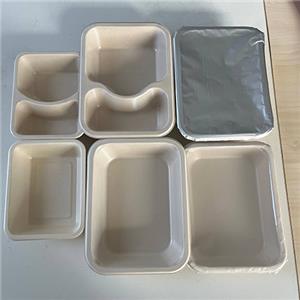
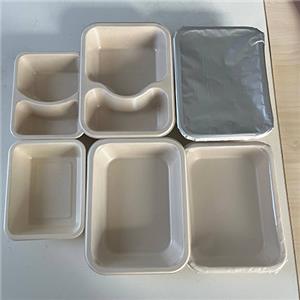
The fiber can be molded into different tray shapes, including:
- 1-compartment ready meal trays
- 2-compartment meal trays
- 3-compartment meal trays
- Deep meal trays
- Shallow meal trays
- Custom-shaped food trays
- VSP trays
- MAP trays
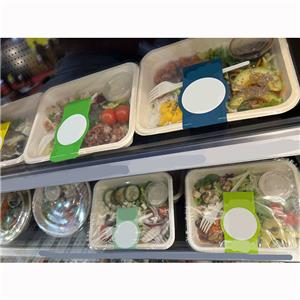
- Supermarket prepared-food trays
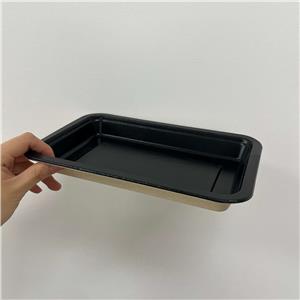
For applications that require heat sealing or additional barrier performance, the tray can be produced with a functional film layer.
The basic structure can be understood as:
Molded bagasse fiber + functional film + lidding solution
The bagasse provides the main tray structure, while the film can be selected according to the food and packaging process.
Why Is Bagasse Suitable for Ready Meals?
Ready meals require more than an attractive package.
The packaging needs to protect the food throughout its complete journey:
Food preparation → Filling → Sealing → Refrigeration or Freezing → Transportation → Retail → Consumer Heating
Bagasse can provide a rigid molded structure while allowing manufacturers to create different tray shapes and compartment layouts.
When combined with an appropriate film structure, a bagasse tray can also be designed for applications requiring:
- Heat sealing
- Water resistance
- Oil resistance
- Leak resistance
- Barrier performance
- Refrigerated storage
- Frozen storage
- Microwave heating
- Oven heating
- MAP
- VSP
The actual performance depends on the tray construction, film, food, temperature, sealing process, and packaging equipment.
Bagasse Ready Meal Tray vs Traditional Plastic Tray
PP, PET, and CPET trays have traditionally been used for many ready meal applications because they offer rigidity, dimensional stability, and compatibility with automated packaging equipment.
Bagasse trays are being developed as an alternative where food companies want to increase the fiber content of their packaging.
However, the goal should not simply be to replace one material with another.
The new package still needs to perform in the actual production environment.
| Requirement | Traditional Plastic Tray | Laminated Bagasse Tray |
|---|---|---|
| Tray structure | Plastic | Molded bagasse fiber |
| Heat sealing | Yes, depending on structure | Yes, with suitable functional film |
| Oil resistance | Depends on material | Depends on film structure |
| Water resistance | Depends on material | Depends on film structure |
| MAP | Common | Possible with suitable barrier structure |
| VSP | Common | Possible with suitable tray and film design |
| Custom shapes | Yes | Yes |
| 1:1 replacement | Possible | Possible with custom mold development |
| Renewable fiber content | Low | High molded fiber content |
| Material selection | Mainly plastic types | Fiber + selected functional film |
The most important point is that bagasse ready meal packaging should be evaluated as a complete packaging system.
What Types of Food Can Use Bagasse Ready Meal Trays?
Bagasse trays can be developed for many prepared-food applications.
Prepared Meals
Common applications include:
- Rice meals
- Pasta
- Noodles
- Meat and vegetable meals
- Chicken meals
- Fish meals
- Mixed meals
- Frozen prepared meals
Compartment trays can keep different foods separated during storage and presentation.
Fresh and Chilled Food
Bagasse trays can also be considered for selected chilled food applications, including:
- Prepared salads
- Fresh meals
- Chilled pasta
- Prepared vegetables
- Fresh meat products
- Fresh food portions
For chilled products, the tray and film should be selected according to moisture, oil, shelf-life, and sealing requirements.
Frozen Ready Meals
Frozen meals can require a different tray structure from chilled products.
The packaging must withstand low temperatures while maintaining sufficient strength and sealing performance.
The selected film should therefore be evaluated for the complete cold-chain environment.
Choosing the Right Number of Compartments
The tray layout is an important part of ready meal packaging design.
1-Compartment Tray
A single large compartment is suitable when the meal does not require separation between different food components.
Typical applications include:
- Pasta
- Rice meals
- Single-dish meals
- Prepared foods
2-Compartment Tray
Two compartments can separate a main dish from a side dish.
For example:
Main meal + vegetables
or
Rice + meat
This can improve presentation and help prevent different foods from mixing.
3-Compartment Tray
Three compartments can be useful for complete meals containing several components.
For example:
Main dish + side dish + vegetables
The exact shape and compartment size can be customized according to the customer's filling requirements.
Should You Choose a Shallow or Deep Bagasse Tray?
Tray depth depends on the food product.
A shallow tray may be suitable for meals with a relatively flat filling profile.
A deeper tray can provide additional volume for products such as:
- Rice dishes
- Pasta
- Saucy meals
- Mixed prepared foods
- Larger meal portions
The tray should also be designed around the filling equipment, sealing area, stacking requirements, and transportation conditions.
This is one reason custom tooling is important for commercial ready meal packaging.
What Film Should Be Used for a Bagasse Ready Meal Tray?
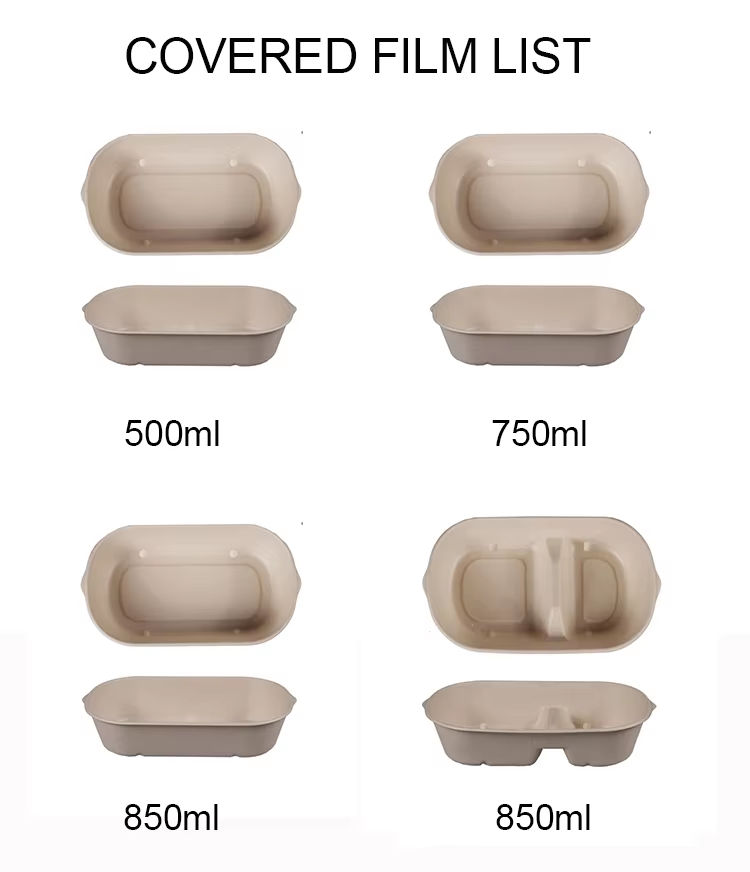
There is no single film that is suitable for every ready meal.
The correct choice depends on the application.
PP Film
PP-based structures can be considered for applications requiring PP sealing characteristics and suitable temperature performance.
They may be used for various chilled and heated food applications.
PET Film
PET-based structures can be considered when PET-related sealing and performance characteristics are required.
CPET Film
CPET is particularly relevant to applications with higher temperature requirements.
It can be considered for certain ready meals that require microwave or oven heating, subject to the specific tray and film construction.
PLA Film
PLA can be considered for applications where a compostable film structure is appropriate.
However, the temperature and performance requirements of the final application must be checked carefully.
EVOH Film
EVOH is mainly considered when higher oxygen barrier performance is required.
This can be especially relevant to selected MAP applications where controlling oxygen transmission is important.
PBAT-Based Film
PBAT-based structures can be considered for applications requiring flexible compostable film solutions.
The suitability depends on the complete formulation and intended use.
The best material is therefore determined by the food + temperature + shelf life + sealing method + packaging atmosphere.
Bagasse Ready Meal Packaging for MAP
Modified Atmosphere Packaging, or MAP, is widely used for prepared foods where shelf-life and product protection are important.
The packaging system replaces or modifies the atmosphere inside the package with a controlled gas mixture.
For a bagasse tray to work in a MAP application, several elements need to be considered together:
Tray structure + barrier film + lidding film + sealing process + gas flushing + food product
The tray needs to provide a reliable sealing surface, while the film structure needs to provide the required barrier performance.
For applications with higher oxygen-barrier requirements, an EVOH-enhanced structure can be considered.
However, MAP suitability should always be verified through actual packaging tests with the intended food product.
Bagasse Ready Meal Packaging for VSP
Vacuum Skin Packaging, or VSP, uses vacuum to create a close-fitting film around the food.
VSP can provide an attractive product presentation while helping keep the food securely positioned inside the package.
For bagasse VSP applications, the tray needs to be designed with:
- Suitable rim geometry
- Sufficient structural strength
- Compatible sealing surface
- Suitable film structure
- Appropriate dimensions
The final system should be tested using the actual VSP equipment and product.
Microwave and Oven Heating
Many ready meals are designed to be heated directly by the consumer.
This makes temperature performance a critical consideration.
Before selecting a tray, the food manufacturer should define:
- Refrigeration temperature
- Freezing temperature
- Microwave temperature
- Oven temperature
- Heating time
- Cooling or reheating cycles
For example, a tray used only for refrigerated meals may require a different film structure from one designed for high-temperature oven heating.
The correct solution should therefore be selected according to the actual heating process.
How Does the Sealing Process Work?

A typical ready meal packaging process may look like this:
1. Tray forming
The molded bagasse tray is produced according to the required shape and dimensions.
2. Food filling
The prepared food is filled into the tray.
3. Optional gas flushing or vacuum
MAP or VSP can be applied when required.
4. Lidding film placement
The compatible lidding film is positioned over the tray.
5. Heat sealing
The tray and lidding film are sealed under controlled temperature, pressure, and dwell time.
6. Quality inspection
The finished package can then be checked for seal quality, leaks, appearance, and other application-specific requirements.
The exact process depends on the customer's equipment and packaging format.
Do You Need a New Sealing Machine?
Not necessarily.
A bagasse ready meal project can often be developed around an existing sealing machine.
However, the tray must be evaluated for compatibility with the machine.
Important parameters include:
- Tray dimensions
- Rim design
- Tooling
- Sealing temperature
- Sealing pressure
- Dwell time
- Lidding film
- Production speed
If the customer does not yet have suitable equipment, a complete solution can include:
Bagasse tray + lidding film + sealing machine
For MAP or VSP applications, the corresponding equipment can also be selected according to the packaging process.
Can a Bagasse Tray Replace an Existing Plastic Tray?
Yes, in many cases a custom bagasse tray can be developed based on an existing plastic tray.
This is especially useful for food manufacturers that already have:
- An established product size
- Existing filling equipment
- Existing sealing equipment
- Existing retail packaging
- Existing labels or artwork
Instead of redesigning the entire package, the existing plastic tray can be used as the reference for a new molded bagasse solution.
The manufacturer can evaluate:
- Overall dimensions
- Tray depth
- Compartment layout
- Rim design
- Sealing area
- Stacking requirements
- Filling volume
Custom tooling can then be developed for the new bagasse tray.
Why Custom Molds Matter
Ready meal products often have very specific packaging requirements.
A standard tray may not provide the right:
- Capacity
- Shape
- Compartment layout
- Rim structure
- Sealing area
- Stacking performance
Custom molding allows the tray to be developed around the actual product.
For example, a food manufacturer may provide an existing plastic tray or technical drawing.
The supplier can then use it as a reference for developing a molded bagasse alternative.
For large B2B packaging projects, this can be more practical than trying to fit the food product into an unsuitable standard tray.
What Should Distributors and Wholesalers Consider?
Distributors and wholesalers have different priorities from food manufacturers.
They need products that can serve multiple customers and applications.
When sourcing bagasse ready meal packaging, consider:
Product Range
Can the supplier provide:
- 1-compartment trays
- 2-compartment trays
- 3-compartment trays
- Shallow trays
- Deep trays
- MAP trays
- VSP trays
- Custom trays
Film Options
Does the supplier provide different film structures for different applications?
Customization
Can customers request custom dimensions, shapes, colors, printing, or labels?
MOQ
Is the minimum order quantity suitable for your market?
Production Capacity
Can the manufacturer maintain consistent supply for regular orders?
Tooling
Can the supplier develop new molds or modify existing designs?
Technical Support
Can the supplier help customers select the right tray and film rather than simply quoting a standard product?
For distributors, having a supplier that can support different food applications can make it easier to develop a broader ready meal packaging product range.
What Should Food Manufacturers Ask a Bagasse Tray Supplier?
Before placing an order, ask the supplier:
- Is the tray heat sealable?
- Which film options are available?
- What temperature range is suitable for the specific tray?
- Can the tray be used for frozen food?
- Can it be used for microwave heating?
- Can it be developed for oven applications?
- Can it support MAP?
- Can it support VSP?
- Can it match our existing plastic tray?
- Can you provide a custom mold?
- Can you supply lidding film?
- Can you recommend sealing equipment?
- Can you provide samples before mass production?
- What testing and compliance documents are available?
- What is the expected production lead time?
These questions can help buyers compare suppliers based on the complete packaging solution rather than only the unit price.
How to Select a Bagasse Ready Meal Packaging Manufacturer in China
China has a large manufacturing base for molded fiber food packaging, but suppliers can differ significantly in their capabilities.
For a commercial ready meal project, look for a manufacturer with experience in:
- Molded bagasse food packaging
- Heat-sealable trays
- Film lamination
- Custom molds
- Ready meal applications
- MAP and VSP packaging
- Lidding films
- Packaging equipment
- OEM and ODM projects
A supplier with these capabilities can help reduce the number of separate vendors involved in a packaging project.
This is especially useful when the customer needs a complete solution rather than a standalone tray.
One-Stop Bagasse Ready Meal Packaging Solutions
For many B2B customers, buying the tray is only one part of the project.
A complete solution may include:
- Bagasse tray
- Functional film
- Lidding film
- Sealing machine
- MAP or VSP equipment when required
- Custom mold
- Labels or printing
This approach allows the packaging supplier to consider the complete production process.
It can also make communication easier when customers are testing a new packaging format.
Why Work With Hebei Mountain?
Hebei Mountain Environmental Protection Technology Co., Ltd. specializes in molded bagasse food packaging and heat-sealable tray solutions.
Our product range covers standard molded fiber food packaging as well as coated and laminated bagasse trays designed for more demanding food applications.
We support customers with:
- Heat-sealable bagasse trays
- Ready meal trays
- Custom bagasse food trays
- PP, PET, CPET, PLA, EVOH and PBAT-based film options
- MAP and VSP packaging solutions
- Lidding films
- Sealing machines
- Custom molds
- OEM and ODM projects
- 1:1 plastic tray replacement
Our factory has more than 3,000 existing molds and develops 200+ new molds each year, supporting customers that need customized food packaging formats.
For customers with an existing plastic tray, we can evaluate the original dimensions and develop a molded bagasse solution around the required packaging format.
Is Bagasse Ready Meal Packaging Right for Your Product?
The answer depends on your actual application.
Before choosing a tray, define:
Food type → Storage temperature → Heating requirements → Shelf-life target → Sealing method → MAP/VSP requirements → Existing equipment → Tray dimensions → Required film structure
Once these factors are clear, the tray and film can be developed around the actual packaging requirements.
This is a much more reliable approach than selecting a bagasse tray based only on appearance or material name.
Final Thoughts
Bagasse ready meal packaging is moving beyond the traditional concept of disposable fiber food containers.
With the right molded structure and functional film, bagasse trays can be developed for commercial food applications that require heat sealing, leak resistance, temperature performance, barrier protection, MAP, VSP, and custom dimensions.
For food manufacturers and distributors, the key is to select the packaging according to the actual application.
The right solution may not be the same for a chilled ready meal, frozen dinner, microwave meal, supermarket prepared food, or MAP product.
A qualified manufacturer should therefore be able to help with more than the tray itself.
They should be able to support the material, film, mold, sealing process, equipment, testing, and mass production.
Looking for a Bagasse Ready Meal Packaging Supplier?
If you are currently using PP, PET, or CPET food trays and are evaluating a molded bagasse alternative, send us your tray drawing, sample, dimensions, food type, and temperature requirements.
Our team can help evaluate the application and recommend a suitable heat-sealable bagasse tray and complete ready meal packaging solution.
Request a sample or discuss your ready meal packaging project with Hebei Mountain today.