How Can Food Packaging Be More Sustainable? 8 Practical Strategies for Food Businesses
How Can Food Packaging Be More Sustainable?
Food packaging plays an important role in keeping products fresh, protecting food during transportation, and helping businesses deliver products safely. However, packaging also uses resources and can generate waste after use.
For food manufacturers, restaurants, supermarkets, catering companies, and packaging distributors, making food packaging more sustainable means finding a better balance between product protection, material use, cost, and end-of-life options.
There is no single material that works best for every food product. The right approach depends on what is being packaged, how it will be stored and transported, and what waste management systems are available.
In this guide, we explore eight practical ways to improve food packaging sustainability and explain how materials such as sugarcane bagasse can fit into a broader packaging strategy.
1. Reduce Unnecessary Packaging
One of the simplest ways to make food packaging more sustainable is to avoid using more material than necessary.
Extra layers, oversized containers, and unnecessary accessories can increase material consumption, shipping volume, purchasing costs, and disposal needs.
Businesses can start by reviewing their current packaging and asking a few questions:
- Is the container larger than the product requires?
- Are all packaging layers necessary for food safety and protection?
- Can the design use less material without becoming weaker?
- Are separate lids, sleeves, or inserts needed for every order?
- Can packaging dimensions be adjusted to improve shipping and storage efficiency?
For example, a food manufacturer may be able to reduce packaging weight by choosing a better-fitting tray. A takeaway business may reduce unnecessary accessories by offering them only when customers request them.
However, reducing material should not compromise food protection. If a lighter package causes leaks, product damage, or faster spoilage, the overall result may be less sustainable.
The goal is to use the right amount of packaging, not simply the smallest amount possible.
2. Choose Materials Based on the Full Application
Sustainable food packaging starts with selecting materials that match the product and its intended use.
Different foods require different levels of protection. Dry bakery products may need a very different package from oily prepared meals, chilled meat, or refrigerated ready meals.
Common material options include:
| Packaging material | Potential advantages | Important considerations |
|---|---|---|
| Paper and cardboard | Lightweight, printable, and suitable for many dry food applications | Moisture barriers or additional structures may be needed |
| Sugarcane bagasse | Molded plant-fiber option for plates, bowls, and food trays | Performance and end-of-life claims depend on the finished product |
| Recyclable plastics | Can provide lightweight, durable, and functional food packaging | Local collection and recycling acceptance vary |
| Glass and metal | Durable and suitable for selected reusable or recyclable systems | Weight, breakage, transport, and cleaning requirements matter |
| Compostable materials | May fit organic waste collection programs | Certification and suitable composting infrastructure are essential |
A material should not be considered sustainable based on its name alone. Businesses should assess how much material is used, how well it protects food, how far it travels, and whether it can realistically be reused, recycled, or composted after use.
The US Environmental Protection Agency highlights the importance of evaluating packaging production, material efficiency, and recovery at the end of the life of a product. Source: US EPA — Sustainable Packaging.
3. Consider Sugarcane Bagasse for Selected Food Packaging Applications
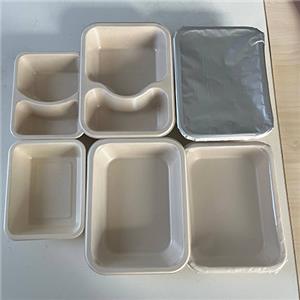
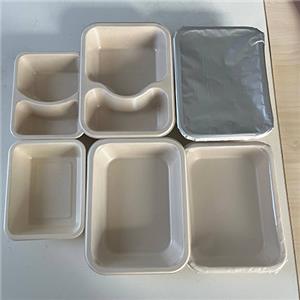
Sugarcane bagasse is the fibrous residue left after juice is extracted from sugarcane. It can be processed into molded products such as plates, bowls, takeaway containers, and food trays.
For food service businesses looking for plant-fiber alternatives to selected conventional disposable packaging, bagasse is one material worth evaluating.
Potential advantages include:
- Molded shapes: Different sizes and designs can be developed for different food applications.
- Rigid structures: Suitable designs can provide practical support for serving and transporting food.
- Food service applications: Products can be developed for catering, takeaway meals, and other prepared-food uses.
- Customization options: Depending on tooling and production requirements, buyers may be able to request specific shapes, sizes, and compartments.
The actual performance depends on the product design and manufacturing process. Buyers should request samples and test the package with their own foods and operating conditions.
It is also important to distinguish ordinary molded bagasse tableware from coated bagasse food trays. The two may have different material structures and disposal options.
Are Bagasse Food Containers Always Compostable?
No. The finished product determines whether a compostability claim is appropriate.
An uncoated molded-fiber product may have different end-of-life properties from a tray containing a plastic lining, coating, adhesive, or other additional component.
If compostability is a purchasing requirement, ask the supplier for relevant documentation covering the complete finished product and check whether the intended composting facility accepts it.
4. Design Packaging to Prevent Food Waste
Packaging sustainability is not only about the package itself. It is also about how effectively the package protects the food inside.
Food production uses land, water, energy, labor, and transportation. When food spoils or is damaged before consumption, those resources are wasted too.
For some products, a package with better sealing, moisture resistance, or structural strength may help reduce leaks, damage, and premature spoilage.
Businesses should evaluate packaging performance against the actual food application.
For ready meals, for example, buyers may need to consider:
- Tray dimensions and portion size.
- Moisture and oil resistance.
- Seal integrity during transport.
- Chilled or frozen storage requirements.
- Compatibility with the intended heating process.
- Stacking and handling performance.
A package that works well for a dry meal may not be suitable for a sauce-heavy dish or a product with a longer refrigerated shelf life.
For this reason, packaging trials should include real food, the intended filling process, storage conditions, transport simulation where appropriate, and the actual sealing equipment of the customer.
The most sustainable option is not necessarily the package with the least material. It is the package that uses resources efficiently while providing the protection the food needs.
5. Evaluate Reusable, Recyclable, and Compostable Options Carefully
Reusable, recyclable, and compostable packaging can all play a role in a sustainable food packaging strategy. They are not interchangeable, and each depends on different systems.
Reusable Packaging
Reusable containers may be suitable for closed-loop systems, workplace cafeterias, dine-in services, or delivery programs with effective collection and washing.
Businesses should consider return rates, cleaning, transportation, durability, and the number of uses achieved.
Recyclable Packaging
Recyclable packaging can help recover materials for future use when suitable collection and processing systems exist.
However, recycling acceptance varies by location. Food residues, mixed materials, labels, coatings, and packaging design can affect whether a package is accepted and processed.
Compostable Packaging
Compostable packaging may be useful where organic waste collection and suitable composting facilities are available.
Businesses should verify the relevant certification and confirm that local facilities accept the specific product. Industrially compostable packaging should not automatically be described as suitable for composting in a domestic setting.
Which Option Is Best?
The answer depends on the application and local infrastructure. A reusable system may work well for repeated use in a controlled setting, while a recyclable or compostable disposable package may be more practical in another setting.
Before changing packaging, talk with local waste collectors and evaluate the complete system, not just the material label.
6. Improve the Design of Ready-Meal and Takeaway Packaging
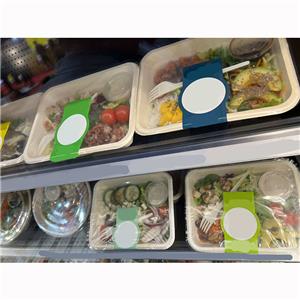
Prepared meals and takeaway foods require packaging that balances protection, convenience, transport, and disposal.
For ready-meal manufacturers and food packaging distributors, sustainability improvements can start with a detailed review of the tray, lid or sealing film, and any secondary packaging.
Useful steps include:
Choose the right tray size. Avoid excessive empty space while leaving enough room to protect the food and support filling operations.
Match the barrier to the food. Use only the level of moisture, oxygen, or other barrier performance required by the shelf-life and storage needs of the product.
Review the full package structure. A molded-fiber tray and its inner lining may have different material properties. Assess the tray, film, lid, labels, and other components together.
Test sealing performance. A reliable seal can help prevent leakage and product damage during distribution.
Consider transport efficiency. Stackable designs and appropriate carton dimensions may improve pallet use and shipping efficiency.
What About Coated Bagasse Ready-Meal Trays?
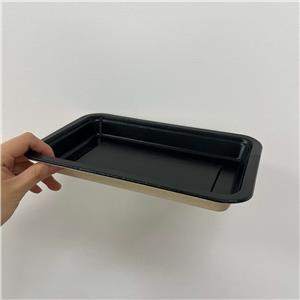
Coated bagasse trays combine a molded bagasse base with an inner film or coating. Depending on the intended application, the lining may use materials such as PP, PET, CPET, PLA, or other selected structures.
These trays can be considered for ready-meal projects that require a particular combination of tray shape, moisture resistance, heat sealing, or barrier performance.
However, a coated bagasse tray is not automatically compostable or plastic-free. Its suitability depends on the complete material structure, product specifications, and verified performance.
When sourcing these trays, buyers should confirm:
- The tray and lining materials.
- The required storage and temperature conditions.
- Sealing method and equipment compatibility.
- Required barrier and leak-resistance performance.
- Available product tests and certifications.
- The intended end-of-life route.
For buyers developing a new ready-meal product, evaluating the tray, sealing film, and sealing equipment together can help avoid compatibility problems and unnecessary packaging changes.
7. Work with Suppliers That Can Support Your Packaging Project
A sustainable packaging strategy depends on more than selecting a material. Product consistency, technical support, customization, and supply reliability also matter.
For wholesalers, distributors, and food manufacturers, a capable supplier should understand the application before recommending a solution.
Before placing an order, ask:
- Can the supplier recommend packaging based on your food type and storage conditions?
- Can it provide samples for practical testing?
- Are the material specifications and product dimensions clearly documented?
- Can it support custom shapes, sizes, compartments, or branding where required?
- Can it provide relevant test reports or certifications for environmental claims?
- Can it maintain consistent quality and supply for repeat orders?
For custom projects, discuss minimum order quantities, tooling costs, sample lead times, production lead times, and packaging specifications before confirming the design.
A supplier that helps you match packaging to the actual application can make the purchasing process more efficient and reduce the risk of choosing a product that does not meet your requirements.
8. Measure Results and Improve Over Time
Sustainability improvements are easier to manage when businesses track their results.
Instead of relying only on general claims such as eco-friendly packaging, establish practical measures that can be compared before and after a packaging change.
Useful metrics include:
- Packaging weight per product or meal.
- Packaging cost per unit.
- Product damage and leakage rates.
- Food spoilage and waste rates.
- Percentage of packaging accepted by local recovery programs.
- Shipping volume and pallet utilization.
- Customer and distributor feedback.
A packaging change that reduces material weight but increases product damage may not deliver the intended benefit. Likewise, a compostable package may not provide its intended end-of-life benefit if local facilities do not accept it.
Review results with suppliers and operational teams, then adjust packaging specifications based on real performance.
The US EPA provides resources for businesses to track food and packaging waste and identify opportunities for waste prevention. Source: US EPA — Tools for Preventing and Diverting Wasted Food.
How Can Businesses Get Started?
For businesses that want to improve food packaging sustainability, a practical starting point is to review one product category at a time.
Step 1: Define the application. Identify the food, portion size, shelf-life requirements, temperature conditions, and distribution method.
Step 2: Review the current package. Check material use, package dimensions, damage rates, and disposal options.
Step 3: Compare suitable alternatives. Consider material performance, total cost, customization needs, and the local recovery system.
Step 4: Test samples. Confirm that the packaging works with the actual food, filling process, storage conditions, and equipment.
Step 5: Verify claims. Request documentation for material composition, food-contact suitability, and environmental certifications where applicable.
Step 6: Monitor results. Measure packaging use, food protection, customer feedback, and end-of-life outcomes.
This approach helps businesses make informed changes without sacrificing food quality, product safety, or supply reliability.
Explore Sustainable Food Packaging Solutions With Us
Our team at Hebei Mountain Environmental Protection Technology Co., Ltd. provides bagasse food packaging and coated bagasse food tray solutions for business customers, including distributors, wholesalers, food manufacturers, and food service operators.
Different applications require different packaging structures. A takeaway plate, a chilled prepared meal, and a heat-sealed ready-meal tray may have very different performance requirements.
When evaluating a packaging project, buyers can discuss:
- Tray shape, size, and compartment design.
- Intended food and storage conditions.
- Moisture resistance and sealing requirements.
- Suitable material and lining options.
- Custom molds and branding requirements.
- Product specifications and relevant supporting documentation.
For coated bagasse ready-meal trays, the lining should be selected according to the intended application. Environmental claims should be based on the complete package and supported by appropriate evidence.
Looking for a packaging solution for your next food product?
Explore our bagasse food trays, learn about our ready-meal packaging solutions, or visit our customization page to discuss your project.
Contact our team to discuss your product requirements, custom packaging needs, and wholesale supply plans.
Frequently Asked Questions
How can food packaging be more sustainable?
Food packaging can become more sustainable by reducing unnecessary material, selecting appropriate materials, improving food protection, evaluating reusable or recyclable systems, using compostable packaging where suitable infrastructure exists, and measuring real-world results.
What is the most sustainable food packaging material?
There is no single best material for every application. The answer depends on the food, required protection, material quantity, transport, reuse potential, local recycling or composting infrastructure, and the environmental impact of the complete package.
Is sugarcane bagasse a sustainable food packaging material?
Bagasse is a plant-fiber material used to make molded food packaging. It may be a suitable option for selected food service applications, but the environmental performance and disposal options depend on manufacturing, product design, coatings, and local waste management systems.
Is compostable packaging always better than recyclable packaging?
No. Compostable packaging may fit certain organic waste collection systems, while recyclable packaging may be preferable where effective recycling is available. The choice should reflect the complete package and the local collection and processing infrastructure.
Can coated bagasse trays be used for ready meals?
Some coated bagasse trays are designed for ready-meal applications. Buyers should confirm the tray structure, lining material, sealing performance, temperature requirements, and compatibility with their equipment before ordering.
Are coated bagasse trays compostable?
Not automatically. Some trays contain linings or other components that may affect compostability. Buyers should request documentation for the complete finished tray and verify the conditions under which it can be composted.
How can businesses reduce food packaging costs and waste?
Businesses can review package dimensions, remove unnecessary components, reduce material where practical, improve shipping efficiency, and test packaging to prevent leaks or product damage. Tracking both packaging waste and food waste helps identify which changes are most effective.
What should importers and distributors look for in a sustainable packaging supplier?
Look for clear product specifications, application-based recommendations, consistent quality, sample testing, customization support, relevant certifications, transparent material information, and reliable supply for repeat orders.