How to Package My Food Product: A Complete Guide to Food Packaging Materials and Solutions
Introduction: How Do You Choose the Right Food Packaging?
If you are developing a new food product, one of the first questions you will face is: How should I package my food product?
The answer depends on what you sell, how the food will be stored, how far it needs to travel, and how customers will use it. Packaging that works for dry snacks may not be suitable for ready meals, frozen foods, fresh produce, or products containing sauces and oils.
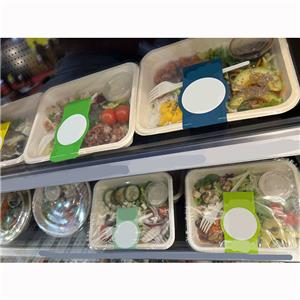
The right food packaging protects the product, supports food safety, communicates your brand, and helps control costs throughout the supply chain. For businesses selling through supermarkets, restaurants, online channels, or food distributors, it can also influence shelf presentation and customer satisfaction.
For importers, wholesalers, and food packaging distributors, understanding these requirements is essential when selecting products for different customers and markets.
In this guide, we explain how to choose food packaging materials, evaluate performance requirements, and develop customized packaging. We will also explore how bagasse food containers and coated bagasse trays can meet the needs of selected foodservice, retail, and ready-meal applications. For a wider view of how the package itself shapes what shoppers choose, see our guide to how product packaging influences food choices.
1. Start by Understanding Your Food Product
Before choosing a container, identify the characteristics of the food itself. This is the most important step because different foods place different demands on their packaging.
What Type of Food Are You Packaging?
| Food product | Key packaging requirements |
|---|---|
| Dry snacks and bakery products | Protection from handling damage and, where required, moisture or oxygen |
| Fresh fruit and vegetables | Suitable ventilation, protection from crushing, and appropriate moisture management |
| Hot takeaway meals | Heat tolerance, structural strength, and resistance to food moisture and oil |
| Ready meals | Secure closure, suitable barrier performance, and compatibility with storage and reheating conditions |
| Sauces and liquid foods | Reliable leak control and compatible closures |
| Frozen meals | Low-temperature performance and resistance to cracking or deformation |
| Meat, seafood, and prepared foods | Appropriate food-contact materials, hygiene, and application-specific barrier requirements |
These are starting points rather than universal specifications. The correct packaging depends on the food formulation, shelf-life target, distribution environment, and applicable food safety requirements.
For example, a tray for a chilled pasta meal may need to resist oil and moisture while supporting heat sealing. A package for dry biscuits may place greater emphasis on moisture protection and preventing breakage.
Practical tip: Write down your product's ingredients, moisture and oil content, storage temperature, expected shelf life, portion size, and distribution method before contacting packaging suppliers.
This information will help manufacturers recommend a suitable package rather than simply offering a standard container.
2. Choose the Right Food Packaging Material
Once you understand your product requirements, compare the available packaging materials.
There is no single material that is best for every food product. The right choice balances performance, price, appearance, supply reliability, and end-of-life considerations.
Plastic Food Packaging
Plastic remains widely used in food packaging because it can offer a combination of low weight, durability, moisture resistance, and design flexibility.
Different plastic materials serve different purposes:
- PP (polypropylene): Used in many food containers and trays, including products designed for certain hot-fill or reheating applications.
- PET (polyethylene terephthalate): Commonly used in food trays and containers where clarity, rigidity, or particular barrier properties are needed.
- CPET (crystallized PET): Used in certain ready-meal trays designed for specified temperature conditions.
- PLA (polylactic acid): A plant-derived polymer used in selected packaging applications. Its heat resistance and end-of-life characteristics depend on the product formulation and processing.
- EVOH-based structures: Used as a barrier layer in suitable multilayer packaging to reduce the transmission of certain gases.
- PBAT-based materials: Used in selected flexible films and other formulations, including some designed for biodegradability or compostability under specified conditions.
These materials are not interchangeable. Their suitability depends on the finished package, food-contact requirements, temperature conditions, and intended disposal route.
For buyers sourcing trays and lidding films, compatibility between the tray material, film structure, sealing process, and food product is particularly important, and the criteria are set out in our guide to choosing the right film for a bagasse food tray.
Paperboard Food Packaging
Paperboard is used for cartons, bakery boxes, takeaway boxes, sleeves, and other food packaging formats.
It can provide good printability and a familiar paper-based appearance. However, resistance to grease, moisture, and liquids depends on the board construction and any coatings or liners.
If you are packaging wet or oily food, ask whether the specific paperboard product has been designed and tested for that application.
Bagasse Food Packaging
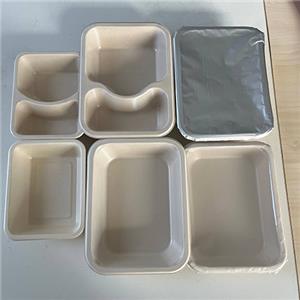
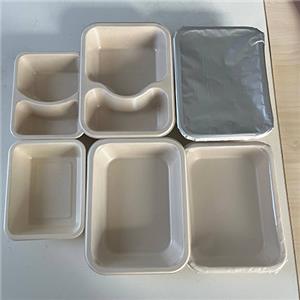
Bagasse is the fibrous residue left after sugarcane juice is extracted. It can be processed into molded fiber products, including plates, bowls, takeaway containers, and food trays.
Bagasse packaging offers a plant-based alternative to conventional plastic containers in many foodservice applications.
Potential benefits include:
- A renewable plant-based raw material.
- A natural molded-fiber appearance.
- Different shapes, sizes, and compartment configurations.
- Options for products intended for composting, subject to the finished product's composition and relevant requirements.
Traditional uncoated bagasse containers can work well for many takeaway and foodservice uses. For products containing substantial oil or moisture, however, buyers should evaluate whether additional barrier protection is necessary.
This is where coated bagasse trays become an important option.
3. When Should You Consider Coated Bagasse Food Trays?
Some food products need more than a molded fiber container. Ready meals, prepared foods, and products containing sauces may require improved resistance to oil and moisture, as well as a package that can be sealed for storage and distribution.
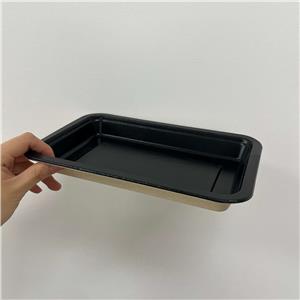
Coated bagasse trays combine a molded sugarcane fiber base with a functional inner film.
At Hebei Mountain Environmental Protection Technology Co., Ltd., we manufacture bagasse food packaging, including coated trays for selected food packaging applications.
Depending on the required product specification, film options may include PP, PET, CPET, PLA, EVOH-based structures, and PBAT-based options.
The right material depends on the application rather than the material name alone.
Benefits of Coated Bagasse Packaging
Improved resistance to oil and moisture
A suitable inner film can help protect the molded fiber base from food liquids and grease. This is useful for selected ready meals, prepared dishes, and other foods with demanding moisture requirements.
Heat-sealing options
Compatible tray and lidding-film combinations can be designed for heat sealing. This can help food manufacturers create consistent packages for retail distribution, and the test method is described in our article on whether bagasse trays can be heat sealed.
Different temperature requirements
Some tray and film combinations can be designed for chilled or frozen food applications, while others may be suitable for microwave reheating. Each intended use must be confirmed against the specific product specification and test results.
Flexible design
Tray dimensions, depths, and compartment layouts can be developed to suit portion sizes, food presentation, and packaging equipment.
Options for commercial food production
For food manufacturers, a suitable coated tray may fit into a packaging system that includes filling equipment, lidding film, heat-sealing machines, labeling, and secondary packaging.
It is important to clarify that a coated bagasse tray is not automatically fully compostable simply because its base is made from sugarcane fiber. Where the inner film contains plastic, the complete package must be evaluated before making compostability claims.
Similarly, heat-sealing capability does not automatically mean a tray is suitable for microwave use, oven heating, or modified atmosphere packaging (MAP).
For wholesale buyers, clear product specifications help prevent application errors and support accurate claims to end customers.
4. Design Packaging Around Storage and Shelf Life
Food packaging must protect the product for the period between production and consumption.
However, packaging alone does not determine shelf life. Ingredients, processing, hygiene, storage temperature, and the distribution environment also matter.
When developing your package, consider the following factors.
Moisture Protection
Some products need to retain moisture, while others need protection from external humidity.
A fresh prepared meal may require resistance to liquid penetration. Dry snacks may need a moisture barrier to preserve texture.
The required level of protection should be based on the food and its storage conditions.
Oxygen and Gas Barriers
Oxygen can affect the quality of certain foods, including products that are sensitive to oxidation.
For selected prepared foods, barrier films and modified atmosphere packaging may help manage the internal package environment. These solutions require appropriate materials, validated packaging processes, and food safety controls.
If you are developing a MAP-ready tray, ask your supplier for data on the complete package structure, including the tray, lidding film, sealing conditions, and relevant gas-barrier performance.
Temperature Resistance
Determine whether the food will be stored at room temperature, chilled, frozen, or reheated by the end user.
Do not assume that a package suitable for hot filling is also suitable for freezing or microwave reheating. The entire package must meet the intended conditions.
Physical Protection
Packaging must also withstand handling, stacking, transport, and storage.
A tray that deforms under the weight of stacked products can affect presentation and may cause problems in automated production or distribution.
For distributors, evaluating these requirements before purchasing helps ensure that the selected packaging is suitable for the customer's actual product.
5. Decide Whether You Need Standard or Custom Food Packaging
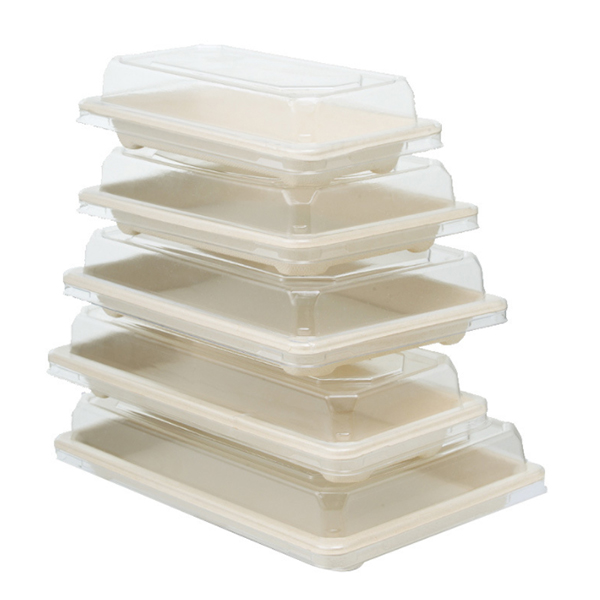
Not every food product requires a custom mold. Standard packaging can be a practical choice when the available dimensions and performance meet your needs.
However, customized packaging may be worthwhile when you need a specific appearance, portion size, compartment layout, or fit with existing production equipment.
When Standard Packaging Makes Sense
Choose a standard package when:
- You want to launch a product quickly.
- Your product fits an existing container size.
- Your initial order volume does not justify new tooling.
- You want to test market demand before investing in customization.
When Custom Packaging May Be Better
Consider custom packaging when:
- Your product has an unusual shape or portion size.
- You need multiple compartments.
- Your packaging must fit a particular filling or sealing line.
- You want a distinctive presentation for your own brand.
- Your business needs a repeatable packaging format for large-volume production.
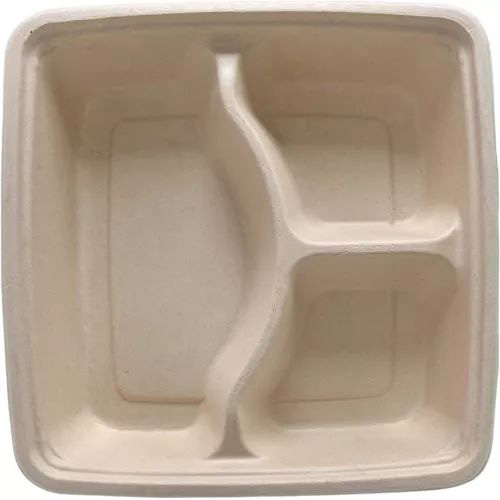
At Hebei Mountain Environmental Protection Technology Co., Ltd., we support OEM/ODM product development and custom molded-fiber packaging projects.
Depending on the project, the process may include reviewing a drawing or existing sample, confirming dimensions and material requirements, developing a mold, producing samples, and testing the package for its intended application.
For distributors and wholesalers, this creates an opportunity to develop differentiated products rather than competing only on the price of standard containers.
6. Consider Food Safety and Packaging Compliance
Food-contact safety should be a basic requirement when selecting a packaging supplier.
Before placing an order, identify the regulations that apply in your destination market and the type of food contact involved.
Ask your manufacturer about:
- Applicable food-contact declarations and test reports.
- Material composition and relevant specifications.
- Intended food types and contact conditions.
- Temperature limits and restrictions.
- Environmental certifications, where relevant.
- Traceability and quality-control procedures.
Requirements can differ between countries and regions. A document issued for one market does not automatically establish compliance in another.
Environmental claims also require care. Terms such as compostable, biodegradable, and recyclable have different meanings and may be subject to specific rules.
If your packaging contains a molded bagasse base with a plastic liner, assess the complete product rather than making claims based only on the base material.
For international distributors, accurate documentation helps reduce sourcing risks and makes it easier to provide reliable information to customers. The documents we make available on request are listed in our certification and test report section.
7. Calculate the Total Cost of Your Food Packaging
The cheapest container is not always the most economical choice.
Packaging cost includes more than the price of each unit. You should also consider transportation, storage, waste, production efficiency, and the risk of damaged products.
Here are several factors to compare:
| Cost factor | Questions to ask |
|---|---|
| Unit price | How does the price change with order volume? |
| Shipping | How many units fit in a carton and shipping container? |
| Storage | Can the containers be nested efficiently? |
| Production | Does the package work with existing filling and sealing equipment? |
| Product protection | Could leaks, deformation, or damage create additional costs? |
| Customization | Are there mold, tooling, or sample-development charges? |
| Supply reliability | Can the supplier meet repeat-order requirements? |
For coated bagasse trays, include the tray, lidding film, and any required sealing equipment when evaluating the complete packaging solution.
A slightly more expensive package may be commercially preferable if it meets the required performance and works efficiently with the production process.
For wholesalers, comparing the total cost of a suitable packaging system provides a better basis for purchasing decisions than comparing unit prices alone.
8. How to Find a Reliable Food Packaging Manufacturer
If you are an importer, distributor, wholesaler, or food brand, your packaging supplier can directly affect product quality and supply continuity.
A reliable manufacturer should be able to explain which products are suitable for your application, provide relevant specifications, and support product evaluation before large-scale orders.
Before choosing a supplier, consider these questions:
- Does the manufacturer produce the packaging format you need?
- Can it offer both standard products and custom designs?
- Can it explain the differences between available film materials?
- Does it provide samples and support application testing?
- Can it supply the required food-contact documentation?
- Are production capacity and lead times suitable for your business?
- Can it support repeat orders and export requirements?
Why Work with Hebei Mountain Environmental Protection Technology Co., Ltd.?
We focus on bagasse food packaging, including molded fiber plates, bowls, takeaway containers, and coated trays for selected ready-meal applications.
Our capabilities include an in-house mold library, customized product development, and OEM/ODM support. We work with business customers to identify suitable packaging structures based on their food products, dimensions, barrier needs, sealing requirements, and target markets.
Our manufacturing operations in China and Cambodia also give buyers options to discuss production location and supply-chain planning.
For distributors and wholesalers, our goal is to help develop packaging products that fit the application, meet the agreed specification, and support long-term commercial supply.
Whether you need standard molded bagasse containers or coated trays for prepared foods, the first step is to define the product requirements and evaluate samples before confirming a bulk order.
9. A Step-by-Step Checklist for Packaging Your Food Product
If you are starting a new packaging project, use this checklist to organize the process.
Step 1: Define the product. Record its ingredients, portion size, moisture and oil content, and intended use.
Step 2: Confirm storage conditions. Decide whether the food will be stored at ambient temperature, chilled, frozen, or reheated.
Step 3: Identify protection requirements. Determine whether you need leak resistance, moisture protection, gas barriers, structural strength, or tamper evidence.
Step 4: Choose a material. Compare plastic, paperboard, molded bagasse, and coated bagasse based on performance, cost, and disposal requirements.
Step 5: Select the package format. Choose the size, shape, lid, compartment layout, and sealing method.
Step 6: Request samples. Test the package with the actual food and expected handling conditions.
Step 7: Confirm compliance. Obtain relevant food-contact documentation and verify any environmental claims.
Step 8: Evaluate the total cost. Include packaging materials, shipping, storage, tooling, and production requirements.
Step 9: Confirm the specification. Agree on dimensions, material structure, quality requirements, order quantities, and lead times.
Following these steps can make packaging development more organized and reduce the risk of selecting a container that does not meet the product's requirements.
Conclusion: Choose Food Packaging That Fits Your Product and Market
So, how should you package your food product?
Start with the food itself, then work backward through its storage conditions, protection requirements, packaging format, material choice, compliance needs, and total cost.
Plastic and paperboard can be suitable for many applications, while molded bagasse provides a plant-based option for selected foodservice and takeaway uses. When additional resistance to oil or moisture and heat-sealing functionality are required, coated bagasse trays may offer another solution.
For food packaging distributors and wholesalers, understanding these differences helps you recommend products that fit customers' real needs and build a more competitive packaging range.
Frequently Asked Questions
1. How do I choose the right packaging for my food product?
Start by identifying the food type, ingredients, moisture and oil content, storage temperature, shelf-life requirements, and distribution method. Then compare packaging materials and formats based on food protection, compliance, cost, and usability.
2. What is the best material for food packaging?
There is no single best material for every product. Plastic, paperboard, molded bagasse, and coated bagasse each have different properties. The right choice depends on the food, packaging performance requirements, cost, and available disposal options.
3. Is bagasse food packaging suitable for commercial food products?
Yes. Bagasse containers are used in many foodservice and takeaway applications. Buyers should confirm the specific product's food-contact suitability, structural performance, and compatibility with the intended food and storage conditions.
4. What is a coated bagasse tray?
A coated bagasse tray consists of a molded sugarcane fiber base with a functional inner film. Depending on the film and product design, it can offer improved resistance to oil and moisture and may be designed for heat-sealed food packaging.
5. Can coated bagasse trays be used for ready meals?
Some coated bagasse trays can be developed for ready-meal applications, including selected chilled or frozen products. Suitability depends on the tray, film, storage temperature, sealing process, and any reheating requirements.
6. Are coated bagasse trays compostable?
Not necessarily. Compostability depends on the complete package, including the bagasse base, inner film, and other components, as well as the relevant certification and composting conditions. A plastic-lined tray should not automatically be described as fully compostable.
7. Can I customize food packaging for my own brand?
Many manufacturers offer OEM/ODM services, including custom dimensions, shapes, compartments, and other design features. Customization may require tooling and sample development, so buyers should confirm the cost, minimum order quantity, and lead time.
8. What should I ask a food packaging manufacturer before ordering?
Ask about material specifications, food-contact documentation, sample testing, customization, tooling costs, minimum order quantities, production lead times, quality control, and export experience. For coated trays, also confirm film compatibility, sealing performance, and temperature limitations.
Looking for a bagasse food packaging manufacturer for your business?
Hebei Mountain Environmental Protection Technology Co., Ltd. supplies molded bagasse food packaging and coated tray solutions for business customers.
Contact our team to discuss your product specifications, explore standard or customized packaging options, and request samples for evaluation.
We welcome inquiries from importers, distributors, wholesalers, supermarket suppliers, and food brands looking for a manufacturing partner for their food packaging projects.