Can Bagasse Trays Be Heat Sealed? A Complete Guide to Heat-Sealable Bagasse Food Packaging
Can bagasse trays be heat sealed?
Yes — specially designed coated or laminated bagasse trays can be heat sealed.
But there is an important difference between a standard molded bagasse tray and a heat-sealable bagasse food tray.
A conventional molded fiber tray is mainly designed to hold and present food.
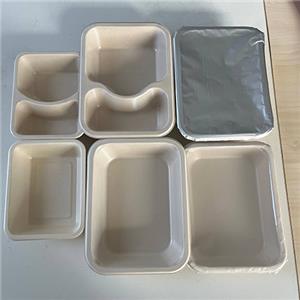
A heat-sealable bagasse tray is designed as part of a complete packaging system. It combines molded bagasse fib
This makes heat-sealable bagasse trays suitable for applications such as:
- Ready meals
- Frozen meals
- Chilled prepared foods
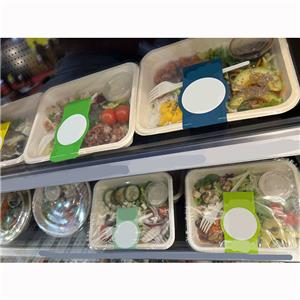
- Supermarket food
- Fresh food
- Foodservice
- MAP packaging
- VSP packaging
- Custom food packaging
In this guide, we explain how heat sealing works, what film options are available, how to select the right tray, and what food manufacturers should test before mass production.
What Is a Heat-Sealable Bagasse Tray?
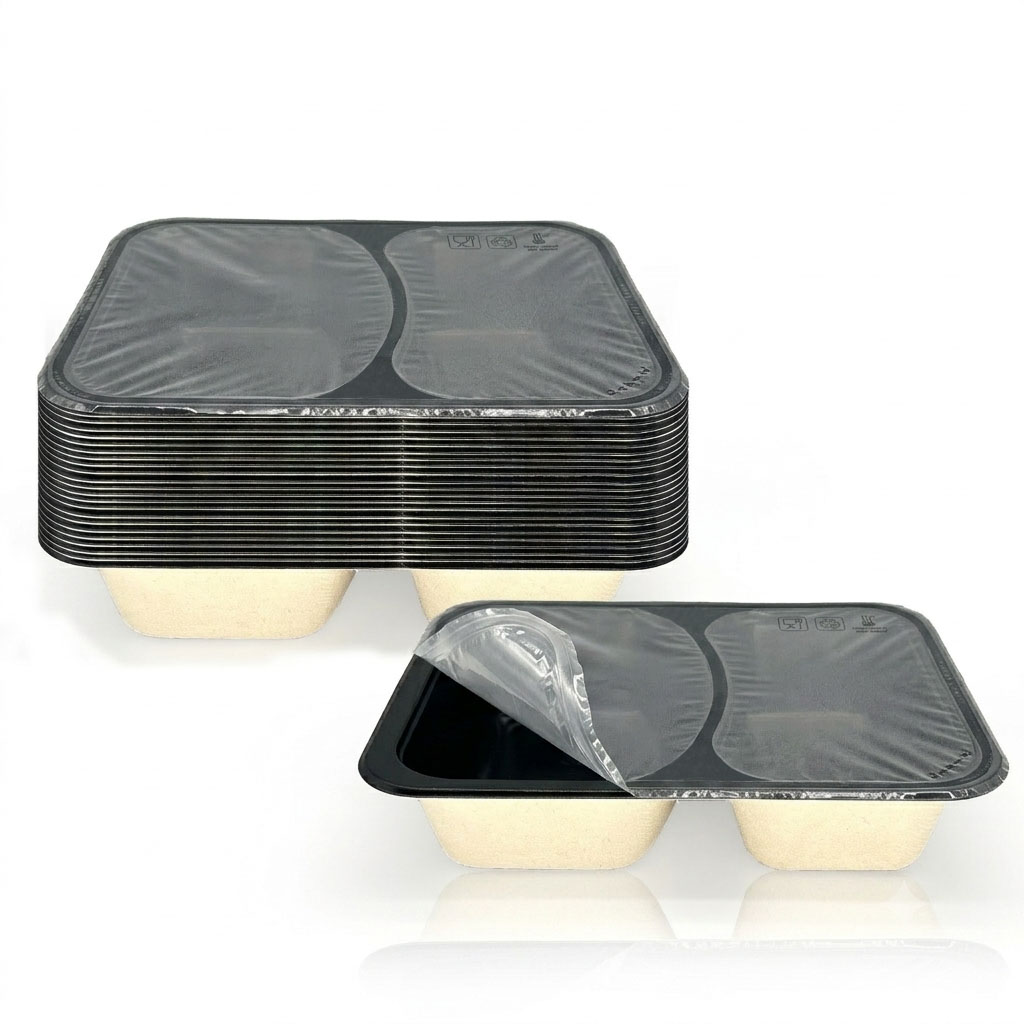
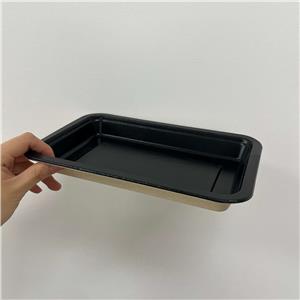
A heat-sealable bagasse tray is a molded sugarcane fiber tray with a functional film or coating designed to create a seal with a compatible lidding film.
The basic structure is:
- Molded bagasse fiber
- Functional film
- Lidding film
The molded fiber provides the main structure of the tray.
The functional film provides the surface required for specific packaging performance, including heat sealing.
The lidding film closes the package.
When the compatible surfaces are heated under controlled pressure for a defined period, they form a seal.
This allows molded bagasse packaging to be used in applications where a sealed package is required.
Can Untreated Bagasse Be Heat Sealed?
Generally, untreated molded bagasse fiber should not be considered equivalent to a purpose-designed heat-sealable tray.
The fiber itself is not normally the sealing layer used in a commercial heat-sealing system.
For heat-sealable applications, a suitable film or coating is normally incorporated into the tray structure.
This distinction is important when purchasing bagasse food packaging.
A supplier may offer a molded bagasse tray, but that does not automatically mean the tray is suitable for heat sealing.
When contacting a manufacturer, specifically ask for:
Heat-sealable bagasse trays with a compatible functional film.
How Does Heat Sealing Work?
The process is relatively simple in principle.
A typical process looks like this:
Step 1 — Fill the Tray
The food is placed into the molded bagasse tray.
Step 2 — Position the Lidding Film
A compatible lidding film is placed over the tray.
Step 3 — Apply Heat and Pressure
The sealing tool presses the lidding film against the tray rim while applying controlled heat.
Step 4 — Hold for the Required Time
The sealing surfaces remain under pressure for the required dwell time.
Step 5 — Cool and Release
The sealing tool releases after the seal has formed.
Step 6 — Inspect the Package
The finished package is checked for:
- Seal quality
- Leakage
- Appearance
- Opening behavior
- Tray deformation
- Film adhesion
The exact sealing parameters depend on the tray film, lidding film, machine, and application.
Why Does the Tray Film Matter?
The film is one of the most important parts of a heat-sealable bagasse tray.
Different films have different temperature and sealing characteristics.
Common options include:
- PP
- PET
- CPET
- PLA
- EVOH-enhanced structures
- PBAT-based structures
The choice should depend on the actual application.
For example, a chilled ready meal may have very different requirements from an ovenable frozen meal.
A MAP product may also require higher barrier performance than a short-life foodservice product.
Therefore:
Film selection should follow the packaging requirements.
What Film Can Be Used for Heat-Sealable Bagasse Trays?
PP
PP-based structures can be considered for many chilled and heated food applications.
They can be useful when the customer is familiar with PP packaging and wants a heat-sealable bagasse tray based on a PP-compatible structure.
Typical applications may include:
- Ready meals
- Prepared foods
- Chilled food
- Foodservice
- Supermarket products
The actual temperature and sealing range should be confirmed for the specific tray construction.
PET
PET-based structures can be considered when PET-related packaging characteristics are required.
PET may be suitable for selected:
- Food trays
- Prepared foods
- Chilled meals
- Fresh food applications
As with other films, the final sealing performance depends on the complete tray and lidding system.
CPET
CPET is particularly relevant to higher-temperature food applications.
It can be considered for selected:
- Ovenable meals
- Microwave meals
- Frozen ready meals
- Heat-intensive prepared foods
If a customer currently uses a CPET plastic tray, a CPET-based functional film can be evaluated as part of a molded bagasse replacement project.
The actual temperature capability must be verified for the specific tray and film structure.
PLA
PLA-based film can be considered for compostable-oriented packaging applications.
It may be relevant for:
- Compostable food packaging
- Chilled foods
- Selected ready meals
- Foodservice packaging
However, PLA should not be selected simply because it is bio-based.
The actual application temperature, sealing conditions, compostability requirements, and final certification requirements should all be considered.
EVOH-Enhanced Structures
EVOH is primarily used to improve oxygen barrier performance in multilayer packaging structures.
This makes it particularly relevant to selected MAP applications.
For example:
Bagasse tray + EVOH-enhanced barrier structure + MAP lidding film
may be considered when oxygen transmission needs to be controlled more tightly.
EVOH is therefore not simply another general-purpose sealing film.
It is mainly relevant when barrier requirements justify the additional structure.
PBAT-Based Structures
PBAT-based films can be considered for selected compostable packaging projects.
They may be used where a flexible compostable film structure is required.
The final package should be evaluated according to the intended application and applicable compostability requirements.
Does the Lidding Film Need to Match the Tray?
Yes.
The tray and lidding film should be considered as a pair.
A heat-sealable bagasse tray does not mean that any lidding film can be used.
The two sealing surfaces need to be compatible.
The packaging system may include:
Bagasse tray → Functional film → Compatible lidding film → Heat sealing
If the materials are not properly matched, problems may include:
- Weak seals
- Inconsistent sealing
- Film peeling
- Leakage
- Excessive sealing temperature
- Tray deformation
- Difficulty opening the package
This is why it is useful to test the actual tray and lidding film together.
What Sealing Parameters Should Be Checked?
Heat sealing normally depends on three main parameters:
Temperature
The sealing surface needs to reach an appropriate temperature to create the required bond.
Pressure
The sealing tool needs to apply sufficient and consistent pressure.
Dwell Time
The sealing surfaces need to remain under heat and pressure for the required period.
These three factors are often discussed together as:
Temperature + Pressure + Time
However, several other factors can also affect sealing performance.
These include:
- Tray rim geometry
- Film thickness
- Lidding film structure
- Machine tooling
- Tray flatness
- Food contamination
- Production speed
- Cooling conditions
This is why there is no single universal “bagasse tray sealing temperature.”
The correct parameters must be established for the specific tray and sealing system.
Why Is the Tray Rim So Important?
The sealing process takes place around the tray rim.
If the rim is poorly designed, even a suitable film may not produce a reliable seal.
A commercial heat-sealable tray should therefore have a sealing area designed around:
- Lidding film
- Sealing tool
- Tray dimensions
- Required seal width
- Production speed
- Packaging method
The rim also needs sufficient structural stability to withstand the pressure applied by the sealing machine.
For custom trays, rim design should be considered during mold development rather than added as an afterthought.
Can Heat-Sealable Bagasse Trays Be Used for Ready Meals?

Yes.
Ready meals are one of the key applications for heat-sealable bagasse trays.
A typical structure may be:
- Bagasse tray
- Functional film
- Food
- Lidding film
- Heat sealing
The exact material structure depends on the product.
For example:
Chilled Ready Meal
A PP, PET, or suitable PLA-based structure may be considered.
Frozen Ready Meal
The film needs to maintain performance under the intended freezing and storage conditions.
Ovenable Ready Meal
A suitable high-temperature structure, such as a CPET-based option, may be evaluated.
MAP Ready Meal
A higher-barrier structure may be considered, including an EVOH-enhanced option when required.
The final package should be tested using the actual food and processing conditions.
Can Bagasse Trays Be Heat Sealed for MAP?
Yes, specially designed bagasse trays can be developed for selected MAP applications.
MAP adds another layer of technical requirements.
The packaging system needs to maintain the desired atmosphere after sealing.
This means the tray and lidding film need to provide appropriate:
- Seal integrity
- Gas retention
- Oxygen barrier
- Moisture control
- Tray strength
For applications with higher oxygen-barrier requirements, an EVOH-enhanced structure can be evaluated.
But MAP performance should not be assumed based only on the film name.
Actual packaging tests are required.
Can Bagasse Trays Be Used for VSP?
Selected heat-sealable bagasse trays can also be designed for VSP.
Vacuum Skin Packaging applies vacuum and forms a film closely around the food.
This requires careful control of:
- Tray geometry
- Tray strength
- Rim structure
- Functional film
- Lidding film
- Vacuum conditions
VSP should be tested using the actual machine and product because the food shape and packaging process can affect the final package.
Can a Heat-Sealable Bagasse Tray Be Used in a Microwave?
Selected structures can be developed for microwave applications.
But microwave suitability depends on the complete packaging system.
The test should consider:
- Microwave power
- Heating time
- Food weight
- Food moisture
- Food oil content
- Tray material
- Functional film
- Lidding film
A tray designed for chilled food should not automatically be used for microwave heating.
If microwave heating is required, it should be included in the original material selection and testing process.
Can a Heat-Sealable Bagasse Tray Be Used in an Oven?
Some bagasse tray structures can be developed for higher-temperature applications.
For these projects, temperature performance becomes especially important.
The manufacturer should know:
- Maximum oven temperature
- Heating duration
- Food weight
- Food composition
- Tray dimensions
- Lidding structure
- Cooling conditions
CPET-based functional structures may be considered for applications requiring higher temperature performance.
The final package must be tested under the actual oven conditions before commercial use.
What About Frozen Food?
Frozen food creates two separate challenges:
Low-temperature storage
and
Potential high-temperature reheating
A frozen ready meal may remain below freezing for an extended period and then be heated directly by the consumer.
The tray therefore needs to perform across the complete temperature cycle.
Testing should include:
Freezing → Storage → Transportation → Heating
The film and seal also need to remain reliable during the transition between temperatures.
How Do You Test a Heat-Sealable Bagasse Tray?
Before mass production, we recommend testing the complete packaging system.
1. Visual Inspection
Check:
- Tray shape
- Rim flatness
- Film coverage
- Surface defects
- Sealing appearance
2. Seal Strength Test
Check whether the seal provides sufficient strength for the intended application.
3. Leak Test
Fill the package with the actual food or a suitable test medium and evaluate whether leakage occurs.
4. Temperature Test
Evaluate the package under the required:
- Refrigeration
- Freezing
- Microwave
- Oven
conditions.
5. Stacking Test
Check whether filled packages can withstand the expected stacking conditions.
6. Transportation Test
Evaluate the package under realistic handling and transportation conditions.
7. Production-Line Test
Run the tray through the customer's actual sealing machine.
This final step is particularly important.
A tray that works in a laboratory environment may require adjustments when running at commercial production speed.
What Can Cause a Poor Heat Seal?
Several problems can affect sealing quality.
Incorrect Temperature
If the temperature is too low, the sealing surfaces may not bond sufficiently.
If it is too high, the film or tray may be damaged.
Incorrect Pressure
Insufficient pressure can result in incomplete contact.
Excessive pressure may deform the tray rim.
Incorrect Dwell Time
Too little time may result in incomplete sealing.
Too much time may reduce production efficiency or damage the package.
Food on the Sealing Area
Sauce, oil, or food particles on the rim can interfere with sealing.
This is a common practical issue in ready meal production.
Incompatible Lidding Film
The lidding film must be compatible with the tray's sealing layer.
Poor Rim Design
An unstable or uneven rim can make consistent sealing difficult.
Machine Tooling
The sealing tooling needs to match the tray dimensions and rim structure.
How Can Manufacturers Improve Sealing Consistency?
For commercial production, consistency is more important than achieving one successful seal.
Manufacturers should control:
- Tray dimensions
- Rim geometry
- Film thickness
- Film application
- Sealing temperature
- Sealing pressure
- Dwell time
- Machine tooling
- Filling accuracy
- Cleanliness of the sealing area
Regular quality checks should also be performed during production.
This helps identify changes before they result in large quantities of defective packages.
Can You Use an Existing Plastic Tray as the Reference?
Yes.
This is one of the most useful approaches for customers replacing existing plastic packaging.
For example, a food manufacturer may currently use:
CPET tray + lidding film + heat sealing
The new project can be developed as:
Bagasse tray + functional film + compatible lidding film + heat sealing
The existing plastic tray can provide information about:
- Dimensions
- Tray depth
- Compartment layout
- Filling volume
- Rim design
- Sealing area
- Stacking requirements
A custom bagasse mold can then be developed around the required packaging format.
Can the Existing Sealing Machine Still Be Used?
In many projects, an existing sealing machine can be used, provided the new tray and tooling are compatible.
Before making a decision, check:
- Tray dimensions
- Tooling
- Sealing area
- Sealing temperature
- Pressure
- Dwell time
- Production speed
- Lidding film
A production-line trial should be performed before final approval.
If the customer does not have suitable equipment, a supplier may provide a complete system including:
Tray + lidding film + sealing machine
For MAP or VSP projects, specialized equipment can also be considered.
What Is a One-Stop Heat Seal Packaging Solution?
A heat-sealable tray is only one part of the complete packaging process.
For a commercial food manufacturer, a complete project may include:
1. Bagasse Tray
The molded fiber tray provides the basic structure.
2. Functional Film
The film provides the required sealing and application-specific performance.
3. Lidding Film
The lidding film closes the package.
4. Custom Mold
The mold creates the required tray shape.
5. Sealing Machine
The machine applies the required heat and pressure.
6. MAP or VSP Equipment
Specialized equipment can be included when required.
7. Labels or Printing
Branding and product information can be added according to the project.
This is why food manufacturers often benefit from working with a supplier that understands the entire packaging process.
How Much Does a Heat-Sealable Bagasse Tray Cost?
There is no single standard price.
The cost depends on factors such as:
- Tray size
- Tray depth
- Number of compartments
- Film type
- Film thickness
- Order quantity
- Custom mold
- Printing or labeling
- Packaging requirements
- Delivery destination
A standard molded fiber tray and a custom MAP-ready tray with a high-barrier film structure can have very different costs.
For B2B buyers, the most useful approach is to request a quotation based on the actual specification.
What Information Should You Send for a Quote?
To receive a more accurate quotation, provide:
Product Information
- Food type
- Filling weight
- Food dimensions
Tray Information
- Existing tray sample
- Length
- Width
- Height
- Number of compartments
Temperature
- Chilled
- Frozen
- Microwave
- Oven
Packaging Method
- Heat sealing
- MAP
- VSP
Equipment
- Existing sealing machine
- Existing tooling
- Production speed
Film
- Current lidding film
- Required functional film
- Compostability requirements, if applicable
Quantity
- Trial order quantity
- Monthly volume
- Annual volume
The more complete the information, the easier it is to recommend a suitable tray structure.
How to Choose a Heat-Sealable Bagasse Tray Manufacturer
Not every molded fiber supplier specializes in heat-sealable food packaging.
Before placing an order, ask:
- 1. Do you manufacture heat-sealable bagasse trays?
- 2. Which functional films can you provide?
- 3. Can you match our existing plastic tray?
- 4. Can you develop a custom mold?
- 5. Can you provide samples?
- 6. Can you test the tray on our sealing machine?
- 7. Can you provide compatible lidding film?
- 8. Can you support MAP?
- 9. Can you support VSP?
- 10. Can you provide sealing equipment?
- 11. Can you provide relevant testing and compliance documentation?
- 12. Can you support regular mass production?
A supplier's ability to provide a complete solution can be particularly important for food manufacturers starting a new packaging conversion project.
Heat-Sealable Bagasse Trays From Hebei Mountain
Hebei Mountain Environmental Protection Technology Co., Ltd. specializes in molded bagasse food packaging and heat-sealable coated and laminated food trays.
Our film options include:
- PP
- PET
- CPET
- PLA
- EVOH-enhanced structures
- PBAT-based structures
The appropriate structure can be selected according to the customer's:
- Food type
- Temperature requirements
- Sealing method
- Barrier requirements
- MAP/VSP application
- Existing packaging equipment
We also provide:
- Custom bagasse trays
- Ready meal trays
- 1:1 plastic tray replacement
- Custom mold development
- Lidding films
- Sealing machines
- MAP solutions
- VSP solutions
- OEM and ODM services
Our factory has more than 3,000 existing molds and develops 200+ new molds each year, allowing us to support both standard packaging and customized food packaging projects.
For customers replacing existing PP, PET, or CPET trays, the existing tray or technical drawing can be used as the starting point for a new molded bagasse packaging project.
Heat Sealing Checklist for Food Manufacturers
Before approving a heat-sealable bagasse tray, check the following:
Tray
- ☐ Correct dimensions
- ☐ Correct tray depth
- ☐ Suitable rim design
- ☐ Correct compartment layout
Film
- ☐ Suitable functional film
- ☐ Correct temperature range
- ☐ Appropriate sealing characteristics
- ☐ Required barrier performance
Lidding
- ☐ Compatible with tray film
- ☐ Correct sealing structure
- ☐ Suitable for the food application
Equipment
- ☐ Existing machine compatibility
- ☐ Correct tooling
- ☐ Suitable temperature
- ☐ Suitable pressure
- ☐ Suitable dwell time
Product
- ☐ Actual food tested
- ☐ Storage conditions tested
- ☐ Heating conditions tested
- ☐ Leak performance tested
Production
- ☐ Production-line trial completed
- ☐ Seal consistency confirmed
- ☐ Packaging approved before mass production
Final Thoughts
So, can bagasse trays be heat sealed?
Yes.
But the correct answer is more specific:
Purpose-designed coated or laminated bagasse trays can be heat sealed when the tray film, lidding film, sealing machine, and sealing parameters are properly matched.
The most important factors are:
- Tray structure
- Functional film
- Lidding film
- Temperature
- Pressure
- Dwell time
- Machine
- Food
For simple foodservice applications, a standard molded bagasse tray may be sufficient.
For ready meals, frozen foods, supermarket products, MAP, VSP, or other sealed food packaging, a more carefully engineered tray structure may be required.
The best way to confirm performance is to test the complete package using the actual food and production equipment.
Need a Heat-Sealable Bagasse Tray?
If you are currently using a PP, PET, or CPET tray and want to evaluate a molded bagasse alternative, send us your existing tray, drawing, food information, temperature requirements, and sealing-machine details.
Hebei Mountain can help evaluate the application and develop a suitable heat-sealable bagasse tray, functional film, lidding solution, mold, and sealing system.
Request a sample or contact our packaging team to discuss your project.