Bagasse Tray vs CPET Tray: Can Molded Fiber Replace CPET in Ready Meal Packaging?
CPET trays have been widely used for ready meals, frozen foods, prepared foods, and other applications where packaging needs to handle higher temperatures.
At the same time, food manufacturers and brands are increasingly exploring molded fiber packaging as an alternative to conventional plastic packaging.
This raises an important question:
Can a bagasse tray replace a CPET tray?
In some applications, a molded bagasse tray with a suitable functional film can be developed as an alternative to a conventional CPET tray.
However, the replacement is not simply a matter of changing the material.
The new tray needs to meet the requirements of the food product, heating process, sealing system, storage conditions, packaging line, and distribution environment.
This guide compares bagasse trays and CPET trays and explains what food manufacturers should evaluate before starting a CPET-to-bagasse packaging conversion project.
What Is a CPET Tray?
CPET stands for crystallized polyethylene terephthalate.
It is a type of PET material that is commonly used for food trays requiring higher-temperature performance.
CPET trays are found in applications such as:
- Frozen ready meals
- Microwave meals
- Ovenable meals
- Prepared foods
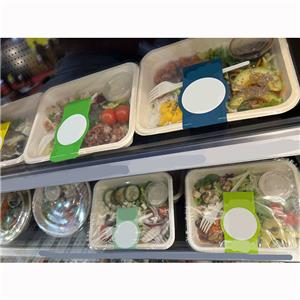
- Supermarket ready meals
- Foodservice products
One reason CPET is popular is that it can provide a combination of rigidity, dimensional stability, and temperature performance.
For food manufacturers, this makes CPET a practical material for products that move from refrigerated or frozen storage into a heating process.
But when a company wants to reduce its reliance on conventional plastic packaging, a different tray structure may need to be evaluated.
This is where coated or laminated bagasse trays can become relevant.
What Is a Bagasse Tray?
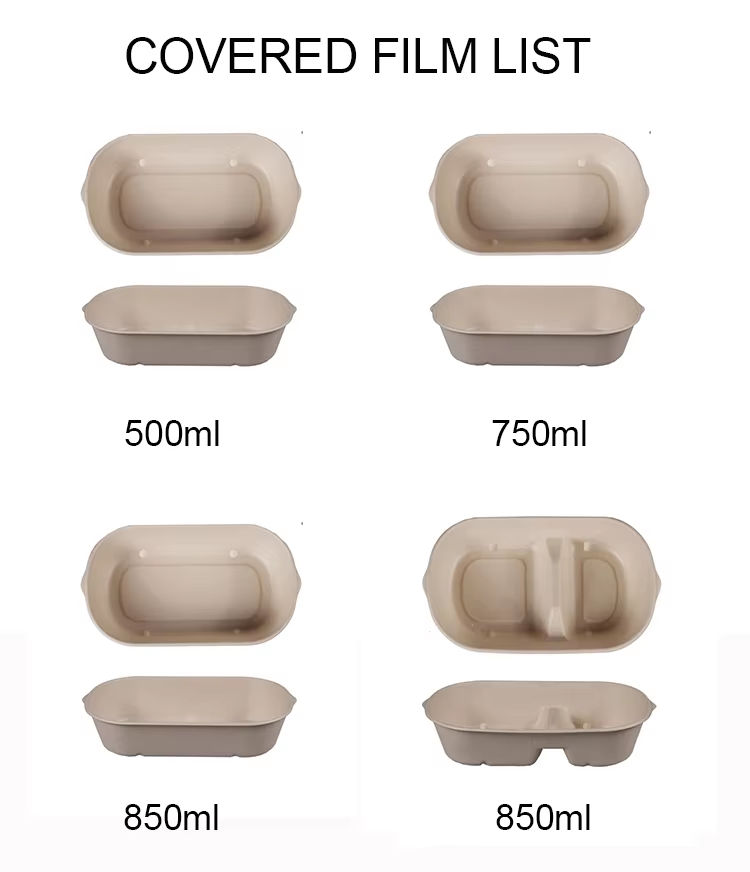
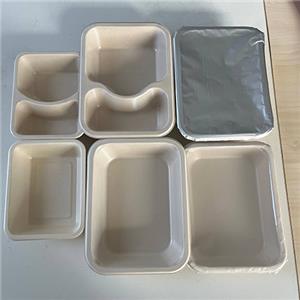
A bagasse tray is made from molded sugarcane fiber.
Bagasse is the fibrous material remaining after sugarcane processing.
The fiber is processed into pulp and molded into food packaging products.
For simple foodservice applications, an untreated molded bagasse tray may be sufficient.
For industrial ready meals, however, additional performance may be required.
A functional film can be added to the tray to provide properties such as:
- Heat sealing
- Moisture resistance
- Oil resistance
- Leak resistance
- Barrier performance
- Temperature-specific performance
The basic structure is:
Molded bagasse fiber + functional film + lidding film
This is different from a conventional CPET tray, which is formed from a plastic resin.
Bagasse Tray vs CPET Tray: Basic Comparison
The two tray structures are fundamentally different.
| Feature | CPET Tray | Coated Bagasse Tray |
|---|---|---|
| Main tray material | Crystallized PET | Molded sugarcane bagasse fiber |
| Tray structure | Plastic | Molded fiber |
| Heat sealing | Depends on compatible sealing structure | Functional film provides sealing surface |
| High-temperature applications | Common | Possible with suitable film structure |
| Frozen applications | Common | Possible with suitable construction |
| MAP | Common | Possible with suitable barrier structure |
| VSP | Common | Possible with suitable tray and film |
| Custom shape | Yes | Yes |
| 1:1 replacement development | Possible | Possible with custom mold |
| Fiber-based structure | No | Yes |
| Film selection | Integrated into plastic structure | Selected according to application |
This comparison shows why a bagasse tray should not be treated as a simple drop-in material replacement.
The complete packaging structure needs to be evaluated.
Can a Bagasse Tray Replace a CPET Tray?
It can be possible for selected applications, but the final suitability needs to be tested.
A successful CPET replacement project normally starts with the existing tray.
The food manufacturer provides:
- Existing CPET tray
- Technical drawing
- Tray dimensions
- Food information
- Storage conditions
- Heating requirements
- Sealing specifications
- Existing packaging equipment
The bagasse tray manufacturer can then evaluate the requirements and develop a suitable molded fiber structure.
This may involve:
Existing CPET tray → Tray analysis → Custom bagasse mold → Film selection → Prototype → Sealing test → Heating test → Production-line test
The goal is to reproduce the required packaging functions rather than simply copy the material.
Why Would a Food Manufacturer Consider Replacing CPET?
There are several reasons why a food company may investigate alternatives to conventional plastic trays.
One is the increasing demand for packaging with more fiber-based or renewable material content.
Another is the need to respond to customer sustainability requirements or packaging strategies.
For some brands, moving from a conventional plastic tray to a molded fiber structure can also create a different packaging appearance.
However, sustainability goals should not be separated from packaging performance.
The new package still needs to:
- Protect the food
- Maintain product quality
- Seal reliably
- Survive transportation
- Handle the required temperature
- Run on the production line
- Meet the applicable food-contact requirements
That is why CPET replacement should be approached as a technical packaging project.
Temperature Is the First Question
The first thing to determine is the actual temperature range of the product.
Consider the complete journey:
Production → Refrigerated Storage → Frozen Storage → Transportation → Consumer Heating
The highest and lowest temperatures can be very different.
For example, a frozen ready meal may experience:
Freezing → Frozen storage → Transportation → Microwave heating
An ovenable meal may experience:
Refrigerated storage → Transportation → Oven heating
These applications can require different tray structures.
A bagasse tray with one film structure should not automatically be assumed to be suitable for every temperature condition.
Can Bagasse Trays Be Used in the Oven?
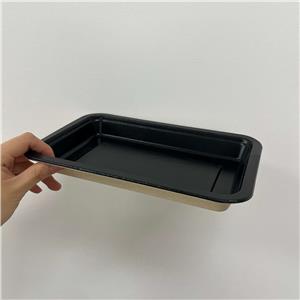
Selected coated bagasse trays can be developed for applications requiring higher-temperature heating.
However, the film structure is critical.
CPET is already widely associated with ovenable food packaging, so replacing CPET requires careful testing.
The manufacturer should evaluate:
- Maximum temperature
- Heating duration
- Food weight
- Food moisture
- Oil content
- Tray dimensions
- Film structure
- Lidding system
- Oven type
For higher-temperature applications, CPET-based functional films can be considered for the bagasse tray structure.
The final temperature performance should always be confirmed through testing of the complete package.
Can Bagasse Trays Be Used in a Microwave?
Selected bagasse tray structures can be developed for microwave-ready meal applications.
Again, the important factor is not simply the word “bagasse.”
The complete package needs to be evaluated.
The test should consider:
- Microwave power
- Heating time
- Food weight
- Food moisture
- Oil content
- Tray structure
- Functional film
- Lidding material
A tray designed for chilled food should not automatically be used for microwave heating.
If microwave use is part of the application, it should be included in the original material and tray design process.
What About Frozen Ready Meals?
Frozen ready meals place different demands on packaging.
The tray may be exposed to low temperatures for an extended period before being heated.
The packaging therefore needs to maintain:
- Structural integrity
- Seal performance
- Dimensional stability
- Resistance to the actual food
- Performance throughout the cold chain
The selected film should be evaluated for the intended low-temperature conditions.
For a CPET replacement project, frozen-storage testing should be part of the qualification process.
Heat Sealing: CPET vs Bagasse
Heat sealing is one of the most important areas to evaluate.
A conventional CPET tray may already be designed around a particular sealing film and machine.
A bagasse tray needs a suitable functional film and sealing surface.
The sealing system can depend on:
- Tray rim design
- Functional film
- Lidding film
- Sealing temperature
- Sealing pressure
- Dwell time
- Machine tooling
- Food contamination
- Production speed
This means a successful replacement should be tested using the actual sealing machine whenever possible.
A tray may seal well during a laboratory test but behave differently at production speed.
Can a Bagasse Tray Work With an Existing Sealing Machine?
In many projects, the answer can be yes, subject to equipment and tray compatibility.
This is one reason 1:1 replacement development is useful.
The existing CPET tray can provide the reference dimensions for:
- Overall length
- Overall width
- Height
- Tray depth
- Rim width
- Corner radius
- Compartment layout
- Sealing area
The new bagasse tray can then be developed around the required dimensions.
However, molded fiber has different material characteristics from CPET.
The tray geometry and tooling may therefore need adjustments even when the final dimensions are similar.
The actual production-line test is the final verification.
Bagasse Tray vs CPET Tray for MAP
Modified Atmosphere Packaging, or MAP, is commonly used for ready meals and other prepared foods.
The package may contain a controlled gas atmosphere designed around the product and shelf-life requirements.
For MAP, the packaging system needs suitable:
- Seal integrity
- Oxygen barrier
- Moisture control
- Tray structure
- Lidding film
A standard molded fiber tray is not automatically equivalent to a CPET tray in barrier performance.
For this reason, a coated or laminated bagasse tray is normally considered for MAP applications.
When higher oxygen-barrier performance is required, an EVOH-enhanced structure can be evaluated.
The actual performance should be confirmed through appropriate packaging and shelf-life testing.
What About VSP?
Vacuum Skin Packaging is another application where tray design matters.
The film forms closely around the food under vacuum.
A bagasse VSP tray therefore needs an appropriate:
- Tray shape
- Rim structure
- Sealing surface
- Structural strength
- Functional film
- Lidding film
A CPET-to-bagasse conversion for VSP should be tested with the actual VSP equipment.
The goal is to confirm that the bagasse tray can withstand the process while maintaining the required appearance and seal integrity.
What About Oil, Water, and Sauces?
Ready meals can contain significant amounts of moisture, oil, or sauce.
This is an important difference between a simple molded fiber food container and a coated bagasse ready meal tray.
For ready meals, the functional film can help provide the required resistance against:
- Water
- Oil
- Sauces
- Food moisture
However, the actual performance depends on the film structure and food conditions.
Testing should use the actual food product whenever possible.
For example, a tray tested with dry food may perform differently when filled with a hot meal containing sauce and oil.
1:1 CPET Tray Replacement
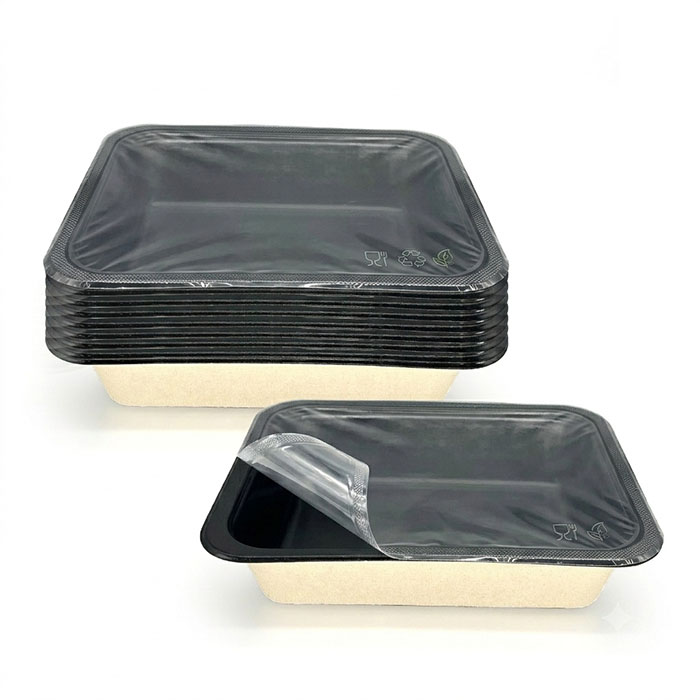
One of the most practical approaches for food manufacturers is to use the existing CPET tray as the starting point.
Instead of asking the customer to redesign its entire packaging system, the manufacturer can evaluate the current tray.
The development process can include:
Existing Tray Analysis
Measure the current tray and review its function.
Mold Development
Develop a custom bagasse mold based on the required dimensions.
Film Selection
Select the appropriate functional film according to temperature, sealing, and barrier requirements.
Prototype Production
Produce samples for initial testing.
Sealing Test
Test the tray with the customer's lidding film and sealing equipment.
Food Test
Test the package using the actual food.
Temperature Test
Evaluate the required storage and heating conditions.
Production-Line Trial
Run the tray on the commercial packaging line.
Final Approval
Confirm the design before mass production.
This process reduces the risk of discovering major compatibility problems after a large order has already been placed.
What About Cost?
Unit price is an important factor in every commercial packaging project.
However, comparing only the tray price can produce a misleading result.
A complete cost evaluation may include:
- Tray unit price
- Lidding film
- Mold cost
- Sealing equipment
- Packaging-line adjustments
- Transportation
- Storage
- Product loss caused by packaging failure
- Testing
- Certification
- Minimum order quantity
For an existing CPET package, the most useful comparison is therefore:
Total packaging cost + production compatibility + required performance
rather than simply:
CPET tray price vs bagasse tray price
The final economics depend on the specific project.
What About Mold Costs?
Custom bagasse trays normally require custom tooling.
The mold needs to reflect the desired:
- Tray dimensions
- Compartments
- Depth
- Rim
- Corner shape
- Stacking structure
- Sealing area
For companies replacing an existing CPET tray, the existing tray or drawing can be used as the design reference.
This can simplify the development process.
For larger packaging programs, the mold investment should be evaluated together with the expected production volume.
Which Tray Is More Suitable for Your Application?
Instead of asking whether bagasse or CPET is universally better, evaluate the requirements of your product.
Choose CPET When:
Your current package already meets the required application and your packaging strategy continues to specify a conventional CPET structure.
Evaluate Bagasse When:
You are looking for a molded fiber alternative and your application can be supported by a suitable functional film structure.
Evaluate a CPET-Film Bagasse Tray When:
You need a molded fiber tray while maintaining a film structure designed for higher-temperature applications.
Evaluate EVOH-Enhanced Bagasse When:
Your application requires higher oxygen-barrier performance, particularly for selected MAP applications.
The final selection should be based on testing rather than material preference alone.
What Should You Send to a Bagasse Tray Manufacturer?
If you want to replace an existing CPET tray, providing detailed information can make the development process much faster.
Send:
1. Existing CPET tray
A physical sample is useful.
2. Technical drawing
If available, include dimensions.
3. Food information
Tell the manufacturer what product will be packaged.
4. Temperature requirements
Include freezing, refrigeration, microwave, and oven conditions where applicable.
5. Sealing information
Provide the sealing machine model and current sealing parameters if available.
6. Lidding film
Provide the current film specification.
7. Packaging method
State whether the package uses standard heat sealing, MAP, VSP, or another process.
8. Target volume
Expected monthly or annual quantity helps determine the appropriate production and tooling approach.
With this information, the supplier can recommend a more appropriate tray and film structure.
What Makes a Good CPET Replacement Project?
A successful project should focus on the entire package.
The key elements are:
- Tray
- Functional film
- Lidding film
- Sealing machine
- Food
- Storage
- Transportation
- Consumer heating
If one element is ignored, the packaging conversion may not work as expected.
For example, a tray may have sufficient temperature resistance but fail during sealing.
Or the tray may seal successfully but not provide the required barrier performance for the intended shelf life.
This is why packaging conversion should be tested as a complete system.
Why Work With a Manufacturer That Provides the Complete Solution?
A CPET replacement project may involve several different suppliers if the tray, film, lidding film, mold, and equipment are sourced separately.
A one-stop manufacturer can coordinate more of these elements.
A complete project may include:
- Custom bagasse tray
- Functional film
- Lidding film
- Custom mold
- Heat sealing machine
- MAP equipment
- VSP equipment
- Custom labels or printing
This can simplify technical communication and make sampling more efficient.
CPET Replacement With Hebei Mountain
Hebei Mountain Environmental Protection Technology Co., Ltd. specializes in molded bagasse food packaging and coated or laminated food trays.
For customers currently using CPET trays, we can evaluate the existing tray and develop a molded bagasse alternative according to the required application.
Our capabilities include:
- Heat-sealable bagasse trays
- Ready meal trays
- Custom food trays
- CPET-film bagasse tray structures
- PP, PET, CPET, PLA, EVOH and PBAT-based film options
- MAP packaging solutions
- VSP packaging solutions
- Custom mold development
- 1:1 plastic tray replacement
- Lidding films
- Sealing machines
- OEM and ODM services
We have more than 3,000 existing molds and develop 200+ new molds each year, supporting both standard products and customized food packaging projects.
For a new project, customers can provide an existing CPET tray, drawing, or packaging specification.
Our team can then evaluate the required tray dimensions, film structure, sealing method, and temperature conditions.
CPET to Bagasse: A Practical Conversion Checklist
Before starting a project, use this checklist:
Product
- What food will be packaged?
- What is the filling weight?
- Does the food contain sauce or oil?
Temperature
- Chilled?
- Frozen?
- Microwave?
- Oven?
Packaging
- Heat sealing?
- MAP?
- VSP?
- Other?
Film
- PP?
- PET?
- CPET?
- PLA?
- EVOH-enhanced?
- PBAT-based?
Equipment
- What sealing machine is currently used?
- Can the existing tooling be adapted?
- What is the production speed?
Tray
- Existing dimensions?
- Number of compartments?
- Required depth?
- Stacking requirements?
Commercial
- Expected quantity?
- Required MOQ?
- Mold requirements?
- Delivery schedule?
Having these answers ready can significantly improve the efficiency of the packaging development process.
Final Thoughts
Replacing a CPET tray with a bagasse tray is possible for selected food packaging applications, but it should not be treated as a simple material swap.
The important question is not:
“Is bagasse better than CPET?”
The more useful question is:
“Can we develop a bagasse tray that meets the requirements of our specific CPET application?”
The answer depends on:
Food + Temperature + Sealing + Barrier + Equipment + Storage + Distribution
For suitable applications, a molded bagasse tray with the right functional film can provide a practical pathway toward a fiber-based ready meal packaging format.
For applications requiring higher temperature performance, a CPET-based functional layer can be evaluated.
For MAP applications requiring higher oxygen barrier, an EVOH-enhanced structure may be considered.
For compostable-oriented applications, other film structures such as PLA or PBAT-based options may be evaluated.
The final packaging design should always be confirmed through actual product and production-line testing.
Looking to Replace Your CPET Food Tray?
If your company currently uses CPET trays for ready meals, frozen food, prepared food, or supermarket products, send us your existing tray or technical drawing.
We can evaluate the dimensions, temperature requirements, sealing process, and application, then recommend a suitable heat-sealable bagasse tray and functional film structure.
Contact Hebei Mountain to discuss your CPET-to-bagasse packaging project and request samples.