Can Bagasse Trays Be Used for MAP Packaging? A Guide for Ready Meal Manufacturers
Modified Atmosphere Packaging (MAP) is widely used for ready meals, fresh food, meat, seafood, and other products that need controlled packaging conditions. Traditionally, many MAP applications rely on rigid plastic trays because they offer good sealing performance and barrier properties.
But as food manufacturers look for alternatives to conventional plastic packaging, one question comes up more often:
Can bagasse trays be used for MAP packaging?
The answer is yes — but not every bagasse tray is suitable for MAP.
For MAP applications, the tray, coating or film layer, lidding film, sealing equipment, and gas-barrier requirements all need to work together. Choosing the right material structure is much more important than simply choosing a molded fiber tray.
This guide explains what food manufacturers and distributors should consider when evaluating heat-sealable bagasse trays for MAP packaging.
What Is MAP Packaging?
Modified Atmosphere Packaging, or MAP, is a packaging method that replaces the air inside a package with a controlled gas mixture before sealing.
Depending on the food application, the gas mixture may contain oxygen, carbon dioxide, nitrogen, or other gases.
The purpose of MAP can include:
Helping maintain product quality
Controlling oxidation
Managing microbial growth
Supporting the desired shelf life
Protecting the food during distribution
Reducing the amount of oxygen inside the package
MAP is commonly used for ready meals, fresh meat, seafood, prepared foods, fresh produce, and other chilled food products.
Because the atmosphere inside the package is controlled, the packaging structure needs to maintain its seal and provide the required barrier performance throughout the intended shelf life.
Can a Bagasse Tray Work With MAP?
Yes, a heat-sealable coated or laminated bagasse tray can be designed for MAP packaging.
However, untreated molded bagasse is generally not the same as a plastic MAP tray.
Traditional molded bagasse products are porous fiber structures. They are excellent for many foodservice applications, but MAP packaging requires additional control of:
Gas permeability
Moisture resistance
Seal integrity
Tray rim design
Lidding film compatibility
Processing temperature
Storage temperature
Shelf-life requirements
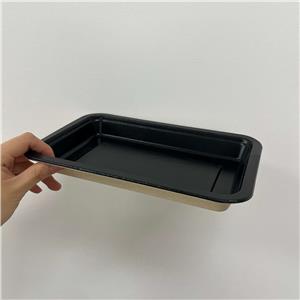
For this reason, MAP-ready bagasse packaging normally uses a functional film or coating on the food-contact and sealing surface.
The film structure can be selected according to the food product, temperature range, barrier requirement, and packaging process.
Why the Film Layer Matters for MAP
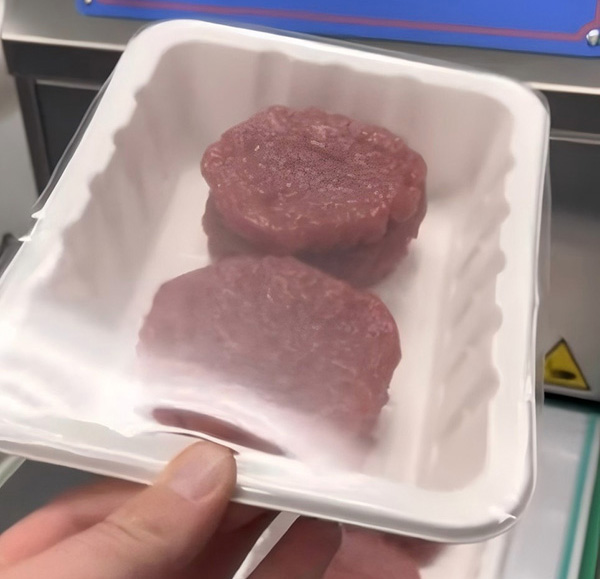
The bagasse fiber provides the main structure of the tray, while the functional film layer can provide properties needed for sealing and barrier performance.
Depending on the application, different film options can be considered, including:
PP
PET
CPET
PLA
EVOH-enhanced structures
PBAT-based structures
These materials do not provide exactly the same performance.
For example, a food manufacturer may prioritize heat resistance for an ovenable meal, while another may prioritize oxygen barrier performance for a chilled ready meal with a longer target shelf life.
This is why there is no single “best film” for every MAP bagasse tray.
The correct structure should be selected based on the actual packaging requirements.
When Is EVOH Worth Considering?
For MAP applications where oxygen barrier performance is important, an EVOH-enhanced structure may be considered.
EVOH is known for its strong oxygen-barrier properties under appropriate conditions.
In a laminated bagasse tray structure, an EVOH-containing layer can help reduce oxygen transmission through the packaging structure.
This can be useful for selected ready meal and chilled food applications where oxygen management is an important part of the packaging design.
However, EVOH should not automatically be added to every bagasse tray.
The required barrier level depends on factors such as:
Food type
Target shelf life
Storage temperature
Gas mixture
Product respiration
Lidding film
Distribution conditions
Packaging machine
Required oxygen transmission rate
A packaging manufacturer should evaluate the complete system rather than selecting EVOH simply because it has a high barrier.
Bagasse MAP Packaging Is a Complete System
One of the most important points for food manufacturers is that the tray itself is only one part of MAP packaging.
A typical MAP package includes:
Food product → Bagasse tray → Functional film layer → Lidding film → Gas flushing → Heat sealing → Finished package
Every part can affect the final result.
For example, a tray may have suitable sealing properties, but the lidding film may not provide the required barrier.
Or the tray and film may be suitable, but the sealing parameters may not be correctly adjusted.
For this reason, MAP projects should be evaluated as a complete packaging system.
Tray Design Matters for MAP
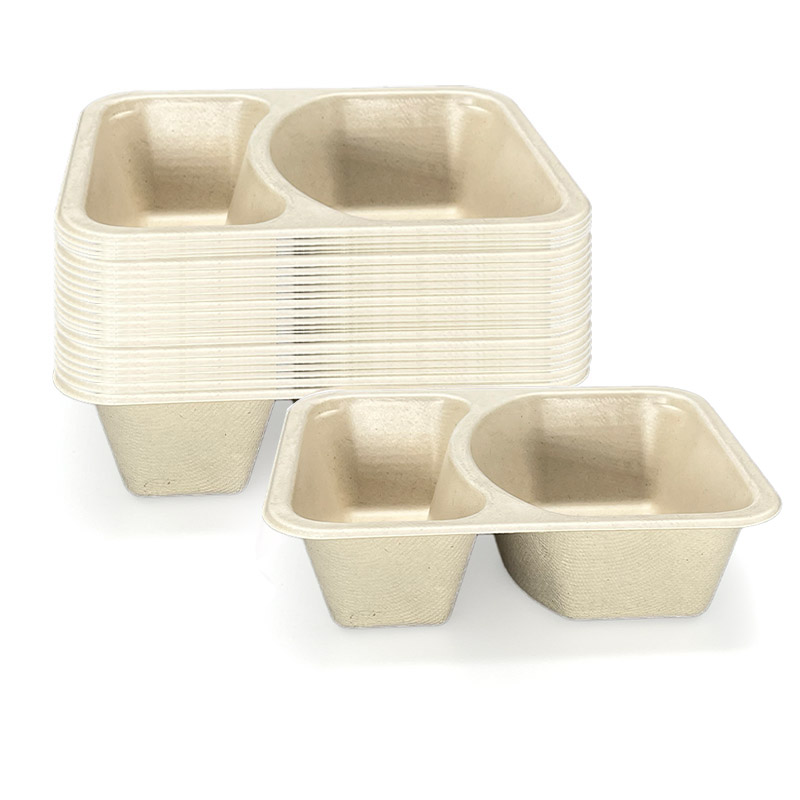
The tray shape and rim design can have a direct impact on sealing performance.
A suitable MAP tray normally needs a clean and stable sealing area around the top rim.
Important design considerations include:
1. Flat sealing rim
The sealing surface should provide enough contact area for the lidding film.
An uneven or unstable rim can make it difficult to achieve a consistent seal.
2. Sufficient rim width
The sealing area needs to match the requirements of the lidding film and sealing equipment.
The exact dimensions depend on the tray design and machine.
3. Stable tray structure
The tray needs enough stiffness to maintain its shape during:
Filling
Gas flushing
Film sealing
Transport
Storage
4. Correct mold design
If a food manufacturer wants to replace an existing PP or CPET MAP tray, the new bagasse tray can be developed based on the original tray dimensions.
This can help simplify the transition to molded fiber packaging.
Can Bagasse MAP Trays Use Existing Sealing Machines?
In many projects, the goal is to use the customer's existing packaging equipment whenever possible.
A properly designed heat-sealable bagasse tray can be developed around the requirements of an existing sealing process.
Before production, the manufacturer should confirm:
Tray dimensions
Sealing area
Tooling configuration
Sealing temperature
Sealing pressure
Dwell time
Lidding film
Gas flushing system
Machine compatibility
The exact sealing parameters should be established through testing rather than copied from another tray.
This is particularly important when replacing plastic trays with molded fiber packaging because different tray materials can behave differently during sealing.
What Foods Can Use Bagasse MAP Packaging?
Potential applications include a wide range of prepared and chilled foods.
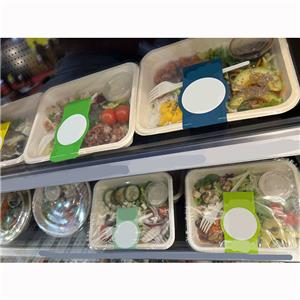
Ready Meals
Bagasse MAP trays can be considered for:
Prepared meals
Frozen meals
Chilled ready meals
Rice dishes
Pasta meals
Meat-based meals
Vegetable meals
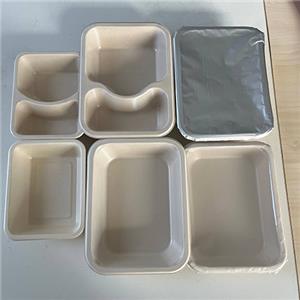
Multi-compartment meals
Fresh Food
Depending on the packaging requirements, applications may include:
Fresh meat
Seafood
Prepared vegetables
Fresh produce
Deli foods
Prepared foods
The suitability of the packaging should always be confirmed through product-specific testing.
Bagasse MAP Tray vs Conventional Plastic Tray
For manufacturers considering a plastic replacement project, it is useful to compare the packaging requirements rather than looking only at the material.
| Requirement | Conventional Plastic Tray | Heat-Sealable Bagasse Tray |
|---|---|---|
| Structural material | Plastic | Molded bagasse fiber |
| Heat sealing | Common | Available with suitable film/coating |
| MAP | Widely used | Possible with suitable structure |
| Oxygen barrier | Depends on structure | Depends on film structure |
| Custom shapes | Available | Available |
| 1:1 replacement | Possible | Can be developed |
| Film selection | Depends on application | PP/PET/CPET/PLA/EVOH/PBAT options |
| Existing equipment | Often compatible | Can be evaluated for compatibility |
| Sustainability positioning | Depends on plastic type | Fiber-based tray structure |
The key point is that MAP capability does not come from the bagasse material alone.
It comes from the design of the complete packaging structure.
What Should Food Manufacturers Test Before Switching to Bagasse MAP Trays?
Before moving to mass production, a food manufacturer should conduct practical testing.
A useful evaluation can include:
1. Seal Strength Test
Check whether the lidding film forms a consistent seal with the tray.
2. Leak Test
Check for leakage after sealing and during handling.
3. Gas Retention Test
Evaluate whether the package maintains the intended atmosphere during the required storage period.
4. Oxygen Transmission Test
Measure oxygen transmission according to the requirements of the application.
5. Water Vapor Barrier Test
For products sensitive to moisture, evaluate moisture transmission performance.
6. Storage Test
Test the finished package under the actual intended storage conditions.
7. Transportation Test
Evaluate package performance during handling, stacking, and transportation.
8. Machine Trial
Run the tray on the customer's actual or intended MAP sealing equipment whenever possible.
These tests provide much more useful information than simply comparing material specifications.
What Can Cause Poor MAP Performance?
If a MAP package does not perform as expected, the problem may not be the tray material itself.
Common causes include:
Incorrect sealing temperature
Insufficient sealing pressure
Incorrect dwell time
Poor tray rim design
Incompatible lidding film
Contamination on the sealing area
Insufficient barrier performance
Incorrect gas flushing
Excessive headspace
Product leakage or liquid contamination
Inadequate storage control
This is why a good MAP packaging project requires cooperation between the food manufacturer, packaging supplier, film supplier, and equipment supplier.
Can Existing Plastic MAP Trays Be Replaced With Bagasse?
In many cases, yes.
For food manufacturers already using PP, PET, or CPET trays, a practical approach is to start with the existing packaging format.
The manufacturer can provide:
Existing tray sample
Technical drawing
Tray dimensions
Product information
Filling weight
Storage temperature
Target shelf life
Current lidding film
Sealing machine information
The bagasse tray manufacturer can then evaluate the structure and develop a suitable molded fiber replacement.
A 1:1 replacement mold can be considered when the existing tray dimensions need to remain close to the current packaging format.
This approach can reduce changes to downstream operations and make the transition easier to evaluate.
One-Stop Bagasse MAP Packaging Solution
For larger food packaging projects, buying the tray alone may not be enough.
A complete solution may include:
Molded bagasse tray
Functional film or coating
Lidding film
Custom mold
MAP equipment
Custom labels or printing
Packaging testing support
This is particularly useful for food manufacturers and distributors that want one supplier to coordinate the main packaging components.
Instead of asking only:
“Can you make a bagasse tray?”
A better question is:
“Can you develop a bagasse MAP packaging system that works with our food product and packaging line?”
That changes the project from a simple tray purchase into a complete packaging solution.
What Should Distributors Ask a Bagasse MAP Tray Manufacturer?
If you are a distributor or wholesaler sourcing MAP-compatible bagasse trays, ask your supplier:
1. Is the tray heat sealable?
2. Which film structures are available?
3. Can the tray be used with MAP?
4. What barrier options are available?
5. Can you provide EVOH-enhanced structures for higher oxygen-barrier applications?
6. Can the tray be customized to our existing dimensions?
7. Can you make a 1:1 replacement mold?
8. Can you supply compatible lidding film?
9. Can you test the tray with our sealing process?
10. Can you provide samples before mass production?
These questions can help you identify whether a supplier is simply selling molded fiber products or actually understands industrial food packaging applications.
Why Choose a Bagasse Tray Manufacturer With Packaging Experience?
MAP packaging is more complicated than standard takeaway food containers.
The supplier needs to understand the relationship between:
Fiber structure + film + tray design + lidding film + sealing + gas flushing + food product + storage conditions
A manufacturer with in-house molding and film-lamination capabilities can coordinate more parts of the development process.
At Hebei Mountain, our focus is on coated and laminated bagasse food packaging for commercial food applications.
We support custom tray development, heat-sealable structures, different film options, 1:1 replacement molds, and packaging solutions for ready meals and other food applications.
For distributors and food manufacturers, this means the project can start from your existing tray, product requirements, or packaging line rather than from a standard catalog product.
Final Thoughts
Can bagasse trays be used for MAP packaging?
Yes — when the tray is specifically designed as a heat-sealable, barrier-capable packaging structure.
For MAP applications, the most important factors are not simply whether the tray is made from bagasse. The complete package needs to be evaluated, including the molded fiber structure, functional film, lidding film, sealing process, gas flushing, barrier performance, food product, and storage conditions.
For food manufacturers looking to replace conventional PP, PET, or CPET trays, a coated bagasse tray can be developed around the existing packaging requirements.
The best starting point is usually a real project.
Have an existing MAP tray that you want to replace with bagasse? Send us your tray drawing, sample, food application, storage temperature, and current sealing requirements. We can evaluate the packaging structure and develop a suitable sample for testing.
Frequently Asked Questions
Can all bagasse trays be used for MAP?
No. Standard molded bagasse trays are not automatically suitable for MAP. MAP applications normally require a suitable sealing and barrier structure.
Does a bagasse tray need a film layer for MAP?
For most heat-sealed MAP applications, a functional film or coating is required to provide the necessary sealing and barrier properties.
Can EVOH be used with bagasse trays?
Yes. EVOH-enhanced structures can be considered when higher oxygen-barrier performance is required for a specific application.
Can bagasse MAP trays replace CPET trays?
Potentially, depending on the food product, temperature, sealing process, barrier requirements, and equipment. Product-specific testing is recommended.
Can a bagasse tray work with an existing MAP machine?
It may be possible. Tray dimensions, rim design, sealing parameters, lidding film, tooling, and machine configuration should be evaluated before production.
Can you make custom MAP bagasse trays?
Yes. Custom molds can be developed from drawings, samples, or existing plastic trays, including 1:1 replacement projects where appropriate.