What Is the Best Packaging for Food Products? A Complete Guide for Buyers
Introduction
What is the best packaging for food products? The answer depends on the food, how it will be stored, how it will reach customers, and what the packaging needs to do.
A container that works well for a dry bakery product may not be suitable for a meal containing sauce. Packaging for chilled ready meals may have different requirements from containers used for hot takeaway food or frozen products.
For food manufacturers, packaging needs to protect the product and work with the production process. For importers, distributors, and wholesalers, it must also offer reliable quality, competitive pricing, and a practical range of products for different customers.
There is no single material that is best for every food application. Plastic, paperboard, molded fiber, and coated bagasse each have different properties and limitations.
In this guide, we compare common food packaging materials, explain how to choose the right option for different products, and explore when bagasse food packaging and coated bagasse trays may be suitable for commercial applications. Two companion guides in this cluster cover related decisions: how product packaging influences food choices and how to package my food product.
1. What Makes Food Packaging a Good Choice?
Before comparing materials, it helps to understand what good food packaging should achieve.
The best package is not necessarily the cheapest, strongest, or most environmentally marketed option. It is the one that meets the product's requirements while making sense for the business using it.
Food Protection
Packaging should help protect food from contamination, physical damage, and relevant environmental conditions during handling and distribution.
The level of protection required depends on the product. Dry foods, oily meals, liquids, and fresh produce place different demands on packaging.
Suitable Storage and Temperature Performance
Consider whether the food will be stored at room temperature, chilled, frozen, or reheated.
The complete package must be suitable for the intended conditions. A container designed for hot takeaway food should not automatically be assumed to be suitable for microwave heating or conventional oven use.
Ease of Handling
Packaging should be practical to fill, close, stack, transport, and use.
For restaurants and foodservice operators, this may mean easy handling and secure closures. For food factories, it may mean compatibility with automated filling and sealing equipment.
Cost and Supply Reliability
Packaging costs include more than the unit price. Freight, storage, tooling, equipment compatibility, and product damage can all affect the total cost.
For wholesale buyers, consistent specifications and reliable repeat orders are also important.
Environmental Considerations
Material choice should reflect the complete package, its expected use, applicable regulations, and available disposal systems.
Terms such as recyclable, biodegradable, and compostable are not interchangeable. Claims should be supported by evidence for the actual finished product.
2. Compare the Main Food Packaging Materials
Different materials are suited to different applications. The following comparison can help narrow your options.
| Packaging material | Common applications | Important considerations |
|---|---|---|
| Plastic | Food containers, trays, lids, and flexible packaging | Material-specific heat resistance, barrier performance, and end-of-life requirements |
| Paperboard | Cartons, sleeves, bakery boxes, and takeaway boxes | Moisture and grease resistance depend on construction and coatings |
| Molded bagasse | Plates, bowls, takeaway containers, and trays | Performance depends on product design and food type |
| Coated bagasse | Selected prepared foods and ready-meal trays | Inner film, sealing compatibility, temperature limits, and complete-package composition |
| Glass and metal | Jars, cans, and selected food containers | Weight, breakage or deformation risks, processing requirements, and cost |
The right choice depends on the specific application rather than the material category alone.
Plastic Food Packaging
Plastic packaging is widely used because different polymers can offer combinations of low weight, durability, moisture resistance, and barrier performance.
For example, PP and PET are used in various food containers and trays. CPET is used in certain ready-meal trays designed for specified temperature conditions. EVOH may be incorporated into multilayer structures to improve resistance to the transmission of certain gases.
These materials have different properties and are not interchangeable. Buyers should confirm the finished package's intended use, temperature limits, and food-contact suitability.
Plastic can be a practical option when the required performance and existing production process make it suitable.
Paperboard Food Packaging
Paperboard is common in cartons, sleeves, bakery packaging, and takeaway boxes.
It offers useful options for printing and brand presentation. However, its resistance to moisture, oil, and grease depends on the board structure and any coatings or liners.
For wet or oily foods, ask the supplier whether the specific package is designed for the intended contact conditions.
Molded Bagasse Food Packaging
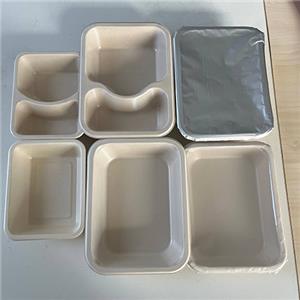
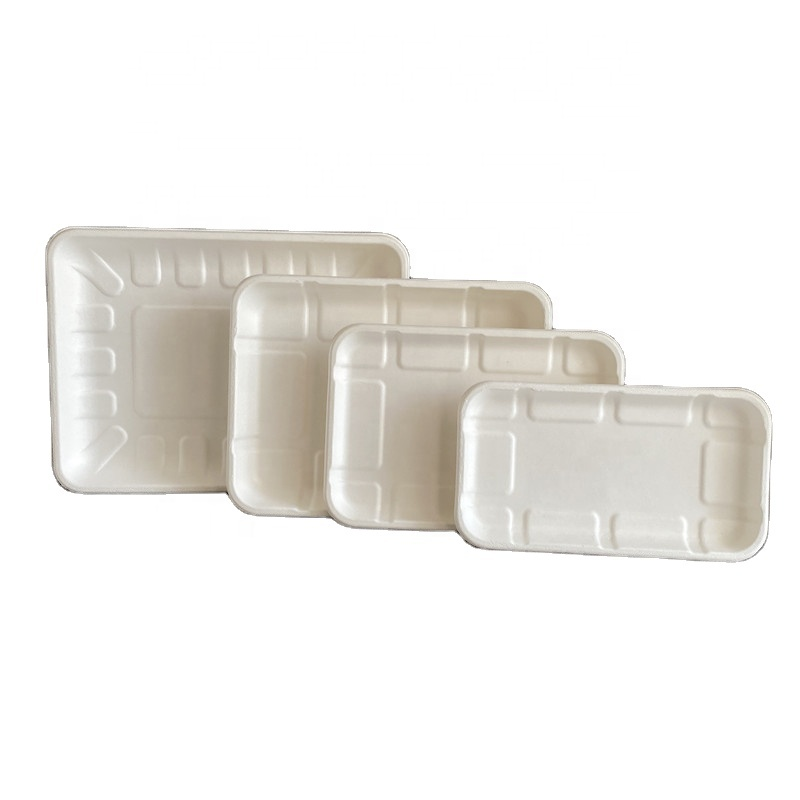
Bagasse is the fibrous residue left after sugarcane juice is extracted. It can be processed into molded fiber products, including plates, bowls, takeaway containers, and food trays.
For businesses looking for plant-based foodservice packaging, bagasse is an option worth considering.
Potential advantages include:
- A molded fiber structure with a natural appearance.
- Different sizes, shapes, and compartment configurations.
- Formats for selected restaurant, takeaway, and catering applications.
- Opportunities for custom designs and private-label product development.
Uncoated bagasse packaging may work well for many foodservice applications, but it is not automatically suitable for every food. Oil resistance, moisture resistance, structural strength, and temperature performance should be checked for the specific product. The formats currently offered are listed on our molded bagasse tray range page.
For foods containing substantial oil or liquid, a container with additional barrier protection may be more appropriate.
3. Is Coated Bagasse Packaging a Good Option for Ready Meals?
For some food products, the main challenge is finding a package that combines a molded fiber base with the functional properties needed for storage and distribution.
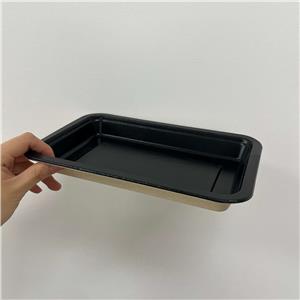
Coated bagasse trays combine a molded sugarcane fiber base with an inner film. Depending on the construction, this film may improve resistance to oil and moisture and can support heat sealing when used with a compatible lidding film.
This makes coated bagasse trays worth evaluating for selected prepared-food and ready-meal applications.
What Are the Potential Benefits?
Resistance to oil and moisture
A suitable inner film can help protect the molded fiber base from food liquids and grease. The actual performance depends on the film and finished tray design.
Heat-sealing options
Some tray and film combinations are designed for heat sealing. The tray flange, lidding film, and sealing conditions must be compatible to achieve the required seal. Compatible tray and film pairs are developed together, as shown in our sealable bagasse tray range.
Different tray formats
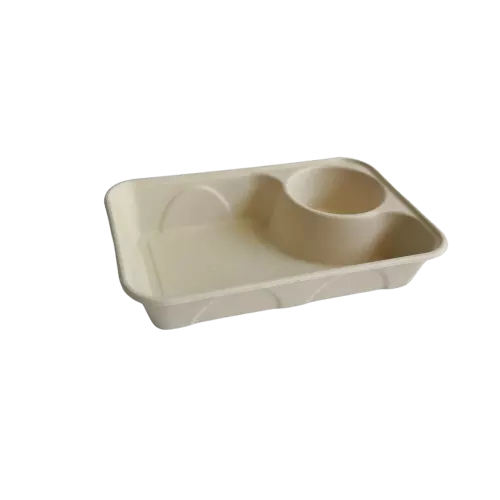
Depending on the product range, buyers may be able to choose different depths, dimensions, and compartment layouts for different meals.
Options for commercial food production
A coated tray can form part of a packaging system that includes filling equipment, lidding film, sealing machines, labels, and secondary cartons.
How Do You Choose the Right Inner Film?
Film selection should be based on the food and the required performance, not simply on which material sounds most suitable.
Options for coated tray projects may include PP, PET, CPET, PLA, EVOH-based structures, and PBAT-based options.
The choice depends on factors such as:
- Food composition and moisture or oil content.
- Storage temperature and any reheating requirements.
- Required gas-barrier performance.
- Heat-sealing conditions and equipment.
- Food-contact requirements in the destination market.
For example, a tray intended for chilled food may require different properties from one designed for a frozen meal or a product requiring a particular gas barrier.
Not every coated bagasse tray is suitable for every temperature or sealing application. Confirm the specifications and evaluate samples before production. How a seal is qualified on the finished pack is described in our article on whether bagasse trays can be heat sealed.
Important environmental note: A coated bagasse tray is not automatically fully compostable or plastic-free. If its inner film contains plastic, any environmental claim must reflect the complete package and be supported by appropriate evidence.
4. What Is the Best Packaging for Different Food Products?
The most suitable material depends on the type of food and how customers will use it.
Takeaway and Restaurant Meals
Takeaway packaging needs to be practical to carry, suitable for the food's moisture and oil content, and compatible with the expected handling conditions.
Molded bagasse plates, bowls, and takeaway containers may suit selected foodservice applications. Foods with more liquid or grease may require a suitable barrier structure and compatible closure.
Ready Meals and Prepared Foods
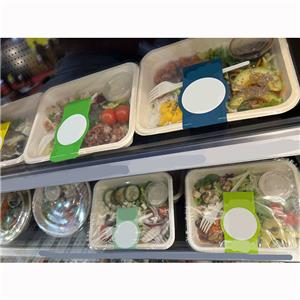
Ready meals may require consistent portioning, secure closure, and packaging compatible with chilled or frozen storage.
For products requiring heat sealing, buyers should check tray and film compatibility. If the food requires modified atmosphere packaging (MAP), the complete packaging system must meet the specified barrier and sealing requirements.
Coated bagasse trays may be an option for selected ready-meal applications, provided the finished product meets the required performance specifications.
Bakery Products and Dry Snacks
Dry bakery products and snacks may need packaging that protects against handling damage and, where necessary, moisture or oxygen exposure.
Paperboard boxes, flexible packaging, and other formats may be appropriate depending on the food and required shelf life.
Fresh Produce
Fresh fruit and vegetables may need protection from crushing, suitable ventilation, and moisture management.
The best solution depends on the type of produce, expected storage period, temperature, and distribution route.
Frozen Foods
Frozen products require packaging that remains suitable at the specified low temperatures.
Do not assume that a package is freezer-safe simply because it is made from plastic, paperboard, or molded fiber. Check the complete package's temperature limits and test it under the intended conditions.
Sauces and Liquid Foods
Liquids and highly sauced foods require special attention to containment and closure performance.
A container that works for a solid meal may not be appropriate for a liquid product. Check the container design, seal, material compatibility, and handling conditions before selecting a format.
5. How Important Is Packaging Cost?
For food producers and wholesale buyers, packaging must fit the budget without compromising essential performance.
A low unit price can be attractive, but it does not always mean lower total cost.
Consider the following when comparing quotations:
- Unit price at different order volumes.
- Freight cost and shipping efficiency.
- Storage space and carton dimensions.
- Compatibility with existing production equipment.
- Mold or tooling charges for custom designs.
- Potential waste from damaged or unsuitable packaging.
- Minimum order quantities and inventory requirements.
- Repeat-order pricing and supply reliability.
For coated bagasse trays, compare the cost of the complete packaging system where relevant, including trays, lidding film, sealing equipment, and labels.
For distributors and wholesalers, the product's resale potential also matters. A packaging item should meet customer needs while leaving enough room for shipping, operating costs, and a sustainable margin.
The best purchase is the one that provides the required performance at a commercially sensible total cost.
6. Standard Packaging or Custom Packaging: Which Is Better?
Standard packaging is often the best starting point when existing dimensions, shapes, and material specifications meet your requirements.
It can reduce initial development costs and allow you to test market demand before committing to a custom design.
Custom packaging may be worth considering when:
- You need a specific tray depth or compartment layout.
- Your production line requires particular dimensions.
- Your customer wants a distinctive product format.
- You are developing a private-label product range.
- Your expected order volume justifies the tooling investment.
For molded bagasse products, custom molds can help create specific shapes and sizes.
Before beginning a custom project, confirm the design, tooling cost, sample-development process, minimum order quantity, and expected lead time, which are set out in our guide to bagasse food packaging MOQ.
For wholesalers and distributors, custom packaging can help differentiate a product range and serve customers whose needs are not met by standard products.
7. What Should You Check Before Buying Food Packaging in Bulk?
Buying packaging in bulk can improve unit economics, but only if the selected product matches the intended use.
Before confirming an order, review these areas.
Product Specifications
Confirm dimensions, material structure, color, capacity, tolerances, and other relevant specifications.
Food-Contact Documentation
Request the appropriate declarations and test reports for the product and target market. Do not assume that documents for one product automatically cover all products from the same supplier. The documents we make available on request are listed in our certification and test report section.
Sample Evaluation
Test the package with the actual food and, where possible, on the production equipment.
For coated trays, evaluate the inner film, closure or seal, handling, and intended temperature conditions.
Quality Control
Ask how the supplier controls dimensions, material consistency, and defects, and how product specifications are maintained across repeat orders.
Supply and Delivery
Confirm minimum order quantities, production lead times, shipping arrangements, and repeat-order procedures.
These checks help reduce the risk of receiving packaging that is unsuitable for the product or difficult to use in normal operations.
8. How to Choose a Reliable Food Packaging Manufacturer
For importers, distributors, and wholesalers, the manufacturer is part of the long-term value of the product.
A supplier should be able to explain the product's intended use, provide relevant specifications, and help buyers evaluate whether the packaging fits their requirements.
Look for a manufacturer that offers:
- Relevant experience with the packaging format you need.
- Clear material specifications and technical information.
- Sample support and product evaluation.
- OEM/ODM or customization capabilities where required.
- Quality-control procedures and consistent product specifications.
- Practical communication about minimum orders and lead times.
- Appropriate export documentation and supply planning.
Bagasse Packaging from Hebei Mountain Environmental Protection Technology Co., Ltd.
Hebei Mountain Environmental Protection Technology Co., Ltd. manufactures bagasse food packaging, including molded fiber tableware and coated trays for selected food packaging applications.
Our capabilities include OEM/ODM support and custom molded-fiber product development. For coated tray projects, the inner film should be selected according to the food, required barrier performance, sealing process, and temperature conditions.
We work with business customers to discuss standard products and customized packaging options. This can help importers, distributors, and wholesalers develop product ranges for restaurant, catering, takeaway, and selected prepared-food markets.
For buyers evaluating coated bagasse trays, the next step is to confirm the intended application, review the relevant specifications, and test samples before committing to bulk production.
Conclusion: The Best Food Packaging Is the One That Fits the Application
What is the best packaging for food products? There is no universal answer.
Plastic can provide useful properties for many food applications. Paperboard can work well for cartons and selected takeaway formats. Molded bagasse offers a plant-based fiber option for certain foodservice uses, while coated bagasse trays may provide additional oil and moisture resistance when the complete package is designed for the intended application.
The right choice depends on food protection, storage conditions, production requirements, cost, compliance, and customer expectations.
For distributors and wholesalers, understanding these differences helps you choose products that serve your market, support repeat orders, and provide lasting commercial value.
Frequently Asked Questions
1. What is the best packaging material for food products?
There is no single best material for every food. Plastic, paperboard, molded bagasse, and coated bagasse each have different properties. The right choice depends on the food, required protection, temperature conditions, cost, and disposal options.
2. Is bagasse packaging suitable for food products?
Bagasse packaging is used for plates, bowls, takeaway containers, and trays in selected foodservice applications. Buyers should confirm the product's food-contact suitability, strength, moisture resistance, and intended use.
3. What is the difference between bagasse and coated bagasse packaging?
Bagasse packaging uses a molded sugarcane fiber base. Coated bagasse packaging adds an inner film that may improve oil and moisture resistance and can support heat sealing in compatible designs.
4. Can coated bagasse trays be used for ready meals?
Some coated bagasse trays are designed for selected ready-meal applications. Suitability depends on the tray structure, film, sealing process, storage temperature, and any required barrier performance.
5. Are coated bagasse trays fully compostable?
Not automatically. Compostability depends on the complete package, including the inner film, and on relevant certifications and disposal conditions. Buyers should verify claims for the finished product.
6. How can I reduce food packaging costs?
Compare total cost rather than unit price alone. Include freight, storage, tooling, equipment compatibility, inventory, and potential product waste. Select a package that meets the required performance without unnecessary features.
7. Should I buy standard or custom food packaging?
Standard packaging is often more economical when available formats meet your requirements. Custom packaging may be worthwhile if you need specific dimensions, compartments, or equipment compatibility. Consider tooling costs, order volume, and lead time.
8. What should I ask a food packaging supplier before ordering?
Ask about material specifications, food-contact documentation, samples, quality control, customization, minimum order quantities, production lead times, export support, and repeat-order consistency.
Looking for a bagasse food packaging manufacturer?
Hebei Mountain Environmental Protection Technology Co., Ltd. supplies molded bagasse food packaging and coated tray solutions for business customers.
Contact our team to discuss your product requirements, explore standard and customized packaging options, and request samples for evaluation.
We welcome inquiries from food packaging importers, distributors, wholesalers, supermarket suppliers, and food brands.