Compostable Trays for Bakeries and Patisseries: Protecting Pastries Without Plastic
A bakery or patisserie tray has to resist grease from the product, hold its shape when the pack is carried, and close in a way that suits how the pastry is sold. Grease resistance comes from the functional film rather than from the fiber, so the film structure is the first thing to confirm and the tray shape is the second.
Baked goods are dry on the outside and often rich in fat on the inside, which is the opposite of the problem a wet ready meal presents. This guide sets out what a compostable fiber tray has to do for pastry, how the forms differ, and what to send a manufacturer when you request samples. For the base material, see our explanation of what bagasse packaging is.
What a bakery tray has to do
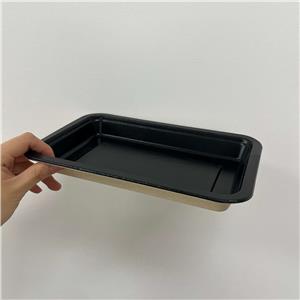
A bakery tray has to carry a fragile product without marking it and without letting fat or moisture reach the fiber base. Molded fiber supplies the rigidity and the shape, and the functional film supplies the barrier, so the two are specified as a pair.
The choice between a coated and an uncoated tray is therefore a functional decision rather than a cosmetic one, and the differences are set out in our comparison of coated and uncoated sugarcane bagasse tableware. A dry product that never touches the base can use the uncoated range, and anything with fat in it is better served by a laminated tray.
Why grease resistance matters more than moisture for pastry
Grease is the harder problem in pastry because fat migrates into uncoated fiber and leaves a visible mark. Moisture matters too, but usually in the other direction: the risk is a crisp product going soft rather than a dry product becoming wet.
That is why pastry is specified against the coating first and the closure second. Our laminated trays are ≤ 5% plastic and our film-free range is 100% plastic-free, and the film-free range is intended for cold, non-sealed applications where no liquid barrier is required. Rigidity under a load belongs in the same conversation, which is the subject of our analysis of fiber strength under load.
Rigid trays, clamshells and platters: choosing the form
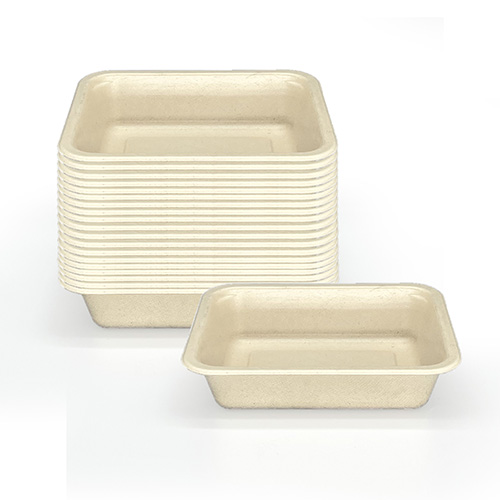
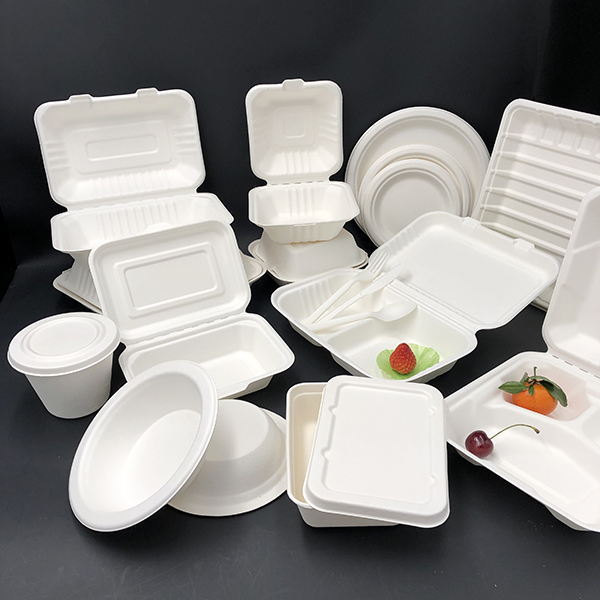
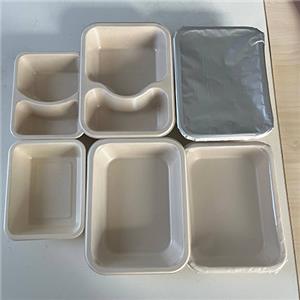
A rigid tray with a separate lid suits a product that must stay upright, a clamshell suits fast service and fewer components, and a flat platter suits presentation and sharing formats. The form is chosen from how the pastry is displayed and carried, not from the material.
Where a format already exists in plastic, the outer dimensions can be reproduced rather than redesigned. Our mold library holds more than 3,000 in-house molds, and we develop 200+ new molds each year, so a new pastry format is a tooling exercise rather than a new material project. Exterior dimensions are kept by our 1:1 plastic tray replacement process.
Window, sleeve or lid: presenting the pastry
The closure decides how much of the product the customer sees, so it is usually settled by merchandising before it is settled technically. A sleeve shows the product and protects it lightly, a rigid lid protects it fully, and a film seal protects it best where the pack is stacked or moved.
Where a film is used, the film and the tray rim have to be matched, because seal behaviour is established on the actual combination. Our bagasse heat seal food trays are supplied as a tray and film system for that reason, and the selection criteria for the film are covered in our guide on how to choose the right film.
Matching the format to the product line
| Product type | What the tray has to do | What to specify |
|---|---|---|
| Croissants and viennoiserie | Resist grease without marking the base | A laminated base, the film structure behind it, and the time the product sits before sale |
| Cream cakes and gateaux | Hold a soft product upright and stop it sliding | Compartment depth, base coating, and a lid that clears the decoration |
| Sliced cakes and traybakes | Carry a cut portion without the cut face drying | Moisture control for the cut face and a closure that covers or seals it |
| Cookies and dry baked goods | Keep a dry product crisp | The moisture barrier you need for the storage period, and a film-free option where no sealing is needed |
| Chilled and frozen pastry | Stay intact through the cold chain | Base behaviour at the storage range you use, and the film or lid selected for that range |
The table is a planning aid rather than a specification, because the format that works is the one drawn around your own product line.
What to specify before you order
A useful enquiry describes the product and the journey rather than the material. Send the pastry item and its fat content, the tray or clamshell it replaces, whether the pack is sold ambient, chilled or frozen, the closure you intend to use, and how the packs are stacked in the crate.
Compliance documentation belongs in the same request. Our laminated trays are PFAS-FREE (ND, < 10 ppm) and ≤ 5% plastic, the certification set is FDA, LFGB, OK Compost Industrial and ABAP, and the supporting test reports cover REACH, POPs, PFAS, PPWR total fluorine and BPA. They are listed together in our certification and test report section, so a buyer can request the full set in one place rather than tracking documents across suppliers.
Frequently asked questions
Will a fiber tray mark a butter-rich pastry?
Not if the tray is laminated, because the functional film is what keeps fat away from the fiber. The film structure is the part to confirm for the fat level in your product, since an uncoated tray is not intended for grease contact.
Is a clamshell or a tray with a lid better for pastry?
A clamshell is better for fast service and fewer parts, and a tray with a separate lid is better where the product must stay upright or be stacked. Rigidity and stacking, not the material, decide which of the two suits a given line.
Can the same tray be used for ambient and chilled pastry?
Sometimes, but the closure usually differs between the two. An ambient pack is often sleeved, while a chilled pack is more often sealed or lidded, so the two are specified as separate requirements.
Can a fiber tray replace a plastic patisserie platter directly?
Yes, where the dimensions can be reproduced rather than redesigned, which is how formats are normally converted from plastic. Our plastic tray replacement process keeps the outer dimensions while the material and the coating change.
Does a bakery tray need a film seal at all?
No. Many pastry formats are sold open, sleeved or lidded, and a film seal is only needed where the pack is stacked, moved or held for longer. The pack design follows the retail format rather than the material.
Need samples for a bakery or patisserie format?
Hebei Mountain Environmental Protection Technology Co., Ltd. manufactures laminated bagasse trays and supplies film structures in PP, PET, CPET, PLA, EVOH-enhanced and PBAT-based options, with 30+ production lines for volume supply. Trays, clamshells and platters can all be developed from an existing plastic format or from a new drawing.
Send us the pastry item, the retail format and the storage conditions, and we will confirm which base and film suit the pack and which samples to run. Please contact our team to start the request.