Compostable Trays for Hospitals, Schools and Staff Canteens: A Buyer's Brief
Institutional catering buys a tray against a written requirement, so the pack has to be documented, repeatable across sites and stable in a high-throughput dish-out line. Hospitals, schools and staff canteens differ in menu and service point, but they buy in the same way: against a specification that has to be met on every delivery.
That is what separates institutional catering from a single restaurant order. This brief sets out what these buyers actually require from a compostable fiber tray, how the formats differ, and what to send a supplier before a tender. It is written for the buyer who has to answer for the packaging after it leaves the kitchen, not for the buyer choosing by appearance.
What institutional catering requires from a tray
An institutional tray has to hold a defined portion, survive a tray-line or a stacked trolley, and behave the same way on the next delivery. Portion consistency and repeatability matter more here than in any other channel, because the menu changes daily but the tray does not.
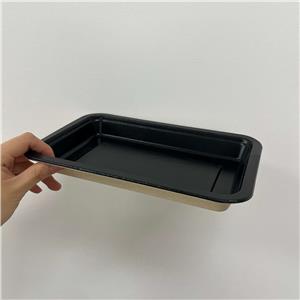
Molded fiber supplies the shape and the rigidity, and the functional film supplies the barrier against sauces and moist dishes. Our laminated trays are ≤ 5% plastic and our film-free range is 100% plastic-free, and the film-free range suits cold or ambient components that are served without sealing.
Procurement, not preference: how these buyers decide
These buyers decide on documented compliance and a stable supply, not on a claim. A public or institutional kitchen is normally asked to show that the packaging it puts into the waste stream is documented, which turns the certificate set and the test reports into a purchasing requirement.
Our laminated trays are PFAS-FREE (ND, < 10 ppm), the certification set is FDA, LFGB, OK Compost Industrial and ABAP, and the supporting test reports cover REACH, POPs, PFAS, PPWR total fluorine and BPA. They are listed together in our certification and test report section, and the wider set a buyer may be asked for is set out in our overview of bagasse food packaging certifications.
Dietary and menu requirements to plan for
The tray has to cope with the widest dish on the menu, not the average one, because a single format usually serves every diet line. That means the coating is chosen for the wettest and fattiest dish, and the compartment layout is chosen for the most complex one.
Where a kitchen runs both hot and cold service from one format, the two uses are specified separately rather than averaged, because the film and the closure differ between them. Rigidity under a loaded portion belongs in the same conversation, which is the subject of our analysis of fiber strength under load.
Serving formats: trays, bowls and compartment packs
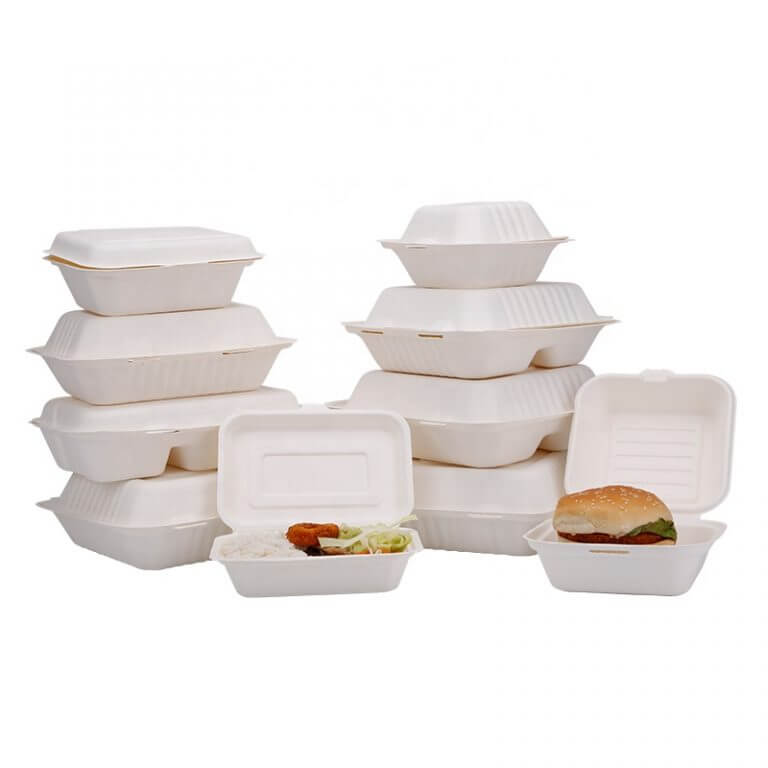
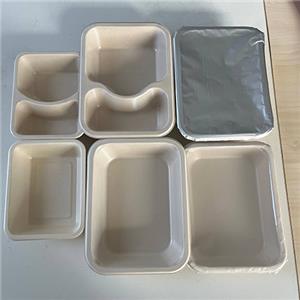
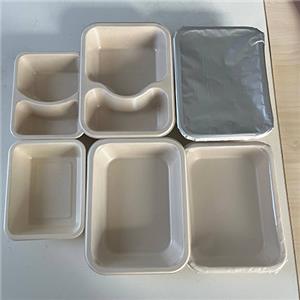
A single-compartment tray suits a plated or spooned main, a compartment pack suits a set meal with sides, and a bowl suits soup, salad and dessert. The service point decides the format, because a tray-line and a trolley service load packs in different ways.
Where the format already exists in plastic, the outer dimensions can be reproduced rather than redesigned, and our 1:1 plastic tray replacement process keeps the footprint your tray-line is already set up for. Sealing, where it is used, is a tray and film pairing rather than a tray choice, which is why our bagasse heat seal food trays are supplied as a system.
Matching the pack to the service point
| Service point | What the tray has to do | What to specify |
|---|---|---|
| Hospital ward trolley service | Hold a defined portion at a set temperature until service | A laminated base, the closure used on the ward, and the storage range you need to cover |
| School and campus canteen | Tolerate fast loading and a heavy stack | Rigidity for the stack, the compartment layout for a set meal, and the coating for the menu |
| Staff canteen counter | Present the dish and allow it to be handled quickly | The format for the serving counter, and a film or lid that suits the pass |
| Central production kitchen | Be filled and closed consistently across shifts | The tray and film pairing for the line, and the tolerance your equipment needs |
| Serving a mixed diet menu | Carry the widest dish on the menu without leaking | The coating for the wettest and fattiest dish, and the compartment layout for the most complex one |
The table is a planning aid rather than a specification, because the format that works is confirmed against your own menu cycle.
What to specify before you order
A useful enquiry describes the service rather than the material. Send the menu cycle and the widest dish on it, the serving temperature, whether the pack is sealed, lidded or open, the tray-line or trolley arrangement, the storage period, and the volume across all sites.
Institutional buyers usually need the commercial terms in writing alongside the technical ones, because volume and delivery are tendered rather than negotiated per order. A list of what to request from a supplier is set out in our guide to questions to ask a bagasse tray manufacturer, and the volume side is covered in our article on bagasse food packaging minimum order.
Frequently asked questions
Do hospitals and schools need different trays?
Not necessarily, but they usually need different closures. A ward service is more often sealed or lidded for transport, while a canteen is more often served open, so the tray can be shared while the closure is not.
Can one fiber tray serve hot and cold service in the same kitchen?
Yes, if the two uses are specified separately from the start. The coating and the film for the hot side are chosen independently from the cold side, rather than compromising on one structure for both.
What documentation does a public sector buyer normally request?
The food-contact documentation together with the certification and test report set, because the buyer is normally asked to show what it puts into the waste stream. Our laminated trays are PFAS-FREE (ND, < 10 ppm) with FDA, LFGB, OK Compost Industrial and ABAP certification, backed by REACH, POPs, PFAS, PPWR total fluorine and BPA reports.
Is a sealed tray required for a canteen service?
No. Sealing matters where the pack is transported or stacked after filling, and an open or lidded service does not need it. The decision follows the distance between the kitchen and the service point.
Can an existing plastic tray be matched so the service does not change?
Usually yes, where the outer dimensions are reproduced rather than redesigned. Keeping the footprint is what allows a tray-line, a trolley and a closure to stay as they are, with the material as the only change. The differences between a coated and an uncoated base are compared in our guide to coated and uncoated bagasse tableware.
Need samples for an institutional service?
Hebei Mountain Environmental Protection Technology Co., Ltd. manufactures laminated bagasse trays and supplies film structures in PP, PET, CPET, PLA, EVOH-enhanced and PBAT-based options, with 30+ production lines for volume supply. Our mold library holds more than 3,000 in-house molds, and we develop 200+ new molds each year.
Send us the menu cycle, the service point and the volume across sites, and we will confirm which base and film suit the service and which samples to run. Please contact our team to start the request.