Bagasse Sushi Trays and Bento Boxes: Choosing Compostable Packaging for Japanese-Style Takeaway
A fiber tray works for sushi and bento when the base is laminated, the compartments keep their shape under a moist load, and the pack is closed with a film or lid that stops the pieces moving in transit. The tray is only one part of that result, because the coating and the closing method decide how the pack behaves once it leaves the kitchen.
Sushi and bento are cold, moist, arranged foods, so they raise different questions from a hot ready meal. This guide covers what to look for in the tray, how compartment layouts are chosen, and what to send a manufacturer when you request samples. For the base material itself, see our explanation of what bagasse packaging is.
What makes a fiber tray suitable for sushi and bento
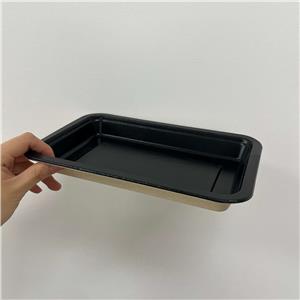
The requirement is a laminated base, a rim wide enough to seal or lid, and enough rigidity that the tray does not flex when it is picked up one-handed. Molded fiber gives the shape and the rigidity, while the functional film supplies the moisture resistance that raw fish, pickled rice and sauces demand.
An unlaminated fiber tray is not suited to a wet, cold pack, because moisture moves through the uncoated fiber. Plastic content separates the two product families: our laminated trays are ≤ 5% plastic, and our film-free range is 100% plastic-free and matched to cold, non-sealed applications. That distinction, not the fiber itself, is what makes a tray right or wrong for sushi.
Compartment layouts for sushi and bento menus
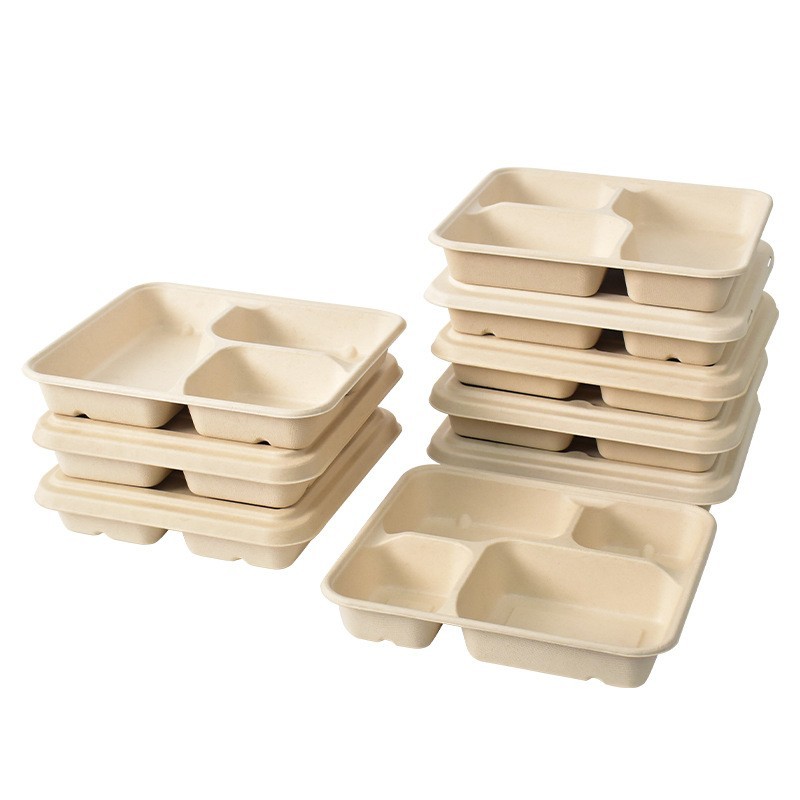
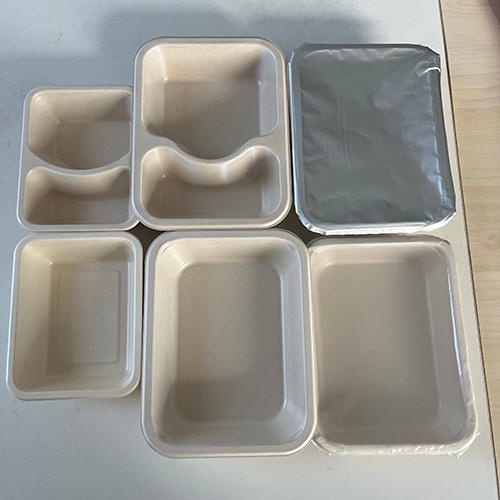
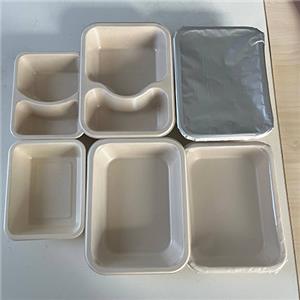
Compartment layout follows the menu, and the constraint is usually depth rather than area. A nigiri or maki set needs shallow, even wells so the pieces sit upright; a mixed bento with a warm component needs a deeper well on one side and a separate sealed area on the other.
Two practical limits shape the drawing: the plate between compartments has to be wide enough to mould cleanly, and the outer rim has to stay wide enough for a sealing film or a lid to grip. Where the format already exists as a plastic tray, the same layout can be reproduced rather than redesigned, and our 1:1 plastic tray replacement process keeps the outer dimensions while the material changes. A range of existing multi-compartment formats is described in our guide to compostable trays for prepared meals.
Which functional film suits cold, moist food
For a chilled sushi or bento pack, the film has to control moisture rather than oxygen, because the risk is a rice base drying out or a crisp component softening. Film choice therefore starts from the food and the storage period, not from the tray.
Our film structures cover PP, PET, CPET, PLA, EVOH-enhanced and PBAT-based options, and the selection criteria are set out in our guide on how to choose the right film for a bagasse food tray. A tray intended for cold service and a tray intended for reheating should not be specified with the same film.
Closing the pack: film seal, lid or sleeve
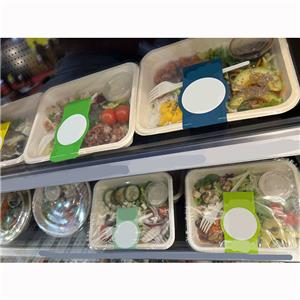
A film seal gives the tightest pack and the best moisture control, a rigid lid gives the best protection for arranged pieces, and a sleeve suits formats that are presented open. Which one is right follows from how the pack is stacked, carried and opened by the customer.
Sealing is a two-part decision, because the film and the tray rim have to work together. Seal strength and leak behaviour are established on the actual tray and film combination, and the sequence is described in our guide to testing a heat sealable bagasse tray. Our bagasse heat seal food trays are supplied as a tray and film system for this reason.
Matching the format to the menu
| Bento format | What it has to do | What to specify |
|---|---|---|
| Nigiri and maki sets | Keep pieces upright and apart so the rice does not shift | Compartment depth, base coating, and a lid or film that does not press on the food |
| Mixed hot and cold items | Hold a warm component beside a chilled one in a single pack | Compartment layout, the film used on each side, and the closing method for each side |
| Multi-course bento | Carry several small portions without mixing them | Number and depth of compartments, and the rim width left free for sealing |
| Sashimi and raw fish | Resist moisture migration into the fiber base | A laminated base, food-contact documentation, and the chilled storage range you need to cover |
| Delivery and longer transport | Stay stable when the packs are stacked and tilted | Tray rigidity, nesting depth, and the lid or sleeve that holds the stack together |
The table is a starting point rather than a specification, because the layout that works is the one drawn around your actual menu.
What to specify before you order
A useful enquiry describes the pack rather than the material. Send the compartment drawing or the plastic tray it replaces, the food and its moisture and fat content, the chilled storage period you need to cover, whether the pack is sealed or lidded, and the stacking arrangement in the delivery crate.
Compliance documentation belongs in the same request. Our laminated trays are PFAS-FREE (ND, < 10 ppm) and ≤ 5% plastic, the certification set is FDA, LFGB, OK Compost Industrial and ABAP, and the supporting test reports cover REACH, POPs, PFAS, PPWR total fluorine and BPA. Those documents are listed in our certification and test report section, so a buyer can request them in one place.
Frequently asked questions
Can a fiber tray hold a raw fish portion without the base breaking down?
Yes, provided the tray is laminated and the pack is closed. The functional film is what keeps moisture away from the fiber, so the coating is the part that has to be confirmed for the storage period you need rather than the fiber base on its own.
Do sushi trays need a film seal, or is a lid enough?
A lid is enough for presentation and short transport, and a film seal is better where the pack is stacked or held for longer. The deciding factors are transport time and how the pack is carried, not the food type alone.
Are laminated trays suitable for a bento that also contains a warm item?
Yes, as long as the two sides are treated as two requirements. The warm compartment is specified for its film and its heat tolerance, and the chilled compartment for its moisture control, which is why the mixed format is drawn early in the project.
Can the tray be branded for a restaurant chain?
Branding is handled at the tooling stage rather than at the packing line, so it is normally decided together with the compartment layout. Where the format is reproduced from an existing tray, our plastic tray replacement process keeps the outer dimensions while the layout is adapted.
What determines the smallest order for a custom compartment layout?
It depends on whether the layout matches a mold we already hold or needs a new one, because that is what changes the set-up involved. Ask for the figure in writing against your own drawing, since it is a commercial term rather than a property of the material.
Need samples for a sushi or bento format?
Hebei Mountain Environmental Protection Technology Co., Ltd. manufactures laminated bagasse trays and supplies film structures in PP, PET, CPET, PLA, EVOH-enhanced and PBAT-based options, with 30+ production lines for volume supply. Our mold library holds more than 3,000 in-house molds, and we develop 200+ new molds each year for new compartment layouts.
Send us the compartment drawing, the food and the transport conditions, and we will confirm which base and film suit the pack and which samples to run. Please contact our team to start the request.