Can Food Manufacturers Switch From Plastic Trays to Bagasse Without Changing Their Packaging Line?
In most ready meal projects the packaging line itself does not have to be replaced in order to switch from a plastic tray to a bagasse tray. What has to change is the tray geometry, the functional film and the settings on the sealing machine - and those are engineering decisions rather than equipment purchases.
This guide explains what can normally stay the same, what always has to be re-validated, where a line change really is unavoidable, and how a tray can be developed from your existing plastic tray so that the filling and sealing equipment keeps working. For the tray materials themselves, see our guide to replacing PP food trays and our bagasse tray vs PP tray comparison.
What "changing the packaging line" actually means
When a buyer asks whether the packaging line has to change, the real question is which parts of the line interact with the tray. Those are the parts that decide the answer: the filler and denester that handle the tray, the sealer that closes it, the lidding film that runs on the sealer, and the handling equipment that moves the sealed pack after sealing. Everything else is normally unaffected.
What usually stays the same
The parts of the line that do not touch the tray material usually stay in place. In a typical switch from a plastic tray to a laminated bagasse tray, the items below are normally unchanged:
- The filling line and the production layout
- Conveyors, coders and metal detectors downstream of the sealer
- The packing and cartoning equipment after sealing
- The lidding film supply chain, where the new tray is developed for a film you already run
- The tray footprint, when the new tray is developed from your existing tray dimensions
What always has to be re-validated
These items have to be re-checked in every project, because they depend on the combination of tray, film and food rather than on the tray alone. The checks below follow the factors that decide whether a fiber tray seals and performs reliably:
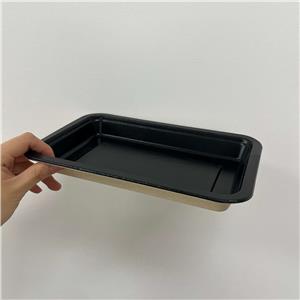
- The sealing surface: a laminated tray seals through the functional film, so the rim has to give the film a flat, consistent sealing area
- Sealing temperature, sealing pressure and dwell time on your own sealer
- Seal strength and leak performance of the finished pack
- Machine tooling and production speed, because a tray can seal in a laboratory test and behave differently at line speed
- Food contamination on the sealing area, which matters more when the tray runs with sauce or oil
- Barrier performance for MAP or VSP formats, confirmed on the complete package rather than from the material name
Plastic tray types and what the switch depends on
| Existing tray | Typical application | What normally stays | What has to be re-validated |
|---|---|---|---|
| PP tray | Chilled and microwave ready meals | Filling line, conveyor, downstream packing | Seal window, microwave performance with the actual food, tray rigidity at temperature |
| PET tray | Chilled prepared foods and MAP formats | Filling line and lidding film supply | Seal integrity and barrier performance for the target shelf life |
| CPET tray | Ovenable and higher-temperature meals | Filling line and tooling layout | Film temperature capability, rim geometry and oven testing of the complete pack |
| Laminated multi-layer tray | High-barrier MAP and VSP formats | Sealer frame, gas mixer and line speed | Tray structural strength for VSP, barrier performance and sealing-surface geometry |
Across our laminated tray range, film structures cover -20°C to 220°C depending on the film selected, so the structure is matched to the temperature profile of the meal rather than chosen by material name. The selection logic is covered in our guide to the right film selection for a bagasse food tray.
Where a line change is unavoidable
Some constraints cannot be solved by tray design, and it is better to identify them in the feasibility stage than after the first order. Before committing to a switch, confirm with your equipment supplier that:
- The existing sealer tooling can reach the sealing pressure and dwell time the new film needs
- The sealer frame can be re-set to the rim width of the fiber tray
- The filler and denester can handle the tray stack height and rigidity of molded fiber
- For VSP, the vacuum and film-draw settings can be adjusted to the fiber tray geometry
- Any in-line printing, registration or inspection equipment still works with the new tray surface
The 1:1 mold replication route
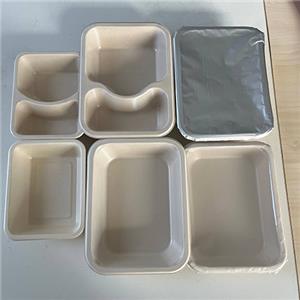
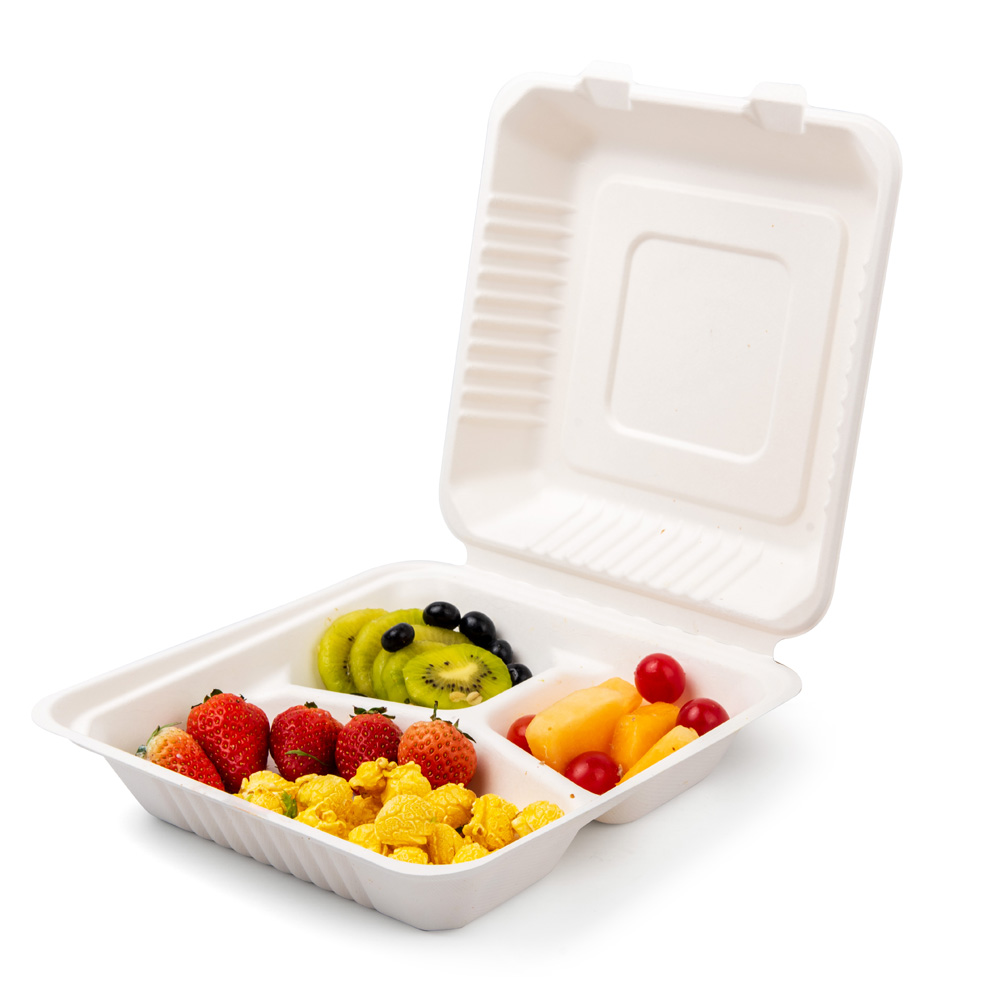
The most practical way to avoid a line change is to develop the new tray from the existing one. This is what 1:1 plastic tray replacement means in practice: overall length, width, depth, rim width, corner radius and compartment layout are taken from the plastic tray you run today, and the new mold is developed around those dimensions. Molded fiber behaves differently from plastic, so the geometry is designed around the required functions rather than copied exactly. Our mold library holds more than 3,000 in-house molds, and we develop 200+ new molds each year.
A line trial protocol you can run before ordering
A line trial is the only reliable way to confirm that a fiber tray runs on your equipment. A workable sequence is:
- Denesting and filling the tray at production speed
- Sealing at the parameters proposed for the new film, using your lidding film
- Seal strength and leak checks on the sealed packs
- Storage of sealed packs under the intended conditions
- Reheating test with the actual meal, in the intended oven or microwave
- If the format uses MAP or VSP, running the gas or vacuum cycle on the complete pack
The seal tests we recommend are set out in our guide to testing a heat-sealable bagasse tray before mass production.
What the switch does not change
A tray switch does not remove the food-contact obligations of the finished package. Whatever the tray is made of, the pack still has to be documented for the market it is sold into, and the documentation has to describe the complete structure. Our food-contact documentation covers FDA, LFGB, OK Compost Industrial and ABAP certifications, supported by test reports for REACH, POPs, PFAS, PPWR total fluorine and BPA. Our laminated trays are PFAS-FREE (ND, < 10 ppm) and ≤ 5% plastic, and our film-free range is 100% plastic-free.
Production planning, packaging and delivery arrangements are handled in the same way as for our existing tray projects.
Frequently asked questions
Can we switch to bagasse trays without buying new sealing equipment?
In many projects the existing sealer is kept, provided its tooling can reach the sealing parameters the new film needs and the frame can be set to the fiber tray rim. The seal window is confirmed on your machine before production.
Will the new tray fit our existing filling line?
That is the purpose of developing the tray from your current tray dimensions. Footprint, depth and compartment layout are based on the tray you run today, and the filling and denesting behaviour is verified in the line trial.
Do we have to change our lidding film?
Not necessarily. Where the tray is developed for a film you already run, the seal window is established with that film. If a higher-temperature or higher-barrier format is needed, a different film structure may be evaluated instead.
Do we need a new mold, and how long does development take?
A custom tray normally needs a custom mold, developed from your existing tray or drawing. We hold more than 3,000 in-house molds and develop 200+ new molds each year, so development can often start from a comparable existing tool. Actual schedules are confirmed per project.
Can the same line run bagasse trays for several markets?
Yes. The packaging line does not change with the destination market; what changes is the documentation set that has to accompany the finished pack, which we can provide for the exact structure you order.
Let us match your existing tray and your existing line
Hebei Mountain Environmental Protection Technology Co., Ltd. manufactures molded bagasse food packaging and laminated food trays and supports plastic tray replacement projects for food manufacturers and distributors. Our capabilities include custom mold development, heat-sealable bagasse trays, film structures in PP, PET, CPET, PLA, EVOH-enhanced and PBAT-based options, and 30+ production lines for volume supply. The tray range includes bagasse heat seal food trays and film-free molded fiber trays.
Send us the plastic tray you run today, your sealing machine details and your food, storage and heating conditions. Please contact our team and we will evaluate whether the switch can be made without changing your packaging line, and request samples for a line trial.