Bagasse Tray vs PET Tray: Can Molded Fiber Replace PET Food Packaging?
PET is one of the most widely used materials in food packaging. It is commonly found in food trays, bakery packaging, fresh food containers, ready meal packaging, and other applications where strength, appearance, and barrier performance are important.
At the same time, food manufacturers and packaging distributors are looking for ways to reduce their dependence on conventional plastic packaging.
This raises an important question:
Can a bagasse tray replace a PET food tray?
In some applications, yes.
But PET and molded bagasse are very different materials. A successful replacement depends on the food product, tray design, sealing method, temperature requirements, barrier performance, and packaging equipment.
For manufacturers considering a switch from PET to molded fiber, the right approach is not simply to compare the two materials. Instead, the complete packaging system needs to be evaluated.
This guide explains the main differences between bagasse trays and PET trays and what food manufacturers should know before starting a PET replacement project.
What Is a PET Food Tray?
PET stands for polyethylene terephthalate.
PET is commonly used in food packaging because it can provide:
- Good rigidity
- Good dimensional stability
- Moisture resistance
- Oil resistance
- Good appearance
- Good transparency in many package formats
- Compatibility with different packaging processes
PET food trays can be used for applications such as:
- Fresh food
- Prepared food
- Bakery products
- Meat and seafood
- Ready meals
- Fruit and vegetables
- Chilled food
- Foodservice packaging
For many manufacturers, PET is already integrated into an existing packaging line.
This means replacing PET involves more than changing the tray material.
The replacement tray needs to work with the rest of the packaging process.
What Is a Laminated Bagasse Tray?
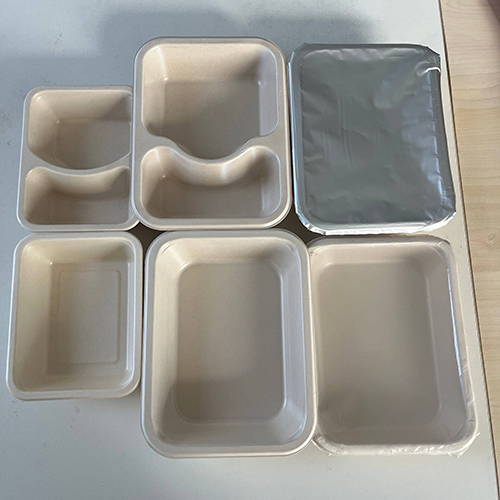
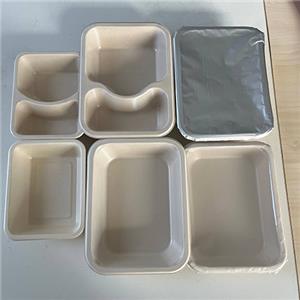
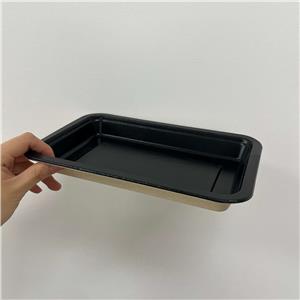
A laminated bagasse tray is made from molded sugarcane bagasse fiber with a functional film or coating.
The molded fiber forms the main body of the tray.
The film layer can provide additional properties required for food packaging, such as:
- Heat sealing
- Water resistance
- Oil resistance
- Leak resistance
- Barrier performance
- Temperature resistance
Depending on the application, the film structure may use:
- PP
- PET
- CPET
- PLA
- EVOH-enhanced structures
- PBAT-based structures
The appropriate structure depends on the product and packaging process.
This makes laminated bagasse different from a basic uncoated molded fiber container.
For industrial food packaging, the goal is to combine the structural advantages of molded fiber with the functional properties required by the application.
Bagasse Tray vs PET Tray: Quick Comparison
| Requirement | PET Tray | Laminated Bagasse Tray |
|---|---|---|
| Main structure | PET plastic | Molded bagasse fiber |
| Rigidity | Good | Can be designed for the application |
| Heat sealing | Common with suitable structure | Available with suitable film |
| Moisture resistance | Good | Depends on film/coating |
| Oil resistance | Good | Depends on film/coating |
| Transparency | Available | Generally opaque fiber structure |
| Custom shapes | Yes | Yes |
| Ready meals | Common | Suitable for selected applications |
| MAP | Common | Possible with suitable barrier structure |
| VSP | Common | Possible with suitable structure |
| Frozen food | Common | Requires suitable structure |
| Microwave use | Depends on PET structure | Depends on complete tray structure |
| Oven use | Application dependent | Requires suitable high-temperature structure |
| Fiber-based tray | No | Yes |
| Existing equipment | Established | Requires compatibility evaluation |
The most obvious difference is appearance.
PET can provide a transparent package, while molded bagasse normally has a natural fiber appearance.
For products where customers need to see the food directly through the tray, PET may still have an important functional role.
For applications where transparency is not essential, molded bagasse can be evaluated as an alternative.
Why Are Food Manufacturers Considering PET Alternatives?
The reason for evaluating PET replacement varies from one business to another.
Some companies may want to:
- Reduce conventional plastic packaging
- Introduce fiber-based packaging
- Develop a more differentiated package
- Respond to customer packaging requirements
- Expand sustainable packaging options
- Offer new packaging formats to retailers
- Develop packaging for sustainability-focused food brands
For distributors and wholesalers, laminated bagasse trays can also provide an additional product category beyond conventional plastic trays.
However, environmental positioning should always be based on the actual material structure and applicable certifications.
A bagasse tray with a plastic film should not automatically be described as plastic-free or compostable.
The complete package needs to be evaluated.
Can Bagasse Provide the Same Rigidity as PET?
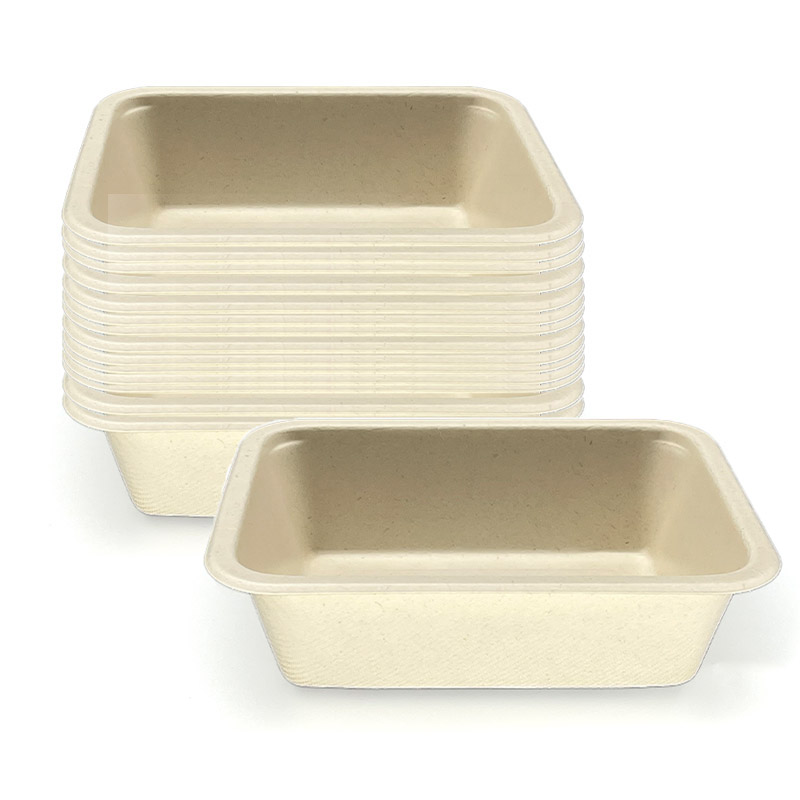
This depends on the tray design.
PET gets much of its structural performance from the properties of the plastic itself and the way the tray is thermoformed.
Molded bagasse uses a different structure.
The strength of a molded fiber tray can be influenced by:
- Fiber quality
- Pulp formulation
- Fiber density
- Wall thickness
- Tray geometry
- Rib structure
- Bottom design
- Corner design
- Mold configuration
This means a bagasse tray should be engineered for the application.
A deep tray carrying a heavy meal may need a different structure from a shallow tray used for a light food product.
For a PET replacement project, the existing PET tray can be used as the reference for developing the new tray geometry.
Can Bagasse Trays Be Heat Sealed Like PET Trays?
Yes, when the bagasse tray has been designed with an appropriate sealing layer.
A typical heat-sealed structure may look like:
Molded bagasse fiber → Functional film → Lidding film
During sealing, the compatible sealing layers form a bond around the tray rim.
Important parameters include:
- Sealing temperature
- Pressure
- Dwell time
- Tray rim design
- Film type
- Lidding film
- Machine configuration
The actual sealing parameters should be established through testing.
Do not assume that the same temperature and pressure used for a PET tray will produce the same result with a laminated bagasse tray.
Can a Bagasse Tray Be Used for MAP?
For selected applications, yes.
MAP packaging requires more than a tray that simply holds the food.
The packaging system may need:
- Good seal integrity
- Suitable oxygen barrier
- Suitable moisture barrier
- Stable tray structure
- Compatible lidding film
- Gas retention
A laminated bagasse tray can be developed for MAP when the tray and film structure are designed around these requirements.
For applications where oxygen barrier is particularly important, an EVOH-enhanced structure can be considered.
However, the required barrier level depends on:
- Food type
- Target shelf life
- Storage temperature
- Gas mixture
- Product characteristics
- Lidding film
- Distribution conditions
The complete package should be tested rather than assuming that a specific film automatically guarantees a particular shelf life.
What About VSP Packaging?
PET trays are widely used in some vacuum skin packaging applications.
If a manufacturer wants to replace a PET VSP tray with molded bagasse, the tray design needs to be evaluated carefully.
Important factors include:
- Tray rigidity
- Tray rim
- Film compatibility
- Tray geometry
- Product weight
- Sealing conditions
- Vacuum process
A suitable laminated bagasse structure can be developed for selected VSP applications.
The existing PET tray can be used as a reference during development.
This is especially useful when the customer wants to maintain similar:
- Tray dimensions
- Product portion
- Retail footprint
- Label position
- Carton size
- Packaging workflow
PET vs Bagasse for Chilled Food
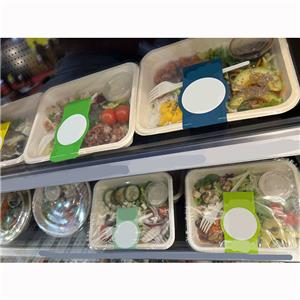
Chilled food packaging can include:
- Ready meals
- Fresh prepared food
- Meat
- Seafood
- Vegetables
- Salads
- Deli products
For these applications, manufacturers may prioritize:
- Moisture resistance
- Seal integrity
- Oxygen barrier
- Food-contact requirements
- Shelf-life performance
- Cold-chain stability
A laminated bagasse tray can be considered when the complete film structure provides the required performance.
For higher-barrier applications, a suitable barrier layer may be incorporated into the laminate.
The right solution depends on the actual food product.
PET vs Bagasse for Frozen Food
Frozen food places different demands on packaging.
The tray may experience:
- Low storage temperatures
- Freezer transportation
- Stacking pressure
- Condensation
- Thawing
- Reheating
The tray structure and film therefore need to remain suitable throughout the intended temperature cycle.
A bagasse tray can be developed for selected frozen food applications, but the film structure must be chosen according to the actual conditions.
A simple comparison such as “bagasse vs PET” is not enough.
The more useful question is:
Can this specific bagasse tray structure withstand our actual freezing, storage, transport, and reheating process?
What About Microwave and Oven Use?
Temperature performance needs to be evaluated based on the complete package.
For microwave applications, the manufacturer should consider:
- Microwave power
- Heating time
- Food moisture
- Oil content
- Tray structure
- Film structure
- Lidding system
For oven applications, the requirements can be even more demanding.
A tray designed for chilled food should not automatically be assumed to be oven safe.
If an existing PET tray is used for a heating application, the replacement bagasse tray should be developed around the actual heating conditions.
This may require a different film structure and tray design.
Does Bagasse Have the Same Transparency as PET?
No.
This is one area where PET has a clear functional difference.
PET can be manufactured in transparent formats, allowing consumers to see the food inside the package.
Molded bagasse is normally opaque.
Therefore, if visual product presentation through the tray is essential, PET may remain the preferred format for that particular application.
But transparency is not necessary for every food product.
For ready meals, prepared foods, institutional meals, airline meals, foodservice applications, and many retail products, the package may instead use:
- Printed labels
- Paper sleeves
- Printed lids
- Cardboard packaging
- Outer cartons
In these cases, the opaque molded fiber tray can still be considered.
Can a Bagasse Tray Be Customized to Match a PET Tray?
Yes.
Custom molding is one of the most useful parts of a PET replacement project.
A customer can provide:
- Existing PET tray
- CAD drawing
- Technical drawing
- Product dimensions
- Sample package
- Photos
- Sealing machine information
The manufacturer can then evaluate the existing format and develop a custom molded fiber tray.
A 1:1 replacement mold can be considered when the customer needs to maintain similar dimensions.
This can help reduce changes to downstream packaging processes.
However, a true one-to-one replacement should always be confirmed through engineering and production trials.
Can the Same Lidding Film Be Used?
Sometimes, but it should not be assumed.
The compatibility between the tray and lidding film depends on the sealing layer.
For example, if the existing PET package uses a particular lidding film, the new bagasse tray may require a different sealing interface.
A packaging supplier should evaluate:
- Film material
- Sealing temperature
- Film thickness
- Seal strength
- Tray coating
- Tray rim
- Machine conditions
The objective is to achieve a reliable seal rather than simply keeping every component unchanged.
Will Existing PET Packaging Equipment Still Work?
It may.
This needs to be evaluated based on the actual machine and tray design.
Important factors include:
- Tray dimensions
- Tooling
- Filling equipment
- Sealing station
- Film feeding
- MAP gas flushing
- Vacuum system
- Conveyor system
- Tray handling
For a simple manual or semi-automatic packaging process, compatibility may be easier to establish.
For a high-speed automated line, engineering and production trials are more important.
A bagasse tray that works well manually may require further optimization before running at high speed.
What Should a PET-to-Bagasse Replacement Test Include?
A structured test program can reduce problems during commercialization.
Step 1: Compare Dimensions
Measure:
- Length
- Width
- Height
- Rim
- Corner radius
- Bottom geometry
Step 2: Test the Empty Tray
Check:
- Rigidity
- Stacking
- Handling
- Deformation
Step 3: Fill With the Actual Product
Test the tray with the real food rather than water or an unrelated product.
Step 4: Run the Sealing Process
Use the intended lidding film and packaging machine.
Step 5: Check Seal Quality
Evaluate:
- Seal consistency
- Peel behavior
- Leakage
- Rim contamination
Step 6: Test Storage Conditions
Use the intended:
- Chilled conditions
- Frozen conditions
- Ambient conditions
- Heating conditions
Step 7: Test the Finished Package
Evaluate:
- Transport
- Stacking
- Handling
- Product protection
Step 8: Evaluate Shelf Life
The final packaging structure should be tested with the actual food product under the intended storage conditions.
PET Tray vs Bagasse Tray: Which One Should You Choose?
There is no universal answer.
The right choice depends on the packaging application.
A PET tray may be particularly relevant when:
- Transparency is essential
- The current packaging line is optimized for PET
- Specific PET barrier properties are required
- The product presentation depends on seeing the food
A laminated bagasse tray may be worth evaluating when:
- A molded fiber structure is preferred
- Transparency is not essential
- The package needs heat sealing
- The customer wants to explore a conventional plastic alternative
- Custom molded fiber geometry is required
- The application is suitable for a coated fiber structure
The final decision should be based on product testing, packaging performance, commercial requirements, and applicable regulations or certifications.
Cost Considerations When Replacing PET
Unit price is only one part of a packaging conversion project.
Food manufacturers should consider:
- Tray price
- Film cost
- Lidding film
- Tooling
- Packaging speed
- Machine compatibility
- Transportation
- Storage
- Product protection
- Testing
- Certification
- Packaging redesign
The cost of a new mold can also affect the economics of a custom project.
However, custom tooling may make sense for large-volume food manufacturers because the resulting tray can be optimized around the product and packaging line.
Distributors should also consider whether a molded fiber tray creates a new commercial opportunity in their market.
Why One-Stop Packaging Support Matters
A PET replacement project may involve several suppliers.
For example:
Tray supplier + film supplier + lidding film supplier + mold supplier + equipment supplier
If each supplier is responsible for only one component, solving compatibility problems can take longer.
A one-stop packaging supplier can coordinate more of the project.
A complete solution may include:
- Bagasse tray
- Functional film
- Lidding film
- Custom mold
- Sealing machine
- MAP equipment
- VSP equipment
- Labels
- Packaging testing
This approach can be especially useful for food manufacturers launching a new ready meal or prepared food product.
How Hebei Mountain Supports PET Replacement Projects
Hebei Mountain focuses on molded bagasse food packaging with functional film structures for commercial food applications.
For customers currently using PET trays, the development process can start from an existing tray, drawing, or packaging requirement.
The project can include:
- Custom bagasse tray development
- Film selection
- Heat-sealable structures
- Custom mold development
- 1:1 replacement evaluation
- Lidding film matching
- MAP compatibility evaluation
- VSP compatibility evaluation
- Packaging equipment support
Our current mold development capabilities include in-house tooling, more than 3,000 existing molds, and support for new custom mold development.
The exact tray structure and film selection are determined by the customer's application rather than using one standard material for every project.
A Practical Checklist for PET Tray Replacement
Before contacting a bagasse tray manufacturer, prepare as much information as possible.
Product Information
- Food type
- Product weight
- Oil or sauce content
- Storage conditions
- Target shelf life
Tray Information
- Existing PET tray
- Dimensions
- Drawing or CAD file
- Compartment layout
- Tray depth
Packaging Process
- Heat sealing
- MAP
- VSP
- Manual or automated packaging
- Current lidding film
Temperature
- Chilled
- Frozen
- Microwave
- Oven
- Reheating
Commercial Requirements
- Estimated annual volume
- Target MOQ
- Custom printing
- Label requirements
- Certification requirements
The more complete the information, the easier it is to evaluate whether a bagasse replacement is technically and commercially practical.
Final Thoughts
Can molded bagasse replace a PET food tray?
For selected food packaging applications, it can be evaluated as an alternative.
But PET and bagasse are not interchangeable materials by default.
PET offers characteristics such as transparency and established plastic packaging performance, while laminated bagasse uses a molded fiber structure combined with a functional film layer.
For a successful PET replacement, manufacturers should evaluate:
Tray design + film structure + lidding film + sealing + barrier + temperature + equipment + food product
If all of these elements are designed together, a bagasse tray can become more than a simple replacement container. It can become part of a complete food packaging solution.
If your company currently uses PET food trays, send us your existing tray sample or drawing. Include your food type, storage temperature, sealing method, and packaging machine information. We can evaluate the existing format and develop a customized laminated bagasse tray for testing.
Frequently Asked Questions
Can bagasse trays replace PET trays?
Selected PET food tray applications can be evaluated for replacement with laminated bagasse trays. The final suitability depends on the food product, tray design, film structure, temperature, sealing process, and equipment.
Are bagasse trays transparent like PET?
No. Molded bagasse trays are generally opaque, while PET can provide transparent packaging. If product visibility is essential, PET may remain more suitable for that application.
Can bagasse trays be heat sealed?
Yes. A laminated bagasse tray can be designed with a suitable sealing layer for heat sealing with compatible lidding film.
Can bagasse trays be used for MAP?
Yes, selected laminated bagasse trays can be developed for MAP applications. Barrier performance, seal integrity, gas retention, and shelf-life requirements should be tested.
Can bagasse replace PET in VSP packaging?
Selected VSP applications can be evaluated using laminated bagasse trays. Tray rigidity, rim design, film compatibility, and vacuum conditions need to be tested.
Can you make a bagasse tray based on our existing PET tray?
Yes. Existing PET trays, technical drawings, or CAD files can be used as references for custom molded bagasse tray development.
Can a bagasse tray be made as a 1:1 replacement for PET?
A 1:1 replacement approach can be considered when the existing dimensions and packaging workflow need to remain similar. The final design should be validated through engineering and production testing.
Does replacing PET with bagasse require a new sealing machine?
Not necessarily. Existing equipment can be evaluated for compatibility with the new tray. Tooling, sealing parameters, film compatibility, and machine configuration should be tested.